
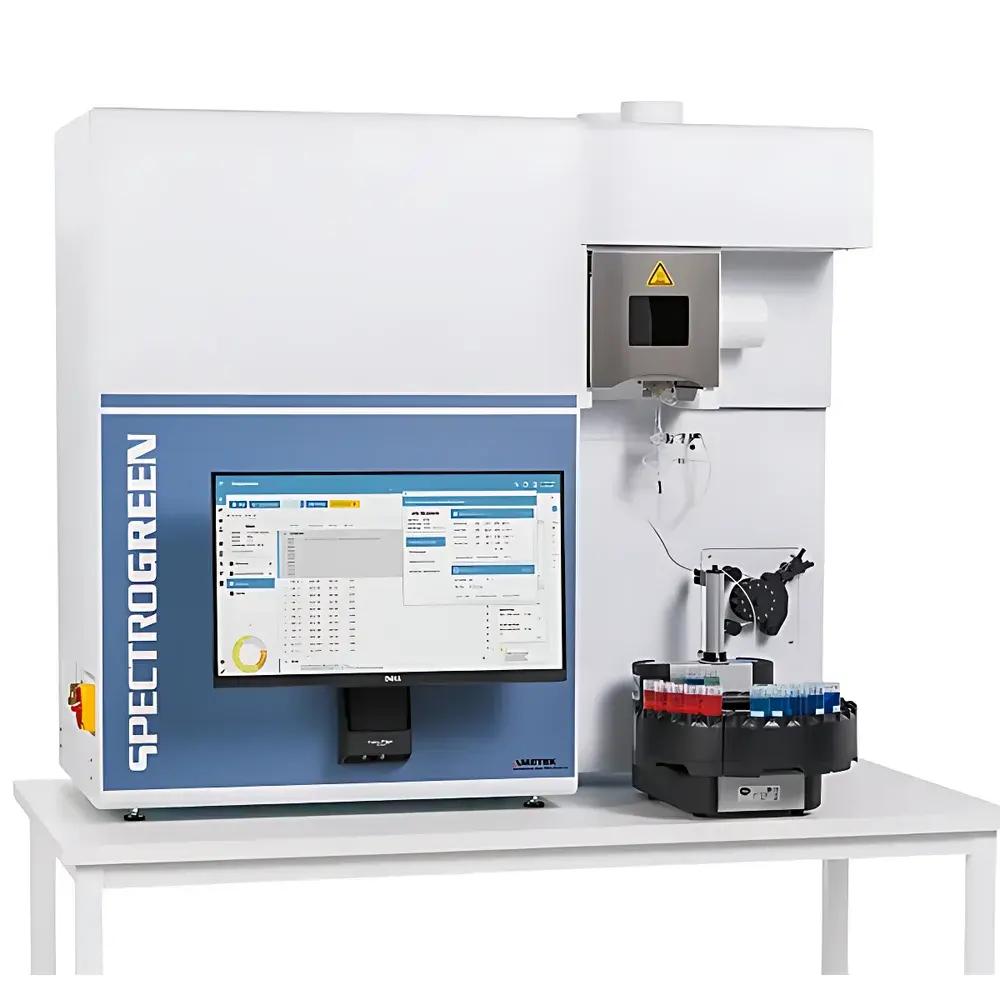
SPECTROGREEN Inductively Coupled Plasma Optical Emission Spectrometer
| Brand | SPECTRO |
|---|---|
| Origin | Germany |
| Manufacturer Type | Authorized Distributor |
| Origin Category | Imported |
| Model | SPECTROGREEN |
| Instrument Type | Full-Spectrum Direct-Reading ICP-OES |
| Detection Limit | Sub-ppb |
| Precision (RSD) | <1.5% |
| Long-Term Stability (RSD) | <0.5% |
| Wavelength Range | 165–770 nm |
| Optical Resolution | 0.007 nm |
Overview
The SPECTROGREEN is a high-performance, full-spectrum direct-reading inductively coupled plasma optical emission spectrometer (ICP-OES) engineered for precision multi-element analysis across demanding application domains. Based on robust RF-driven argon plasma excitation and high-fidelity CCD/CMOS-based spectral detection, the instrument leverages vertical plasma orientation combined with proprietary optical architectures to maximize signal-to-noise ratio and minimize matrix-induced spectral interferences. Its core innovation—the Vertical Dual-Sided Optical Interface (DSOI)—redefines sensitivity benchmarks for ICP-OES by simultaneously capturing emission photons from both lateral sides of a vertically oriented plasma torch via an enhanced reflective mirror system. This eliminates the traditional trade-off between radial observation (robustness, lower sensitivity) and conventional axial/dual-view configurations (complex alignment, elevated operational cost, susceptibility to plasma instability). The result is a stable, reproducible measurement platform delivering sub-ppb detection limits without sample dilution—even for high-matrix samples such as digested soils, brines, petrochemical feedstocks, or biological digests.
Key Features
- Vertical Dual-Sided Optical Interface (DSOI): Patented optical design enabling simultaneous dual-lateral signal collection from a vertically stabilized plasma, achieving 3–5× higher sensitivity versus conventional radial ICP-OES systems.
- TI (Torch Imaging) Technology: Automated switching between horizontal and vertical plasma viewing modes within a single analytical sequence—enabling optimal line selection per element while suppressing ionization interference from easily ionized elements (EIEs) and extending linear dynamic range beyond 6 orders of magnitude.
- Gigabit Ethernet (GigE) Readout System: Enables full-spectrum acquisition, on-board processing, and data transfer in under 100 ms—reducing dwell time per element and accelerating sample throughput without compromising spectral fidelity.
- LDMOS RF Generator: Solid-state 27.12 MHz generator with integrated cooling; delivers stable plasma ignition in ≤10 minutes and supports direct analysis of high-dissolved-solid (TDS >25%) and organic-rich matrices without external chillers or dilution.
- Optical System: Czerny-Turner monochromator with holographic grating, optimized for 165–770 nm coverage and <0.007 nm spectral resolution at 200 nm—ensuring reliable separation of adjacent emission lines (e.g., As 193.696 nm / Al 193.696 nm).
Sample Compatibility & Compliance
The SPECTROGREEN accommodates liquid samples introduced via standard nebulizers (e.g., Meinhard, SeaSpray) and autosamplers compatible with 12–100 mm vials. It supports direct analysis of high-salt solutions (up to 25% w/v NaCl), acid-digested environmental solids (EPA Methods 200.7, 6010D), organic extracts (ASTM D5185), and metal alloys following ASTM E1479. Instrument hardware and firmware comply with IEC 61000-6-3 (EMC), CE marking requirements, and RoHS directives. When operated with audit-trail-enabled SPECTRO ICP Analyzer Pro software under validated workflows, the system meets GLP and GMP data integrity expectations—including full 21 CFR Part 11 compliance for electronic records and signatures when deployed in regulated pharmaceutical or food safety laboratories.
Software & Data Management
Pre-installed SPECTRO ICP Analyzer Pro software provides a role-based, wizard-guided interface for method development, calibration, QC monitoring, and reporting. Key capabilities include automated background correction using polynomial fitting, multi-point internal standardization (e.g., Y, Sc, In), real-time spectral interference assessment (line overlap diagnostics), and customizable report templates compliant with ISO/IEC 17025 and EN ISO/IEC 17025:2017 requirements. Raw spectral data are stored in vendor-neutral .spc format; export options include CSV, PDF, XML, and LIMS-compatible ASTM E1381/E1489 structures. All user actions—including method edits, calibration updates, and result overrides—are logged with timestamp, operator ID, and reason code for full traceability.
Applications
The SPECTROGREEN is routinely deployed in environmental laboratories for EPA 200.7 and ISO 11885 compliance testing of wastewater, sediments, and leachates; in agricultural labs for soil micronutrient profiling (Zn, Cu, Mn, B) per ISO 11047; in food safety programs for heavy metal screening (Pb, Cd, As, Hg) aligned with EU Commission Regulation (EC) No 1881/2006; and in petrochemical QA/QC for wear metal analysis in lubricants (ASTM D5185). Its stability in high-matrix environments also supports routine analysis of catalyst residues (Ni, V, Fe), battery cathode materials (Li, Co, Ni, Mn), and pharmaceutical excipients per USP .
FAQ
What plasma observation modes does the SPECTROGREEN support?
It offers three configurable modes: vertical single-view (SOP), vertical dual-sided (DSOI), and TI-enabled hybrid mode—each selectable per element or group during method setup.
Is external chiller required for the RF generator?
No. The integrated LDMOS generator operates air-cooled and maintains thermal stability across continuous 24/7 operation.
Can the instrument analyze solid samples directly?
Solid samples require prior dissolution or digestion (e.g., microwave-assisted acid digestion per EPA 3052); no laser ablation module is included in standard configuration.
How is spectral interferences managed during multi-element analysis?
Analyzer Pro employs automated line selection logic, secondary wavelength verification, and optional interference correction algorithms based on certified reference material (CRM) response modeling.
What regulatory standards does the software support for audit readiness?
With proper configuration and validation, it supports 21 CFR Part 11, EU Annex 11, and ISO/IEC 17025 documentation requirements—including electronic signature enforcement, audit trail review, and data backup protocols.






