
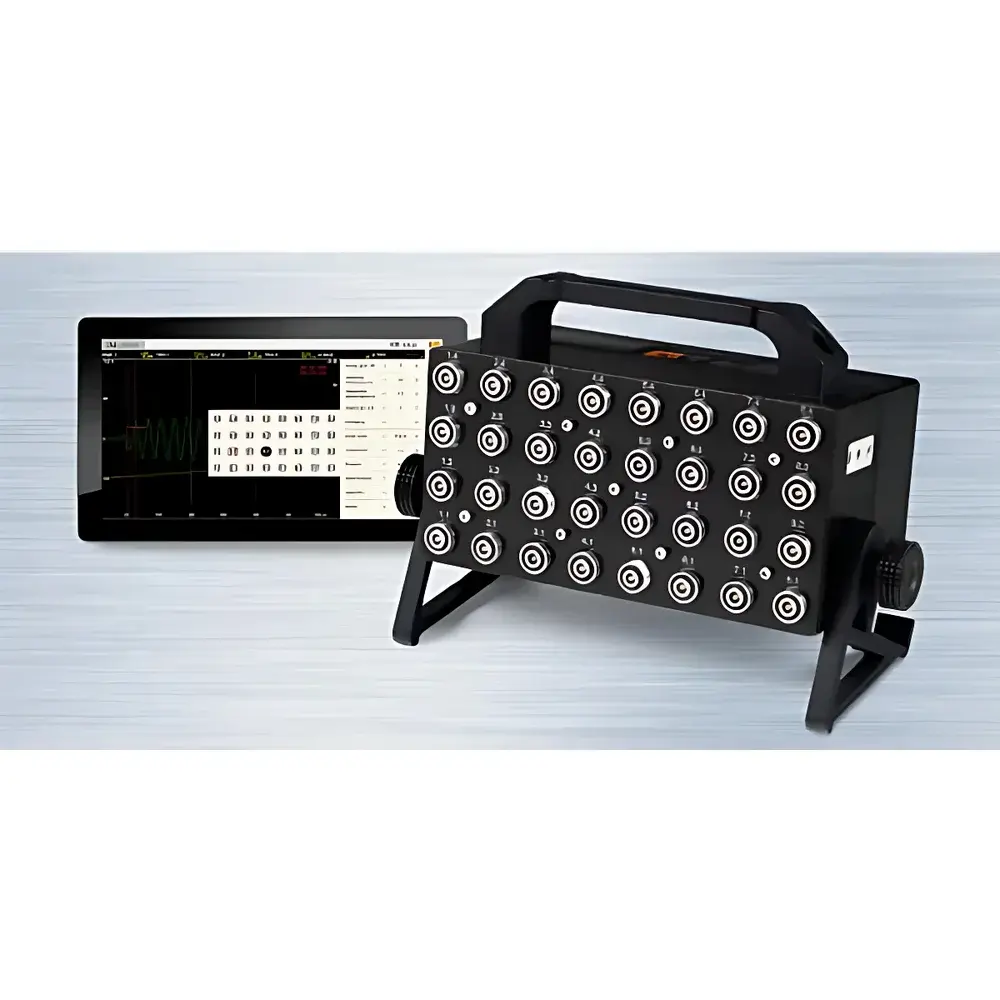
ACS A1052 MultiSONIC Multi-Channel Ultrasonic Pulse Data Acquisition Unit
| Brand | ACS |
|---|---|
| Origin | Hong Kong, China |
| Manufacturer Type | Authorized Distributor |
| Country of Origin | China |
| Model | A1052 MultiSONIC |
| Price Range | USD 1–2 (Unit Price Indicative |
| Channels | 32-channel pulser-receiver array |
| Connectivity | Integrated Wi-Fi interface (IEEE 802.11 b/g/n, 2.4 GHz) |
| Power Supply | Rechargeable Li-ion battery (operational autonomy ≥ 6 h) |
| Excitation | Bipolar pulse burst with user-defined frequency, half-cycle duration, and number of half-cycles |
| Compatible Transducers | All ACS dry-point contact ultrasonic transducers (e.g., A101x series, 20–500 kHz nominal bandwidth) |
| Encoding Support | Golay complementary sequence excitation (length up to 64 bits) |
| Software | MATHILDA32 (free demonstration version included) |
| Operating Modes | Pulse-echo, through-transmission, pitch-catch |
| Compliance | CE, RoHS, FCC Part 15 Subpart B |
Overview
The ACS A1052 MultiSONIC is a portable, battery-powered multi-channel ultrasonic pulse data acquisition unit engineered for field-deployable low-frequency ultrasonic testing (UT) in non-destructive evaluation (NDE) and structural health monitoring (SHM) applications. It operates on the principle of time-of-flight (ToF) and amplitude-based ultrasonic signal analysis, generating controlled bipolar pulse bursts to excite piezoelectric transducers and digitizing returning echoes at 16-bit resolution with programmable sampling rates up to 20 MS/s. Designed for use with dry-point contact transducers—eliminating couplant dependency—the system enables rapid, repeatable inspection of concrete, masonry, timber, composites, and aged metallic structures where conventional wet-coupled UT is impractical. Its compact form factor, integrated Wi-Fi module, and embedded real-time signal processing firmware support stand-alone operation without external PCs during data collection.
Key Features
- 32-channel synchronized pulser-receiver architecture supporting parallel acquisition across sensor arrays or sequential scanning with automatic channel multiplexing
- Programmable excitation: adjustable bipolar pulse burst parameters—including center frequency (20–500 kHz), half-cycle duration (0.5–50 µs), and number of half-cycles (1–64)—enabling optimization for material attenuation and transducer resonance
- Wi-Fi 2.4 GHz (802.11 b/g/n) interface compliant with WPA2-PSK encryption, enabling secure remote control and real-time waveform streaming to Windows/Linux PCs, iOS, and Android devices
- Golay complementary sequence encoding capability for SNR enhancement—up to 12 dB improvement over single-pulse excitation in high-noise environments
- Integrated rechargeable lithium-ion battery with intelligent power management, delivering ≥6 hours of continuous operation and status LED indicators for charge level and communication link integrity
- Firmware-upgradable architecture with dual-boot capability, supporting field updates via SD card or over-the-air (OTA) through Wi-Fi
Sample Compatibility & Compliance
The A1052 MultiSONIC is validated for use with all ACS-manufactured dry-point contact ultrasonic transducers, including the A1012 (25 kHz), A1014 (50 kHz), and A1018 (100 kHz) series, which feature ruggedized ceramic elements and replaceable wear plates suitable for rough-surface inspection. The system meets electromagnetic compatibility requirements per EN 61326-1:2013 (industrial environment) and emissions standards per FCC Part 15 Subpart B Class B. It carries CE marking under the Low Voltage Directive (2014/35/EU) and RoHS 2011/65/EU compliance for hazardous substance restrictions. While not certified to ISO 17025 or ASTM E1158, it supports traceable measurement workflows when used with calibrated transducers and documented acquisition settings, aligning with GLP principles for field-based NDT documentation.
Software & Data Management
The unit ships with MATHILDA32—a lightweight, cross-platform application for real-time waveform visualization, time-domain gating, amplitude mapping, and basic velocity/thickness calculation. Raw data is stored in IEEE-compliant binary format (.bin) with embedded metadata (timestamp, channel ID, excitation parameters, GPS coordinates if enabled via external module). The ACS MultiSONIC SDK provides comprehensive C/C++, Python (PyMultiSONIC), and MATLAB interfaces, including low-level register access, asynchronous acquisition control, and Golay decoding libraries. All software components adhere to FDA 21 CFR Part 11 principles: audit trails are generated for parameter changes and file exports, and digital signatures can be implemented via third-party PKI integration for regulated environments.
Applications
- Concrete delamination and void detection in bridge decks, parking structures, and precast elements
- Moisture ingress mapping in historic masonry and adobe walls
- Layer thickness estimation in multi-layer composite panels (e.g., FRP-strengthened beams)
- Crack depth sizing in reinforced concrete using surface wave dispersion analysis
- Embedded sensor network interrogation for long-term SHM deployments with synchronized multi-node triggering
- Educational laboratories for teaching ultrasonic wave propagation, signal processing, and NDT methodology
FAQ
Is the A1052 MultiSONIC compatible with third-party transducers?
Yes, provided they operate within the specified voltage (±100 V), impedance (50–1 kΩ), and frequency range (20–500 kHz) and use standard LEMO-00 connectors.
Does the system support GPS synchronization?
No built-in GPS; however, external GNSS receivers with NMEA 0183 output can be interfaced via UART to timestamp acquisitions with positional metadata.
Can multiple A1052 units be synchronized for large-area scanning?
Yes—using external TTL trigger signals routed through SMA ports, units can achieve sub-microsecond timing alignment for phased-array or distributed sensing configurations.
What is the maximum cable length between the A1052 and transducers?
Up to 30 m with shielded coaxial cables (RG-174/U); longer runs require impedance-matched cabling and may necessitate signal conditioning to maintain SNR.
Is calibration certificate included with purchase?
A factory verification report (not ISO 17025 accredited) is supplied; accredited calibration services are available upon request through ACS-authorized metrology partners.
Related Products



