
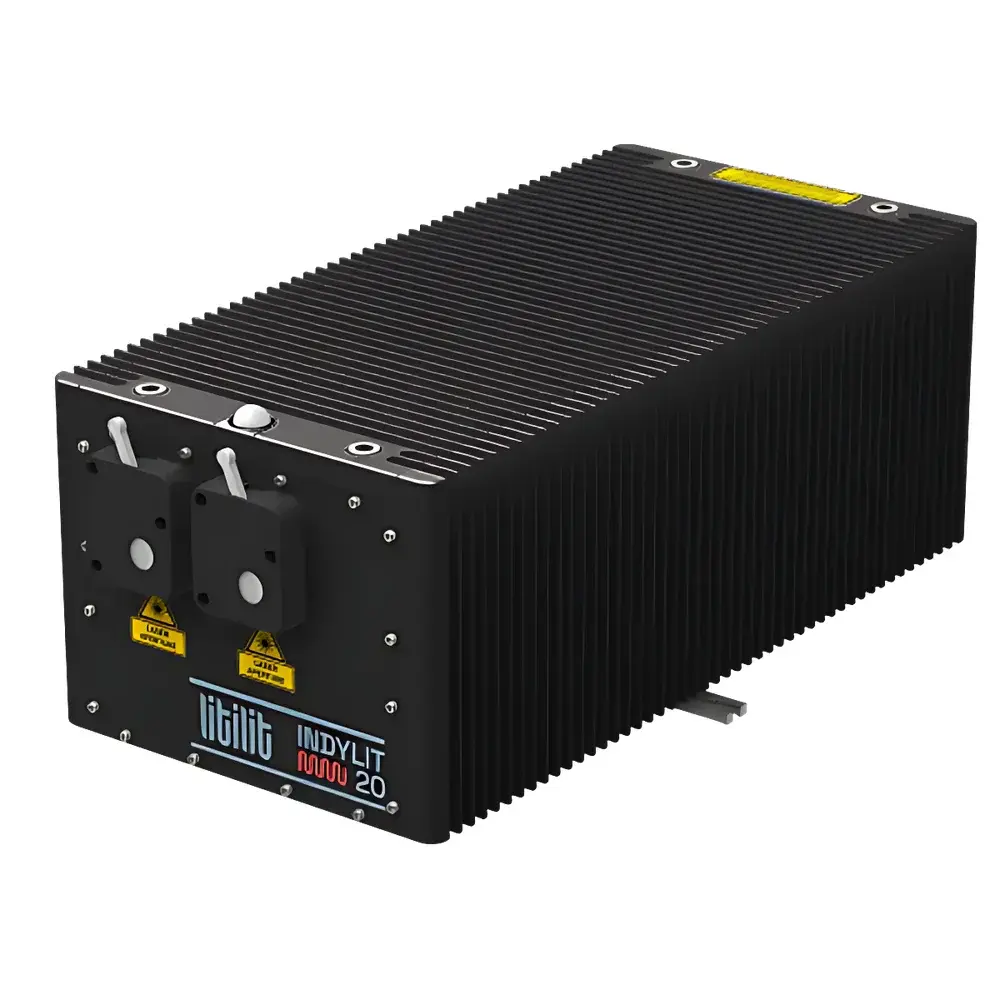
Litilit Indylit 20 Industrial Passive-Air-Cooled Femtosecond Fiber Laser
| Brand | Litilit |
|---|---|
| Origin | Lithuania |
| Model | Indylit 20 |
| Output Wavelength | 1030 ± 2 nm (fundamental), 515 ± 1 nm (SHG) |
| Avg. Power | >13 W @ 100 kHz / >18 W @ 1 MHz (fundamental) |
| Pulse Energy | >130 µJ (fundamental), >70 µJ (SHG) |
| Pulse Duration | <400 fs (adjustable 400 fs – 2 ps) |
| Repetition Rate | 100 kHz – 1 MHz (burst mode down to 30 kHz) |
| Beam Quality | M² < 1.2 |
| Polarization Extinction Ratio | >200:1 |
| Power Stability (RMS) | <1% (fundamental), <2% (SHG) |
| Beam Pointing Stability (RMS) | <20 µrad |
| Cooling | Passive air-cooled laser head, active fan-cooled control unit |
| Dimensions (L×W×H) | Laser Head 498 × 248 × 194 mm³ |
| Input Voltage | 100–240 V AC, 47–63 Hz → 24 V DC |
| Max. Power Consumption | 700 W |
| Operating Temperature | 18–32 °C |
| Compliance | CE, RoHS, IEC 60825-1:2014 Class 4 Laser Product |
Overview
The Litilit Indylit 20 is an industrial-grade, passively air-cooled femtosecond fiber laser engineered for high-reliability micromachining in production environments. Based on Litilit’s patented pulse generation architecture—originally developed for telecom-grade robustness—the system delivers sub-400 fs pulses at 1030 nm with exceptional temporal fidelity, spatial coherence, and long-term parameter stability. Unlike actively water-cooled or thermoelectrically stabilized ultrafast lasers, the Indylit 20 employs a proprietary passive thermal management design in its laser head, eliminating pumps, chillers, and associated failure modes while maintaining RMS beam pointing stability below 20 µrad and power fluctuations under 1% (RMS, 1 s integration). Its all-fiber oscillator-amplifier architecture ensures intrinsic alignment stability, minimal sensitivity to mechanical vibration or ambient temperature drift (<20 µrad/°C), and immunity to optical realignment over time. The laser operates as a fully integrated turnkey system: no periodic optics cleaning, no pump diode replacement, and no active cooling maintenance—making it suitable for 24/7 operation in cleanrooms, semiconductor fabs, and automated production lines where uptime and repeatability are mission-critical.
Key Features
- Passive-air-cooled laser head: Zero liquid coolant, zero condensation risk, and inherently silent operation—ideal for ISO Class 5–7 cleanrooms and space-constrained integration.
- Field-adjustable pulse parameters: Pulse duration tunable from 400 fs to 2 ps via internal dispersion compensation; repetition rate programmable from 100 kHz to 1 MHz (with burst mode support down to 30 kHz and up to 12-pulse bursts).
- High-energy, high-fidelity pulses: >130 µJ pulse energy at 100 kHz (fundamental), with pre-pulse contrast >1:1000 and post-pulse contrast >1:100—critical for nonlinear ablation threshold control in transparent and multilayer materials.
- Integrated SHG module (Indylit 20 SH variant): Seamless wavelength switching between 1030 nm and 515 nm via GUI or CAN bus command; both outputs maintain identical beam quality (M² 200:1), and pointing stability.
- Ruggedized mechanical design: IP54-rated dust resistance; shock-tested to withstand 30 g mechanical impact; optimized for integration into gantry-based, galvo-scanned, or CNC-coupled processing platforms.
- Multi-mode control interface: Real-time monitoring and configuration via USB 2.0 and CAN 2.0B; analog power modulation (0–1 V, rise time <1 µs); TTL-gated pulse picking with sub-millisecond switching latency.
Sample Compatibility & Compliance
The Indylit 20 is compatible with a broad range of optically transparent, reflective, and heterogeneous materials—including fused silica, sapphire, LiNbO₃, silicon wafers, copper, stainless steel, polymer films (PI, PET), and battery electrode coatings (NMC, LFP). Its ultrashort pulse duration enables non-thermal ablation with minimal heat-affected zone (HAZ), satisfying critical process requirements in ophthalmic device manufacturing (e.g., LASIK flap creation per ANSI Z136.3), semiconductor mask repair (ASTM F3077), and display glass cutting (ISO 9241-307). The system complies with IEC 60825-1:2014 (Class 4 laser product), CE marking (2014/35/EU Low Voltage Directive, 2014/30/EU EMC Directive), and RoHS 2011/65/EU. Full audit trails, user-access logging, and configurable safety interlocks support GLP/GMP-aligned validation protocols. Firmware supports FDA 21 CFR Part 11-compliant electronic signatures when paired with validated host software.
Software & Data Management
Litilit provides the Indylit Control Suite—a Windows-based application supporting real-time parameter visualization (power, pulse energy, repetition rate, beam position), automated calibration routines (pulse duration verification via autocorrelation input port), and script-driven sequence execution. All operational data—including timestamped power logs, thermal sensor readings, and CAN bus diagnostic frames—are exported in CSV or HDF5 format for traceability. The embedded CAN protocol stack enables deterministic synchronization with motion controllers (e.g., Aerotech A3200, Galil DMC-41×3) and vision systems (e.g., Basler ace USB3). Remote diagnostics and firmware updates are performed over USB or Ethernet (optional module), with version-controlled rollback capability. Configuration files are digitally signed to prevent unauthorized modification—a requirement for regulated manufacturing environments.
Applications
- Materials micromachining: Drilling, cutting, and surface structuring of brittle materials (glass, ceramics), metals (Cu, Al, stainless steel), and composites with micron-level precision and negligible microcracking.
- Ophthalmic device fabrication: Precision ablation of corneal tissue and intraocular lens (IOL) materials under ISO 11979-2 compliance; low-threshold interaction enabled by high temporal contrast.
- Semiconductor & electronics: Via drilling in SiC and GaN substrates; thin-film removal (ITO, MoS₂); photomask defect repair; and selective solder mask ablation.
- Display manufacturing: Edge deletion of OLED and microLED panels; touch sensor patterning on cover glass; and laser lift-off (LLO) of GaN-on-sapphire structures.
- Battery electrode processing: Selective ablation of cathode/anode coatings for tab formation and current collector exposure—validated for NMC811 and LFP chemistries per UL 1642 test conditions.
- High-contrast laser marking: Black-and-color marking on stainless steel and titanium via controlled oxide layer formation, meeting ISO/IEC 15415 grading standards.
FAQ
Is the Indylit 20 certified for use in cleanroom environments?
Yes—the laser head meets ISO Class 5 particulate limits during continuous operation and carries IP54 ingress protection against dust. No outgassing materials are used in optical path construction.
Can pulse duration be adjusted in real time during processing?
Yes—via CAN register write or GUI slider, with full dispersion recalibration completed in <500 ms. Adjustment preserves spectral phase integrity across the tuning range.
What is the maximum allowable ambient temperature for continuous operation?
Rated for 18–32 °C; operation up to 38 °C is supported with derated average power (contact Litilit for thermal derating curves).
Does the system support external trigger synchronization for multi-laser setups?
Yes—TTL-compatible sync input/output ports provide <1 ns jitter for master-slave timing; optional IEEE 1588v2 PTP module available for sub-100 ns network-wide synchronization.
How is beam pointing stability verified during factory acceptance testing?
Beam centroid position is tracked over 8 hours using a quadrant photodiode array at 100 Hz sampling; RMS deviation and temperature coefficient (<20 µrad/°C) are reported in the Certificate of Conformance.




