
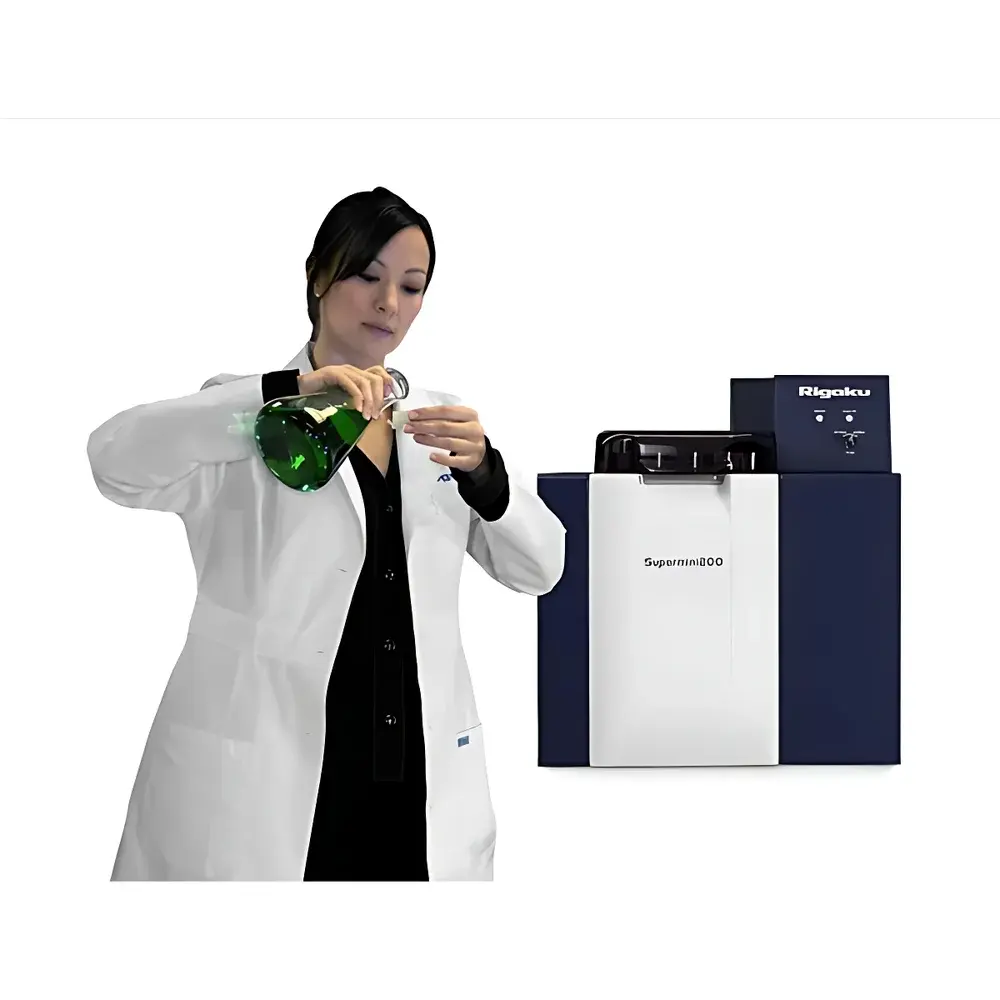
Rigaku Supermini200-W Wavelength Dispersive X-Ray Fluorescence Spectrometer for Chlorine Analysis in Sulfur-Containing Wastewater
| Brand | Rigaku |
|---|---|
| Origin | Japan |
| Instrument Type | Benchtop |
| X-ray Tube Power | 200 W |
| Target Material | Pd |
| Detector Types | Flow-proportional Counter (F-PC) and Scintillation Counter (SC) |
| Analytical Elements | Na (11) to U (92) |
| Configuration | Multi-channel WDXRF |
Overview
The Rigaku Supermini200-W is a benchtop wavelength dispersive X-ray fluorescence (WDXRF) spectrometer engineered for high-precision, matrix-corrected elemental quantification in complex, corrosive liquid matrices—specifically designed for chlorine determination in sulfur-rich refinery wastewater. Unlike energy-dispersive systems, WDXRF achieves superior spectral resolution through Bragg diffraction of characteristic X-rays using analyzing crystals, enabling baseline separation of overlapping peaks such as Cl Kα (2.622 keV) and S Kα (2.308 keV), which is critical when sulfur concentrations reach up to 5 wt%. The instrument operates under helium purge atmosphere to minimize absorption of low-energy X-rays, ensuring optimal sensitivity for light elements including chlorine (Z = 17) and sulfur (Z = 16). Its 200 W Pd-target X-ray tube delivers stable excitation with minimal bremsstrahlung background, while the dual-detector architecture (flow-proportional counter for light elements and scintillation counter for mid-to-heavy elements) supports simultaneous, high-count-rate detection across the full Na–U range.
Key Features
- Benchtop WDXRF platform with fully integrated helium purge system for light-element analysis (Na–Cl)
- Multi-channel optical configuration enabling simultaneous measurement of Cl, S, Fe, Ni, V, Pb, Cr, Si, P, Ca, and other interferents without sequential scanning delays
- Advanced fundamental parameters (FP)-based matrix correction algorithms, including absorption–enhancement modeling for interelement effects (e.g., S–Cl overlap, Fe/Ni/V enhancement of Cl signal, Si/P absorption suppression)
- Pd anode X-ray tube optimized for efficient excitation of Cl and S with reduced continuum background versus Rh or Mo targets
- Robust sample handling for liquid matrices: compatible with Mylar- or polyimide-based vacuum-tight sample cells (tested for ≥20 min exposure to pH 2–5 acidic sulfidic solutions)
- Compliance-ready software architecture supporting audit trails, user access levels, and electronic signatures per FDA 21 CFR Part 11 requirements
Sample Compatibility & Compliance
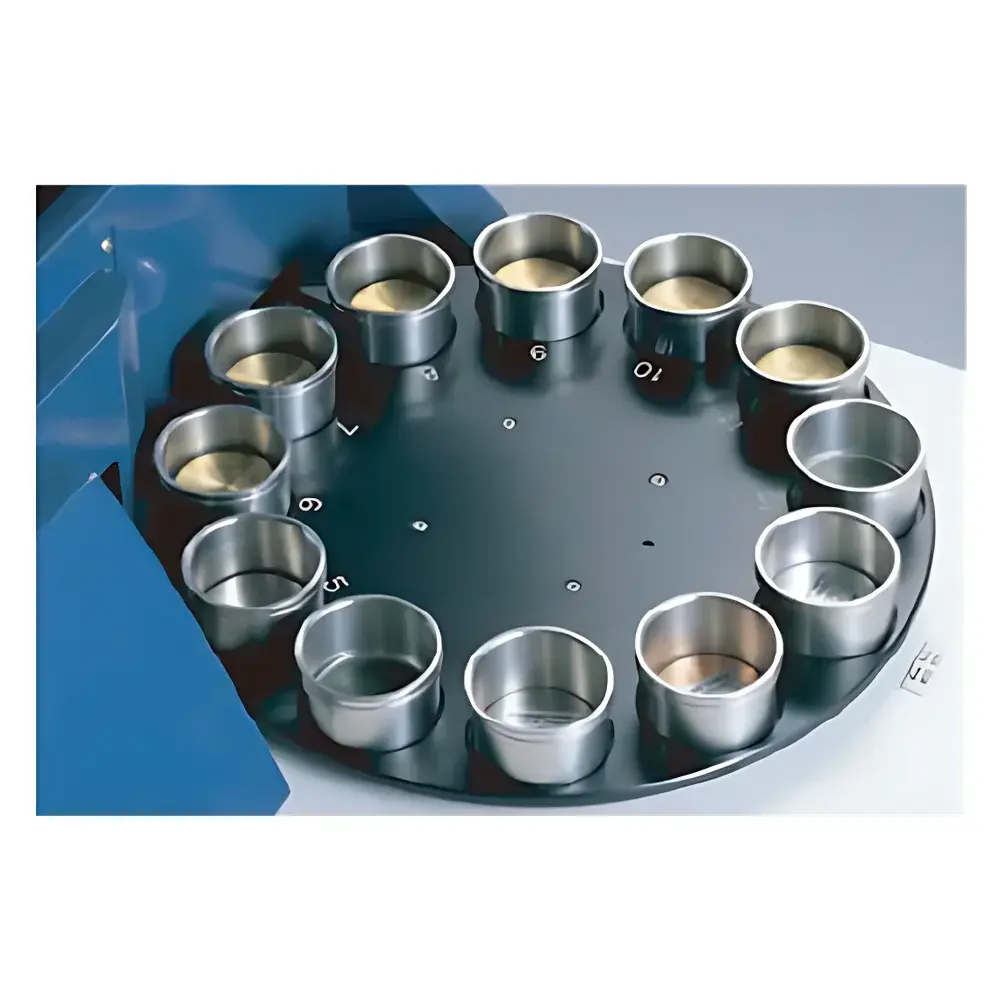
The Supermini200-W accommodates liquid samples sealed in 4–8 µm polymer films (e.g., 6 µm Kapton or 4 µm polyimide) mounted on standard 32 mm sample cups. Prior to analysis, wastewater samples require homogenization and filtration (0.45 µm) to remove suspended solids that may cause spectral artifacts or membrane rupture. For sulfur-containing wastewater, rigorous assessment of film chemical resistance is mandatory: acceptable membranes must retain dimensional stability and X-ray transmission integrity after 20-minute contact with representative sample pH and sulfide concentration. The system meets ISO 20042:2018 (XRF for liquid analysis), ASTM D7359–22 (standard test method for Cl in hydrocarbon liquids), and supports GLP/GMP workflows through traceable calibration verification and certified reference material (CRM) integration. All calibrations are traceable to NIST SRM 2781 (chlorinated hydrocarbon mixtures) and in-house prepared matrix-matched standards.
Software & Data Management
Rigaku’s PC-based QuantExpress™ software provides full control over acquisition parameters, peak deconvolution, and FP-based quantification. It includes dedicated modules for liquid analysis workflow automation—including automatic helium flow monitoring, membrane integrity validation checks, and real-time spectral quality metrics (peak-to-background ratio, FWHM stability). Calibration models incorporate up to 13 interferent elements (S, Fe, Ni, V, Pb, Cr, Si, P, Ca, Na, Mg, Al, K) to compute iterative absorption–enhancement coefficients for chlorine. All analytical results include uncertainty estimation per ISO/IEC 17025:2017 Annex A. Data export supports CSV, XML, and LIMS-compatible formats; raw spectra and processing logs are stored with time-stamped metadata for full auditability.
Applications
- Chlorine quantification in refinery sour water streams (FCC, coking, hydrotreating units) at 0.1–500 ppm level with ±5% RSD repeatability
- Simultaneous multi-element monitoring (S, Cl, Fe, Ni, V, Pb, Ca) to assess corrosion risk and catalyst poisoning potential
- Verification of desalting efficiency and chloride ingress in crude unit overhead systems
- Supporting ASTM D6470 (sour water analysis) and internal refinery specifications requiring CL-1000-level reporting
- Method development for regulatory compliance with EPA 6010D (ICP-OES cross-validation) and ISO 15587-2 (wastewater metal speciation)
FAQ
Why is WDXRF preferred over EDXRF or ion chromatography for Cl analysis in high-sulfur wastewater?
WDXRF provides superior peak resolution between Cl Kα and S Kα, eliminating spectral interference that compromises EDXRF accuracy. Unlike wet chemistry methods, it requires no digestion, derivatization, or column maintenance—reducing turnaround time and reagent costs while avoiding chloride loss during acid volatilization.
How does the instrument correct for sulfur-induced chlorine signal enhancement?
The QuantExpress™ software applies first-principles-based matrix correction using measured S intensity and pre-characterized mass absorption coefficients. It calculates the net Cl intensity by iteratively solving the Sherman equation for absorption–enhancement coupling between S and Cl, validated against matrix-matched standards spanning 0–5% S and 0–500 ppm Cl.
What sample preparation protocol is required for reproducible results?
Samples must be centrifuged (3000 rpm, 10 min), filtered (0.45 µm nylon), and loaded into helium-purged sample cells sealed with chemically resistant polymer films. Each batch includes a blank (deionized water + film) and CRM check standard to verify system stability prior to sample analysis.
Can the Supermini200-W quantify chlorine in solid sludge or emulsified wastewater?
Yes—when dried and pelletized with boric acid binder, or analyzed as settled supernatant after phase separation. Emulsions require demulsification (e.g., centrifugal separation or surfactant-assisted breaking) prior to filtration to prevent film puncture and spectral noise from droplet scattering.
Is method validation documentation available for regulatory submissions?
Rigaku provides IQ/OQ/PQ protocols, ASTM-compliant validation reports (linearity, LOD/LOQ, precision, spike recovery), and GxP implementation guides aligned with USP , ISO/IEC 17025, and refinery-specific QA/QC manuals.





