
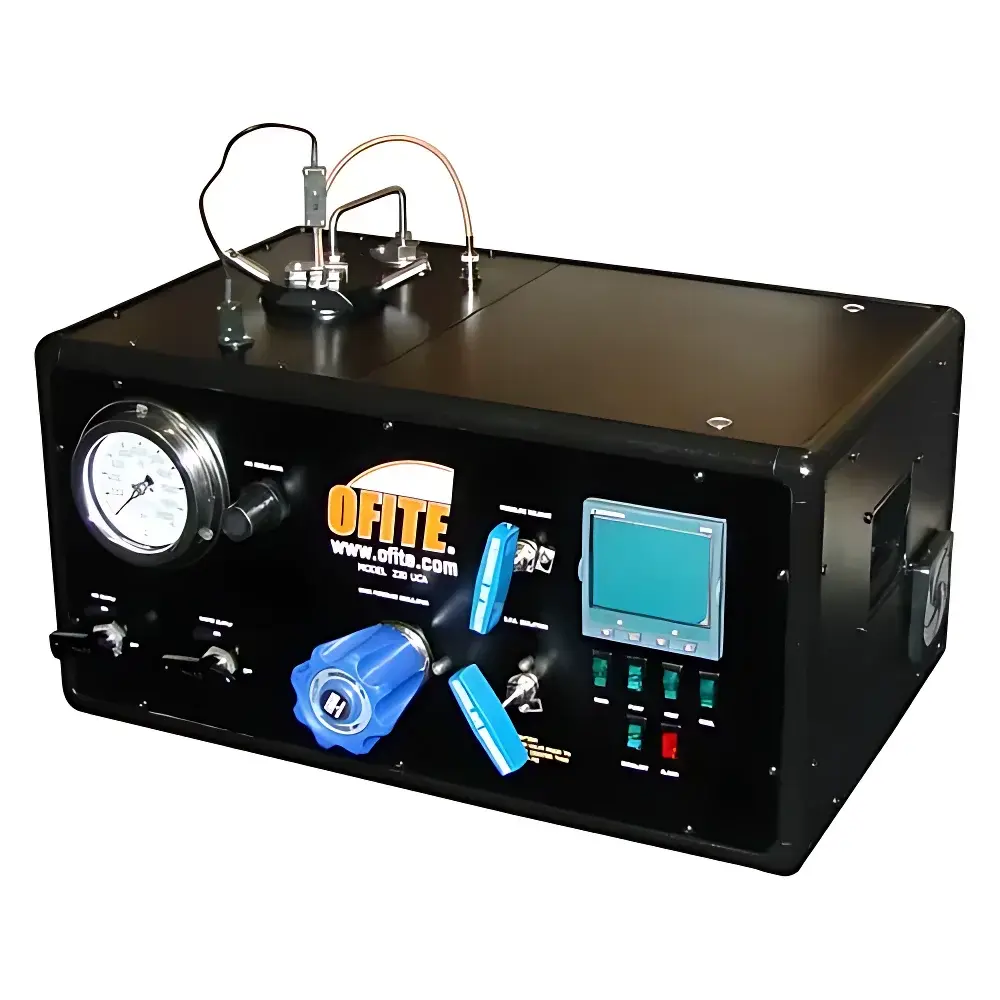
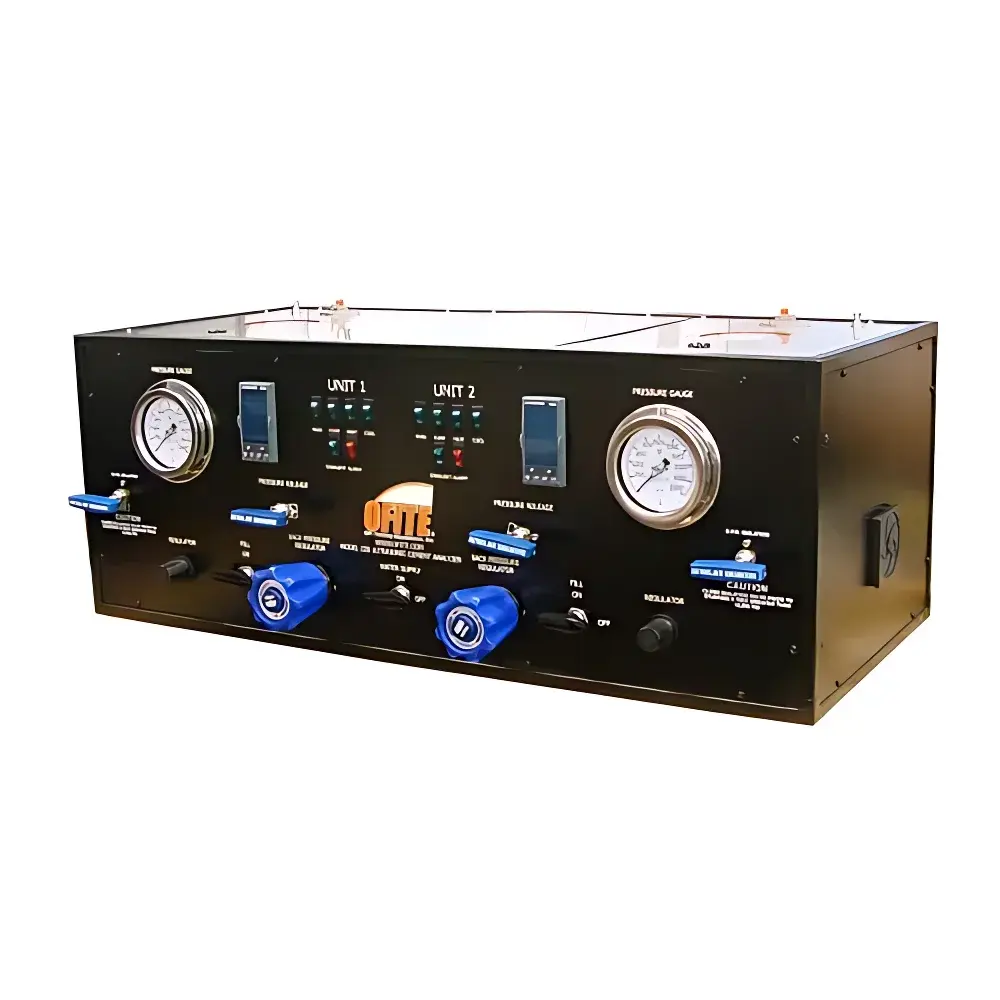
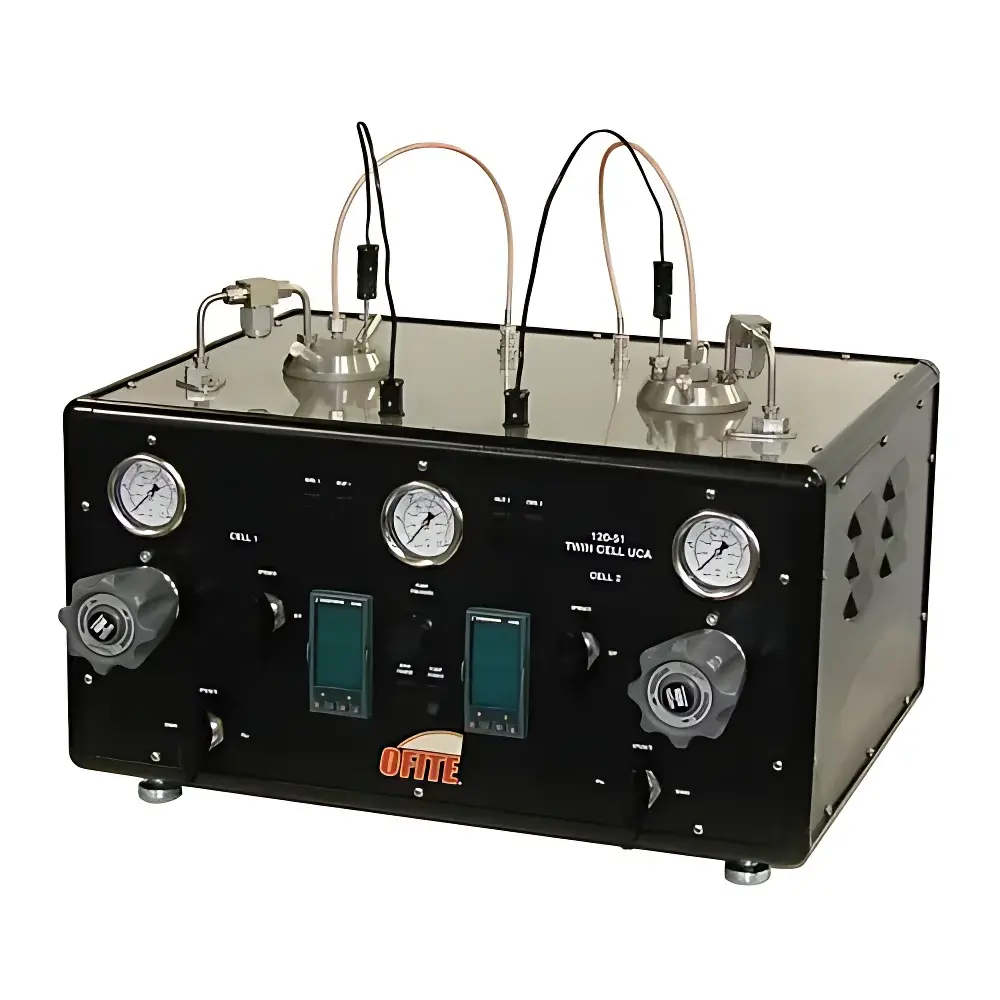
OFITE 120-50/120-51/120-52 Ultrasonic Cement Analyzer (UCA)
| Brand | OFITE |
|---|---|
| Origin | USA |
| Model | 120-50 (Single-Cell), 120-51 (Twin-Cell), 120-52 (Dual-Cell) |
| Max Temperature | 204.4 °C |
| Max Pressure | 138 MPa (120-50/120-52), 34.5 MPa (120-51) |
| Sample Cell Configuration | Single / Twin / Dual |
| Data Interface | RS-232 |
| Software Platform | Windows-based proprietary acquisition and analysis suite |
| Compliance | Designed for ASTM C109, API RP 10B-2, ISO 10426-2, and oilfield cementing QA/QC workflows under GLP conditions |
Overview
The OFITE Ultrasonic Cement Analyzer (UCA) series—models 120-50, 120-51, and 120-52—is a laboratory-grade, non-destructive testing system engineered to monitor the compressive strength development of hydraulic cements in real time under simulated downhole thermal and pressure conditions. Based on ultrasonic pulse transmission velocity (UPV) measurement, the UCA quantifies the evolution of elastic modulus and microstructural rigidity as cement hydrates. As the cement matrix densifies and calcium silicate hydrate (C-S-H) gel forms, longitudinal wave velocity increases linearly with compressive strength—a correlation validated across Class G, H, and specialty oilwell cements per API RP 10B-2 Annex A. Each unit integrates a high-fidelity transducer pair (1 MHz center frequency), precision-controlled autoclave chamber, and synchronized data acquisition hardware calibrated traceably to NIST standards. Unlike destructive cube-break methods, the UCA enables continuous, in-situ monitoring over 72+ hours without sample interruption—critical for evaluating early-age strength gain, set retardation, or thermal cracking risk in nuclear waste grout formulations and geothermal wellbore sealants.
Key Features
- Non-destructive ultrasonic pulse velocity (UPV) measurement with <0.5% repeatability (per ASTM C597)
- Autoclave chambers rated for up to 204.4 °C and 138 MPa (120-50/120-52); 34.5 MPa variant (120-51) optimized for parallel twin-cell efficiency
- Twin-Cell architecture (120-51): two thermally and hydraulically isolated test cells sharing common utility manifolds (air, water, drain, power, RS-232)—enabling statistically robust comparative studies with identical boundary conditions
- Integrated digital pressure regulation via solenoid-controlled bleed valves; temperature stability ±0.3 °C over full range using PID-controlled cartridge heaters and thermocouple feedback
- Real-time waveform capture at 10 MS/s sampling rate; automatic time-of-flight (ToF) detection with sub-nanosecond resolution
- Compact footprint: 120-51 measures only 61 × 46 × 30 cm—matching single-cell size while doubling throughput
- RS-232 interface supports multi-instrument daisy-chaining; software permits concurrent operation of up to four UCAs from one host PC
Sample Compatibility & Compliance
The UCA accommodates standard API-recommended cement slurry volumes (300–500 mL) in stainless-steel cylindrical cells (ID = 50.8 mm). It supports slurries containing silica flour, latex additives, lightweight agents (e.g., cenospheres), and radioactive waste simulants—provided acoustic impedance mismatch remains within transducer coupling limits. All models comply with the mechanical and environmental requirements of ISO 10426-2:2019 for oilwell cement testing and are routinely deployed in nuclear regulatory QA programs per 10 CFR Part 50 Appendix B. The embedded firmware logs all operational parameters—including temperature ramp profiles, pressure hold durations, and raw ToF timestamps—with immutable audit trails satisfying FDA 21 CFR Part 11 electronic record requirements when used with validated software configuration. Calibration certificates include traceability to NIST SRM 1240a (ultrasonic velocity reference block) and Fluke 725 pressure calibrators.
Software & Data Management
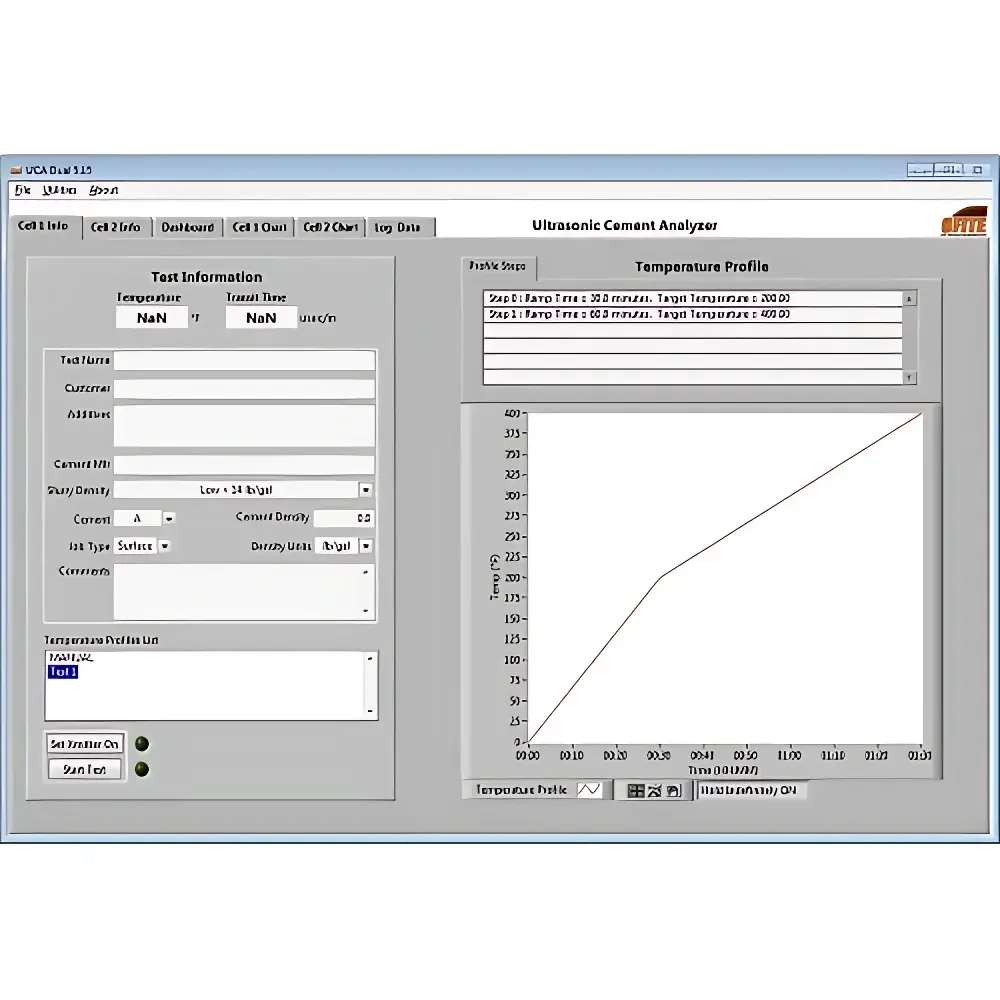
The proprietary Windows-based acquisition software provides fully configurable test protocols: users define multi-step temperature/pressure ramps, dwell times, and sampling intervals (from 1 second to 60 minutes). Raw waveform data is stored in binary format with metadata headers (time stamp, cell ID, T/P setpoints, transducer gain). On-the-fly conversion applies empirically derived UPV-to-strength regressions—either user-loaded calibration curves or factory-default models aligned with API RP 10B-2 Annex B. Export functions generate native Excel (.xlsx) files with time-series strength, velocity, amplitude decay, and signal-to-noise ratio columns; CSV and PDF report templates support automated generation of QC sign-off documentation. Audit mode enforces electronic signatures, change tracking, and role-based access control (admin/operator/viewer), fulfilling GLP/GMP data integrity mandates for nuclear materials certification labs.
Applications
- Accelerated strength validation of low-pH grouts for spent nuclear fuel repository backfill systems
- Thermal stress modeling of cement sheaths exposed to cyclic steam injection (SAGD) in heavy oil reservoirs
- Performance screening of expansive cements for annular isolation integrity in CO₂ sequestration wells
- Early-age hydration kinetics studies under hyperbaric conditions (≥100 MPa) mimicking deep geothermal environments
- Quality conformance testing of Class G/H cements per API Spec 10A and ASTM C150
- Parallel evaluation of additive packages (retarders, accelerators, nanosilica) using 120-51’s dual independent cells
FAQ
What ultrasonic principle does the UCA employ to infer compressive strength?
It measures longitudinal pulse transmission velocity (UPV) through the cement specimen. Increasing UPV correlates directly with rising dynamic Young’s modulus and compressive strength during hydration, following established empirical relationships in API RP 10B-2.
Can the 120-51 Twin-Cell model run two different cement formulations simultaneously?
Yes—each cell has independent temperature and pressure control loops, enabling side-by-side comparison of distinct slurry designs under identical ambient utility conditions.
Is mechanical static gel strength measurement supported?
Optional add-ons (120-53 SGSM for 34.5 MPa; 120-58 SGSM for 138 MPa) integrate torque-sensing viscometers into the UCA frame, permitting static gel strength profiling per API RP 10B-2 Section 8.
Does the system meet nuclear regulatory data integrity requirements?
When configured with audit-mode software and documented calibration records, it satisfies 10 CFR 50 Appendix B, ASME NQA-1, and IAEA SSG-30 data governance expectations for safety-significant cement testing.
What utilities are required for continuous operation?
Compressed air (100–150 PSI, 1/4″ NPT), cooling water (40–100 PSI, 40–100 °F), 230 V / 50 Hz single-phase power, and RS-232 serial connectivity to a Windows host PC with ≥1280×680 resolution.



