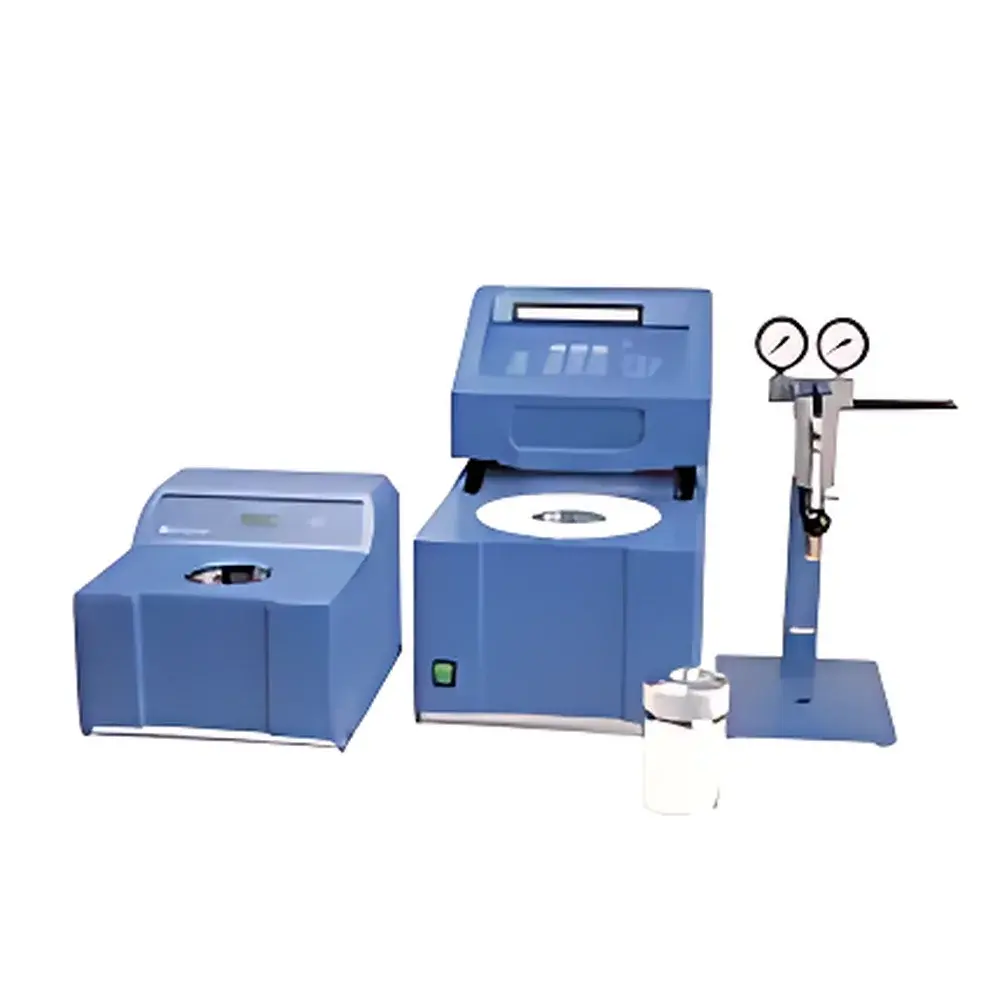
IKA C7000 Basic Calorimetry System
| Brand | IKA |
|---|---|
| Origin | Germany |
| Model | C7000 |
| Measurement Range | up to 30,000 J |
| Measurement Principle | Dual-Dry Bomb Calorimetry (ISO 1928) |
| Measurement Time | ~3 min |
| Temperature Resolution | 0.0001 K |
| Operating Ambient Temperature | 18–30 °C |
| Relative Humidity Limit | ≤80 % RH |
| Max Oxygen Pressure | 40 bar |
| Cooling Medium | Tap Water (12–30 °C), Flow Rate: 120–180 L/h |
| Cooling System Pressure Rating | 9 bar |
| Dimensions (W×D×H) | 800 × 395 × 490 mm |
| Weight | 43 kg |
| Power Supply | 220–240 V, 50/60 Hz, 260 W |
| Interfaces | RS232 (balance, printer, PC), Centronics (printer) |
| Oxygen Bomb Recognition | Auto-coded C7010 anti-halogen bomb |
| Compatible Crucible | C14 combustion crucible |
| Software | C5040 Calwin (menu-driven, instrument control & data management) |
Overview
The IKA C7000 Basic Calorimetry System is a precision-engineered dry-type oxygen bomb calorimeter designed for rapid, high-reproducibility determination of gross calorific value (GCV) in solid and liquid fuels, biomass, waste-derived fuels, and other combustible materials. As the world’s first total heat value measurement system employing direct temperature acquisition from the combustion bomb itself—rather than from an external water jacket—the C7000 eliminates thermal lag and significantly accelerates analysis cycles. Its dual-dry measurement principle complies strictly with ISO 1928:2021 (“Solid mineral fuels — Determination of gross calorific value by the bomb calorimeter method”), ensuring metrological traceability and regulatory acceptability in accredited laboratories. The system achieves typical measurement durations of approximately three minutes per sample, enabled by integrated thermometric precision (0.0001 K resolution), active tap-water cooling (12–30 °C inlet range), and real-time bomb identification via encoded C7010 anti-halogen oxygen bombs.
Key Features
- Direct bomb-integrated temperature sensing architecture for minimized thermal inertia and enhanced measurement speed
- Automated recognition of up to eight coded C7010 anti-halogen oxygen bombs—enabling unattended batch processing and full audit trail linkage between bomb ID and result
- Dual-dry calorimetric mode compliant with ISO 1928, eliminating reliance on water-equivalent calibration and reducing operator dependency
- Integrated C7002 recirculating cooling system with pressure-rated (9 bar) hydraulics, supporting stable thermal equilibrium across ambient fluctuations (18–30 °C)
- Robust mechanical design (43 kg mass, steel-reinforced chassis) optimized for vibration damping and long-term stability in QC/QA environments
- Full RS232 connectivity for balance (e.g., analytical or top-loading), impact or thermal printers, and host PC—supporting automated data capture without manual transcription
- C5040 Calwin software suite featuring intuitive menu navigation, real-time parameter monitoring, customizable report templates, and built-in validation checks for outlier detection
Sample Compatibility & Compliance
The C7000 accommodates standard 1 g–1.5 g samples in platinum or nickel-chromium crucibles, including those requiring halogen-resistant combustion (e.g., PVC, coal blends, municipal solid waste). The C7010 anti-halogen bomb incorporates corrosion-resistant alloys and proprietary liner geometry to ensure quantitative decomposition of sulfur and halogens during combustion—critical for compliance with ASTM D5865, EN 14918, and ISO 18125. All hardware and firmware are engineered to support GLP and GMP-aligned workflows: Calwin logs timestamped operator IDs, bomb serial numbers, calibration events, and environmental parameters (coolant temp, ambient RH), satisfying documentation requirements under FDA 21 CFR Part 11 when deployed with electronic signature modules. Routine verification against certified benzoic acid standards (e.g., NIST SRM 39j) is supported through embedded calibration routines.
Software & Data Management
C5040 Calwin provides a dedicated, non-proprietary Windows-based interface with no third-party runtime dependencies. It enables full method configuration—including ignition energy, oxygen fill pressure (up to 40 bar), pre- and post-combustion equilibration times, and baseline correction algorithms. Raw thermogram data (temperature vs. time) is stored in ASCII-compatible format for secondary analysis in MATLAB, Python, or LIMS platforms. Audit trails are immutable and exportable as PDF or CSV; all user actions—including method edits, result overrides, and calibration updates—are time-stamped and attributed. Optional integration with laboratory information management systems (LIMS) is achievable via RS232 serial protocol or OPC UA gateway adapters.
Applications
- Quality control of coal, coke, and biomass pellets in power generation and cement manufacturing
- Routine energy content certification of refuse-derived fuel (RDF) and solid recovered fuel (SRF) per EN 15440
- Research-grade calorimetry in academic and governmental energy institutes evaluating novel biofuels and pyrolysis oils
- Environmental testing labs performing waste characterization per ISO 21638 and EPA Method 9040C
- Contract testing facilities requiring ISO/IEC 17025-compliant reporting with full measurement uncertainty estimation
FAQ
Does the C7000 require calibration with water-equivalent values?
No. Its dual-dry methodology eliminates water-equivalent calibration; instead, it relies on fundamental thermodynamic constants and direct bomb temperature measurement per ISO 1928.
Can the C7010 anti-halogen bomb be used interchangeably with older IKA bomb models?
No. The C7010 features a proprietary coding interface and modified sealing geometry; only C7000-series instruments recognize its ID and enable full safety interlocks.
Is tap water sufficient for continuous operation?
Yes—provided inlet temperature remains within 12–30 °C and flow rate is maintained at 120–180 L/h. For variable municipal supply conditions, optional inline chillers or closed-loop recirculation units may be added.
What data security protocols does Calwin support?
Calwin implements role-based access control (operator, supervisor, administrator), encrypted local database storage, and configurable auto-backup intervals to network drives or USB media.
How is compliance with ISO 1928 verified during routine use?
The system includes built-in verification routines using certified reference materials; deviation thresholds trigger alert flags and prevent result release until corrective action is logged.