
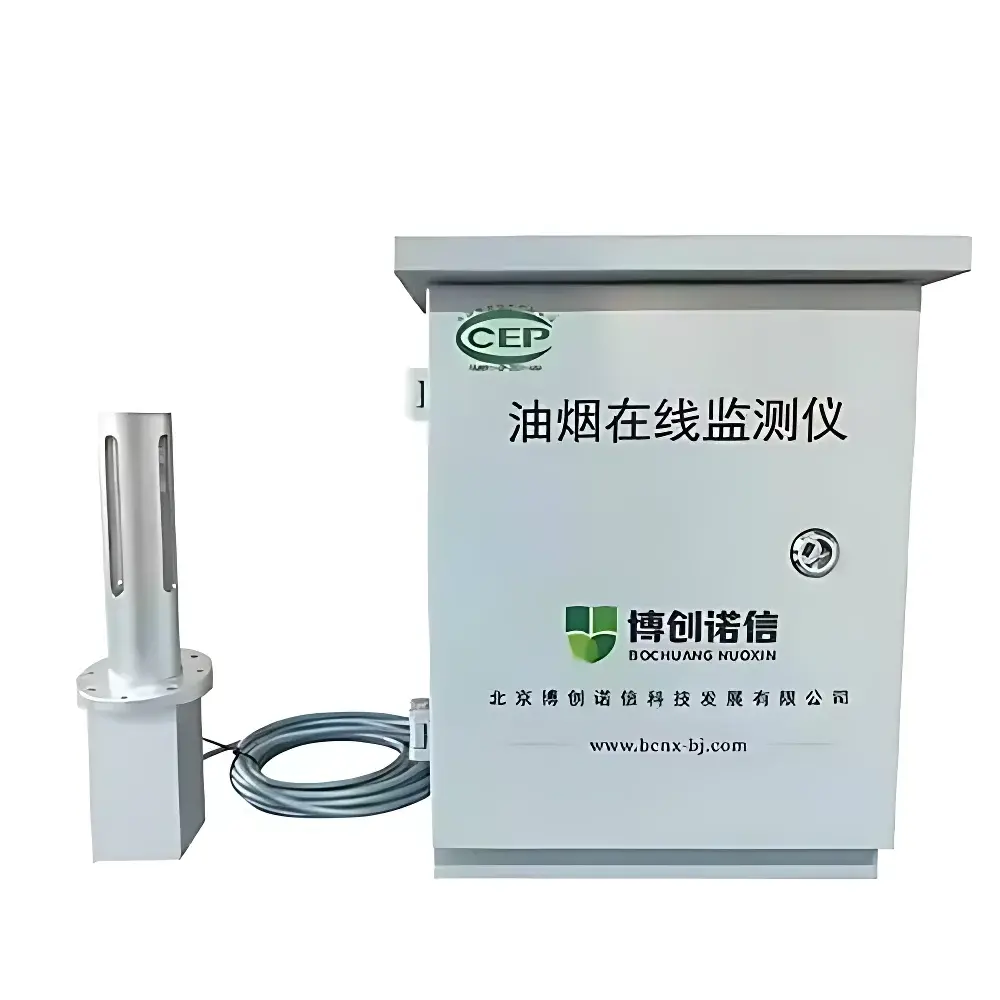
BCNX-YY08 Oil Fume Online Monitoring System
| Origin | Beijing, China |
|---|---|
| Manufacturer Type | Authorized Distributor |
| Origin Category | Domestic (PRC) |
| Model | BCNX-YY08 |
| Price Range | USD 0.14–714 (FOB) |
| Detection Principle | Multi-Parameter Integrated Sensing (Optical Scattering + Semiconductor/PID for NMHC + Dedicated Oil Mist Transduction) |
| Mobility | Fixed Online Installation |
| Application Domain | Commercial Food Service Establishments (Restaurants, Canteens, Street Food Hubs) |
| Oil Mist Measurement Range | 0–30,000 µg/m³ |
| Accuracy | ±10% of reading (vs. reference gravimetric method) |
| Zero Drift | ≤±0.5 mg/m³ over 1 h |
| Relative Error vs. Reference Method | ≤±20% (per HJ 629–2011 & DB11/1488–2018) |
| Linearity Error | ≤10% |
| Insulation Resistance | ≥20 MΩ |
| Withstand Voltage | No arcing or dielectric breakdown at rated test voltage |
| Sampling Cycle | 60 s |
| Operating Voltage | 220 VAC ±10% |
| Power Consumption | 8 W |
| Operating Temperature | 0–70 °C |
| Operating Humidity | 5–95% RH (non-condensing) |
| Probe Dimensions | Ø24 × 248 mm (installation bore: Ø25–26 mm) |
| PM Measurement | Optical scattering principle |
| Resolution | 1 µg/m³ |
| Range | 0–20 mg/m³ (configurable variants: 0–10 mg/m³ or 0–2000 mg/m³) |
| NMHC Measurement | Dual-mode selectable — Metal Oxide Semiconductor (MOS) or Photoionization Detector (PID) |
| Range | 0–30 ppm or 0–1000 ppm |
| Resolution | 0.1 ppm (PID), 1 ppm (MOS) |
| Control Outputs | 4-channel dry-contact relay interface for fan/purifier status monitoring and remote switching |
| Overcurrent Protection | Automatic cut-off after 6 s if load current exceeds threshold |
| Data Reporting Interval | User-configurable (1–3600 s) |
Overview
The BCNX-YY08 Oil Fume Online Monitoring System is an integrated environmental compliance instrument engineered for continuous, real-time emission surveillance in commercial kitchen exhaust ducts. Designed to meet the technical requirements of China’s Technical Specification for Online Monitoring of Cooking Fume Emissions (HJ 629–2011) and local regulatory frameworks such as Beijing Municipal Standard DB11/1488–2018, the system simultaneously quantifies three critical air pollutants: cooking oil mist (as total suspended particulate mass concentration), respirable particulate matter (PM2.5-equivalent), and non-methane hydrocarbons (NMHC). Its measurement architecture employs a tri-sensor fusion approach: a proprietary capacitive/thermal transduction module optimized for viscous aerosol phase detection, a forward-angle optical scattering photometer calibrated for submicron droplet dispersion, and a field-selectable NMHC sensor—either temperature-compensated metal oxide semiconductor (MOS) or ultraviolet photoionization detector (PID)—to accommodate varying volatility profiles of cooking-derived VOCs. Unlike single-parameter stack monitors, the BCNX-YY08 delivers synchronized, time-aligned datasets across all three analytes, enabling correlation analysis between grease loading, particle generation, and volatile organic release—key for root-cause diagnostics during enforcement audits or operational optimization.
Key Features
- Triple-parameter synchronous acquisition: oil mist (0–30,000 µg/m³), PM (0–20 mg/m³, with optional extended ranges), and NMHC (0–30 ppm or 0–1000 ppm)
- Duct-integrated probe design (Ø24 × 248 mm) with minimal intrusion profile and standardized 25–26 mm mounting bore requirement
- Four independent relay outputs supporting both status feedback (e.g., fan RPM signal, purifier power-on confirmation) and active control (remote start/stop command execution)
- User-defined reporting interval (1–3600 seconds), configurable via local LCD menu or remote platform API
- Embedded overcurrent protection: automatic circuit disconnection within 6 seconds upon sustained current exceedance beyond pre-set thresholds
- Robust environmental tolerance: operational integrity verified from 0 °C to 70 °C ambient and 5–95% RH (non-condensing)
- Electrical safety compliance: insulation resistance ≥20 MΩ; dielectric withstand tested per IEC 61010-1
Sample Compatibility & Compliance
The BCNX-YY08 is validated for use in high-humidity, high-grease environments typical of wok-based cooking, steam buffet lines, and deep-fry operations. Its oil mist sensor incorporates anti-fouling surface treatment and thermal self-cleaning cycles to mitigate deposition-induced drift. All measurement channels undergo factory calibration traceable to national metrological standards (CNAS-accredited labs). Regulatory alignment includes conformance with HJ 629–2011 (oil mist accuracy ≤±20% vs. reference method), DB11/1488–2018 (zero drift ≤±0.5 mg/m³/1 h), and general industrial emission monitoring requirements under China’s Environmental Protection Law. While not certified to EU ATEX or UL Class I Div 2, its enclosure meets IP65 ingress protection and operates within safe extra-low voltage (SELV) boundaries for internal circuitry.
Software & Data Management
Data output follows Modbus RTU (RS-485) and MQTT protocols for seamless integration into municipal environmental data platforms (e.g., Beijing Municipal Ecological Environment Monitoring Center’s unified IoT hub). Local 4.3-inch TFT LCD displays real-time values, historical trend graphs (72-hr buffer), device health status, and alarm flags (e.g., sensor timeout, communication loss, overcurrent event). Firmware supports secure OTA updates and audit-log retention (180 days minimum) compliant with GLP-style recordkeeping principles. Raw data packets include UTC timestamps, sensor IDs, confidence indicators, and diagnostic codes—enabling forensic reconstruction of measurement conditions during regulatory review.
Applications
- Continuous compliance verification for restaurants subject to municipal fume discharge permits
- Performance validation of electrostatic precipitators (ESPs) and UV-C oxidation units in real time
- Operational benchmarking across multi-unit food service chains (e.g., identifying outlier locations with elevated NMHC:oil mist ratios)
- Preventive maintenance scheduling based on cumulative grease-loading trends
- Supporting environmental impact assessments (EIAs) for new food court developments
FAQ
Is the BCNX-YY08 certified for use in EU or North American jurisdictions?
No. It is designed and type-approved specifically for Chinese regulatory frameworks (HJ 629–2011, DB11/1488–2018) and lacks CE, UKCA, or EPA certification.
Can the NMHC sensor be field-upgraded from MOS to PID?
Yes—provided the base unit was ordered with dual-sensor hardware support; firmware reconfiguration is required post-installation.
What is the recommended calibration frequency?
Quarterly zero/span verification using NIST-traceable oil mist and isobutylene standards is advised; annual full recalibration is required for regulatory audit readiness.
Does the system support integration with BMS or SCADA platforms?
Yes—via standard Modbus RTU register mapping or custom JSON-over-MQTT schema, with documentation provided for third-party system integrators.
How is data security handled during cloud transmission?
MQTT payloads are encrypted using TLS 1.2; device authentication employs X.509 certificates; no PII or business-identifying metadata is embedded in telemetry streams.
Related Products







