
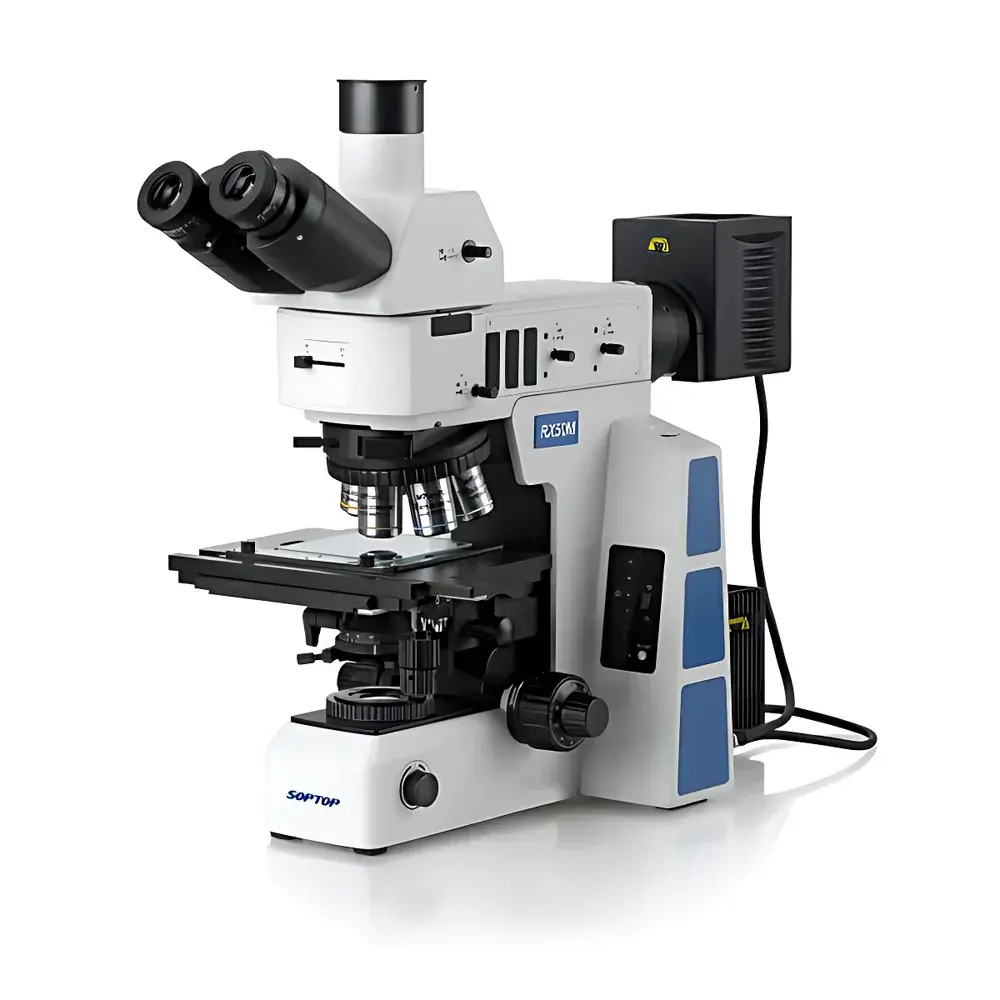
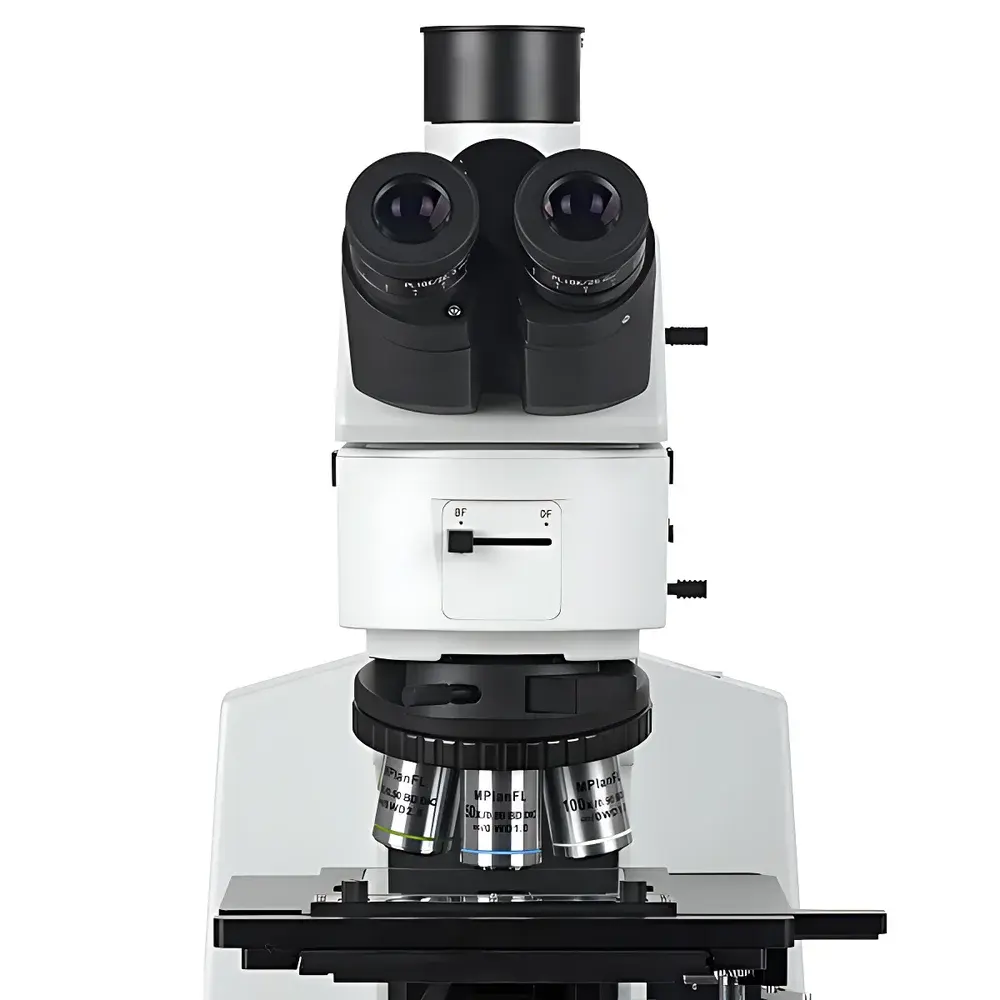
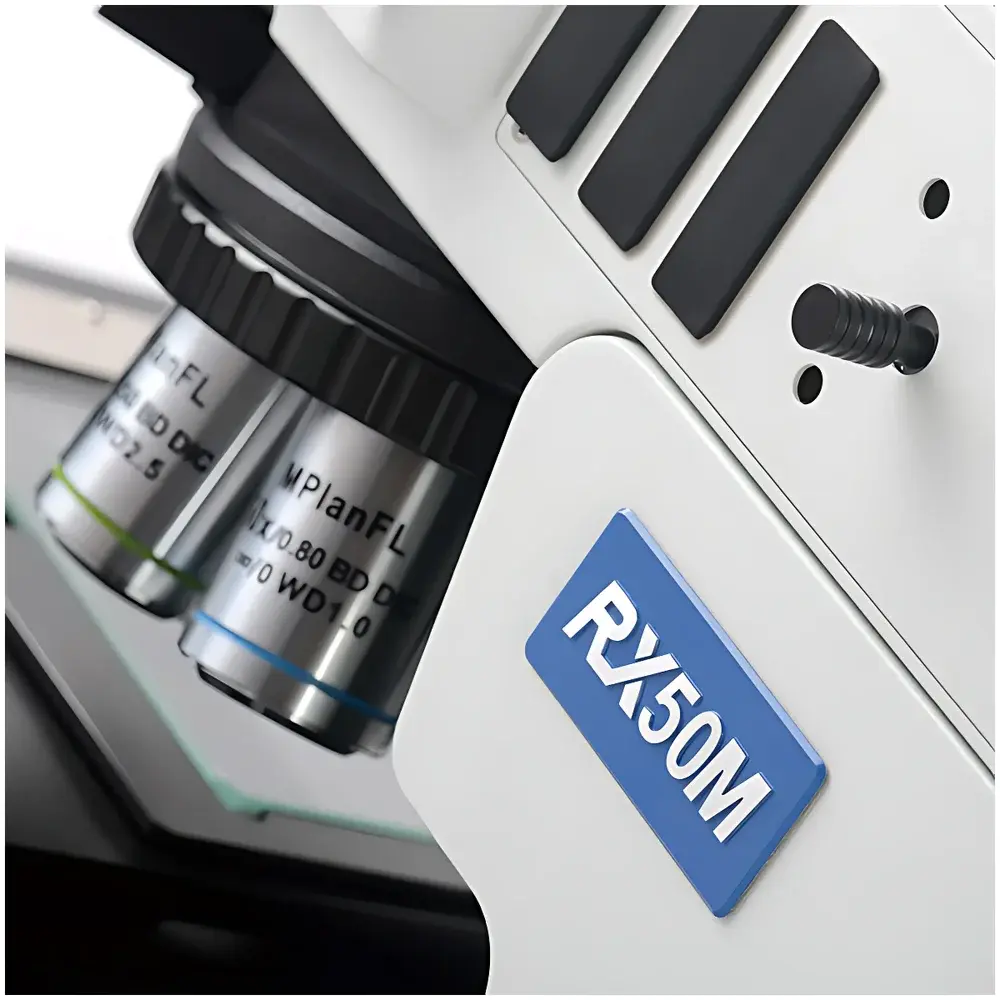
SOPTOP RX50M Research-Grade Upright Metallurgical Microscope
| Brand | SOPTOP |
|---|---|
| Origin | Zhejiang, China |
| Manufacturer Type | Direct Manufacturer |
| Product Origin | Domestic (China) |
| Model | RX50M |
| Mounting Type | Upright |
| Total Magnification Range | 50×–1000× |
| Eyepieces | Widefield Plan Eyepieces PL10×/25 mm with High-Eye-Point Design |
| Objectives | Infinity-Corrected Semi-Apochromatic Metallurgical Objectives, 5×–100×, Long Working Distance, Reflected Brightfield/Darkfield/Polarized/ DIC Compatible |
| Observation Modes | Reflected Brightfield, Reflected Darkfield, Transmitted Brightfield, Reflected Polarized, Reflected DIC (Nomarski) |
| Viewing Head | Trinocular, Adjustable Beam-Splitting Ratio (e.g., 50:50 / 0:100), 25 mm Field Number |
| Polarizer System | Rotatable Analyzer (0°–360°), Fixed Polarizer |
| DIC Module | Optional SOPTOP-Developed Differential Interference Contrast Slider |
| Illumination | LED Reflected & Transmitted Köhler Illumination, Digital Voltage Display, Low-Position Intensity Control |
| Ergonomics | Left-Hand Coarse/Fine Focus, Integrated Illumination Control on Base |
Overview
The SOPTOP RX50M is a research-grade upright metallurgical microscope engineered for high-fidelity microstructural analysis of opaque, reflective specimens—including metals, alloys, ceramics, composites, and semiconductor wafers. Built upon an infinity-corrected optical architecture, the RX50M employs semi-apochromatic long-working-distance objectives optimized for reflected-light imaging, delivering diffraction-limited resolution, chromatic fidelity, and minimal aberration across its full 50×–1000× magnification range. Its modular design supports simultaneous integration of multiple contrast mechanisms—brightfield, darkfield, polarized light, and Nomarski differential interference contrast (DIC)—within a single optical path, eliminating the need for objective or condenser reconfiguration between modalities. The system adheres to ISO 10934-1 (microscopy terminology), ISO 8578 (objective lens classification), and ASTM E3 (standard guide for preparation of metallographic specimens), ensuring metrological traceability and compatibility with international quality assurance protocols.
Key Features
- 25 mm field number trinocular observation head with variable beam-splitting ratio (e.g., 50:50 or 0:100), enabling concurrent visual observation and high-resolution digital imaging without optical compromise
- Reflected illumination system featuring stable, flicker-free white LED source with digital voltage readout and ergonomically positioned low-base intensity control for precise irradiance management
- Rotatable 360° analyzer for quantitative polarized light microscopy—critical for crystallographic orientation mapping, stress birefringence evaluation, and anisotropic phase identification in PCB substrates and thin-film devices
- Integrated DIC slider compatible with SOPTOP’s proprietary Nomarski prisms, generating high-contrast, pseudo-3D topographic images from sub-micron surface features without staining or etching
- Ergonomic left-hand coarse/fine focusing mechanism and coaxial stage controls reduce operator fatigue during extended QC inspections or failure analysis workflows
- Optical train constructed with high-transmission multi-layer anti-reflection coatings and rigorously selected BK7 and fused silica elements to preserve native specimen colorimetry and signal-to-noise ratio
Sample Compatibility & Compliance
The RX50M accommodates standard metallographic specimens (up to 76 mm × 52 mm × 30 mm height) and wafer formats (up to 200 mm diameter with optional stage adapters). Its dual-path illumination supports both reflected-mode examination of polished/mounted samples and transmitted-mode inspection of thin-sectioned geological or polymeric specimens. All optical components comply with RoHS Directive 2011/65/EU and CE marking requirements for laboratory instrumentation. The microscope’s mechanical stability and thermal drift performance meet ISO 10934-2 (vibration sensitivity) and ISO 7944 (environmental operating conditions), making it suitable for GLP-compliant laboratories and ISO/IEC 17025-accredited testing facilities. Optional DIC and polarization modules are validated per ASTM E112 (grain size determination) and ASTM E407 (etchant selection guidelines).
Software & Data Management
The RX50M integrates seamlessly with industry-standard imaging platforms—including SOPTOP’s proprietary MShot Pro software and third-party packages such as NIS-Elements (Nikon), ZEN (Zeiss), and Olympus cellSens—via USB 3.0 or HDMI output. Image acquisition supports RAW TIFF export with embedded EXIF metadata (magnification, objective ID, illumination mode, DIC bias setting). Audit trail functionality records user login, acquisition timestamp, measurement parameters, and calibration events—supporting compliance with FDA 21 CFR Part 11 when paired with validated software configurations. Measurement modules include grain size analysis (ASTM E112), inclusion rating (ASTM E45), phase fraction quantification, and line-profile intensity profiling for interfacial characterization.
Applications
- Metallographic quality control in automotive, aerospace, and power generation component manufacturing
- Fatigue crack initiation and propagation analysis in weld zones and heat-affected regions
- Failure analysis of solder joints, die attach layers, and copper interconnects in advanced packaging
- Crystallographic texture assessment in cold-rolled steels and aluminum alloys using polarized light
- Surface defect detection (scratches, pits, porosity) in precision-machined tooling and injection molds
- Thin-film thickness estimation via interference color correlation in coated optics and PVD/CVD layers
FAQ
Does the RX50M support automated focus mapping or motorized stage control?
Yes—optional motorized Z-axis focus drive and XY programmable stage are available for repeatable multi-location imaging and stitching workflows.
Can the RX50M be calibrated to NIST-traceable standards?
Yes—the system accepts calibration slides certified to ISO 10934-3 (scale accuracy) and supports periodic verification using graticules traceable to NIST SRM 2051a.
Is DIC functionality built-in or requires external hardware?
DIC is enabled via a field-installable slider module containing matched Wollaston prisms; no external alignment optics or separate condenser are required.
What is the maximum working distance achievable at 100× magnification?
The 100× semi-apochromatic objective provides ≥0.8 mm working distance—sufficient for accommodating thick sample holders and probe tips during in-situ testing.
Are software updates and firmware patches provided post-purchase?
Yes—SOPTOP delivers biannual firmware releases and maintains a secure customer portal for authenticated access to validation documentation, service bulletins, and regulatory compliance kits.





