
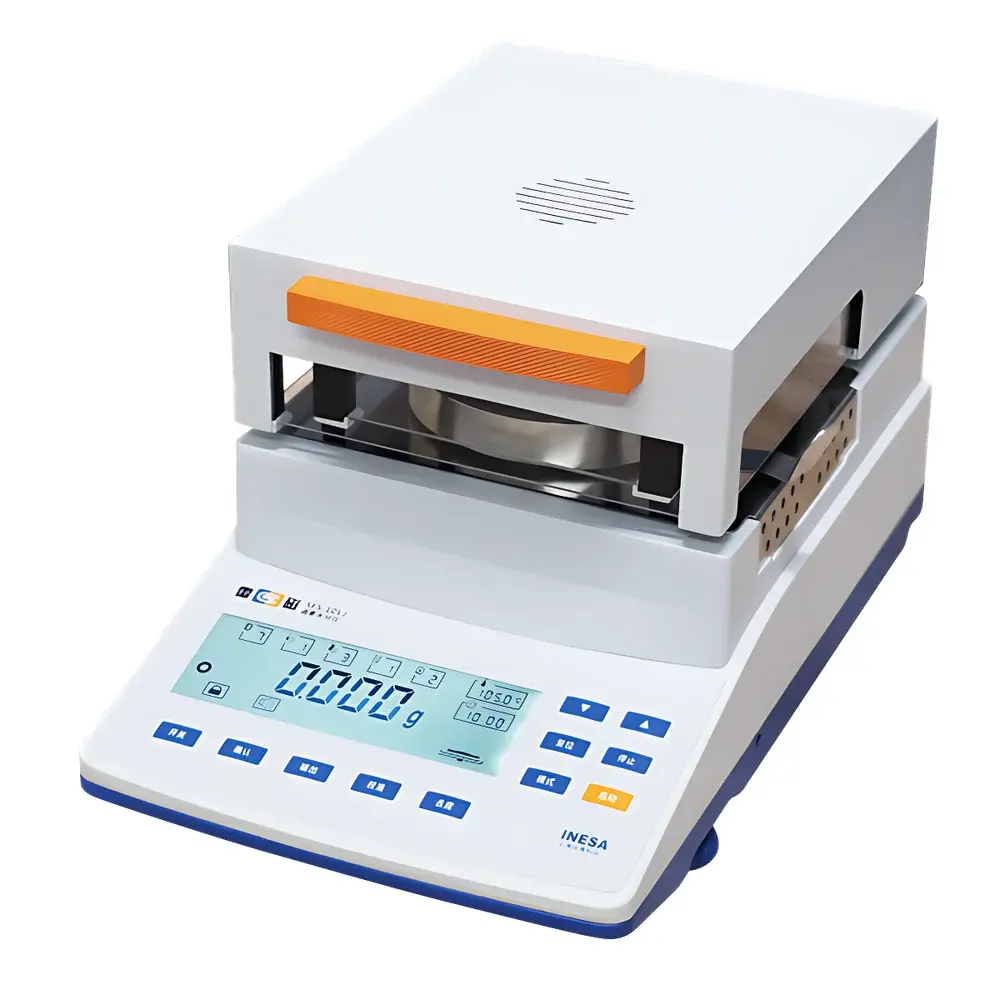
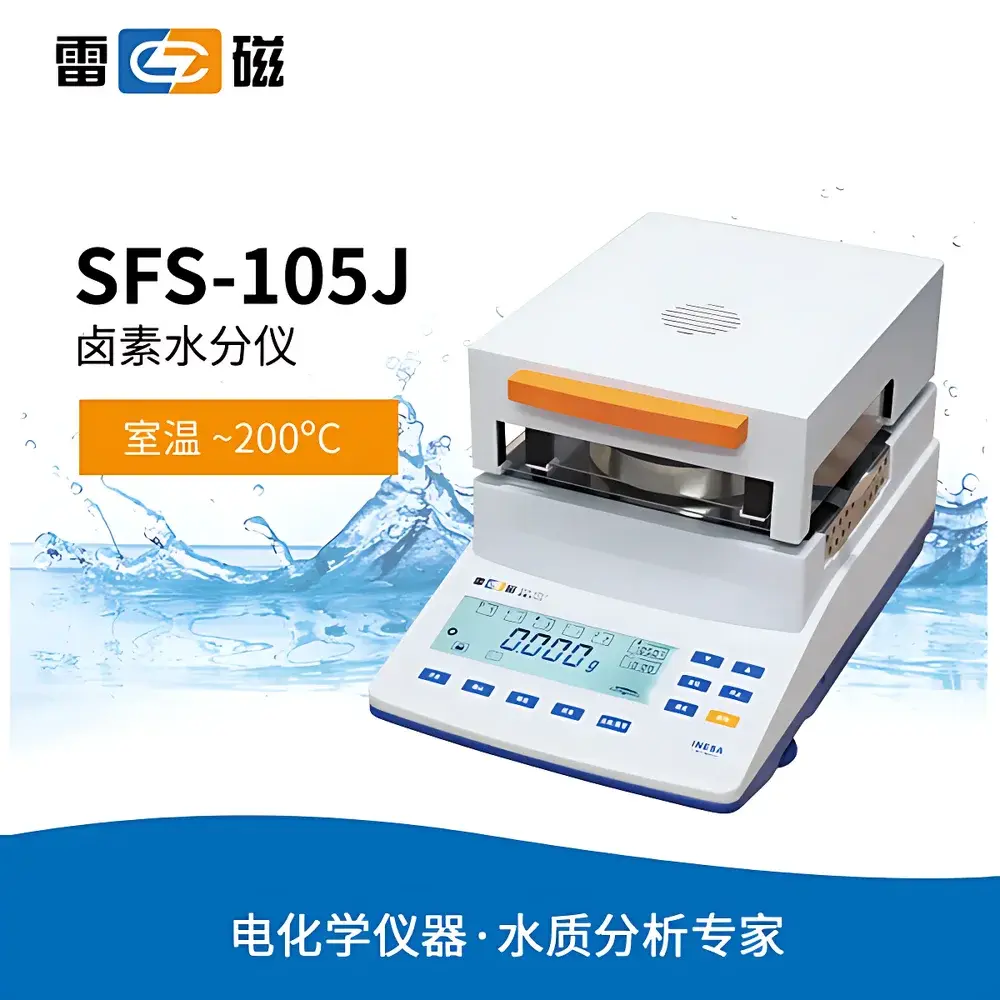
Leici SFS-105J Halogen Moisture Analyzer
| Brand | Leici |
|---|---|
| Model | SFS-105J Halogen Moisture Analyzer |
| Origin | Shanghai, China |
| Manufacturer Type | Original Equipment Manufacturer (OEM) |
| Regional Classification | Domestic (China) |
| Price Range | USD 700 – 1,400 (FOB Shanghai) |
| Weighing Range | 0.2 g – 110 g |
| Readability (d) | 5 mg |
| Verification Scale Interval (e) | 10 mg |
| Moisture Readability | 0.02 % |
| Accuracy Class | Class II (per OIML R76) |
| Minimum Sample Mass | 1 g |
| Heating Source | Circular Halogen Lamp |
| Temperature Control Range | Ambient to 200 °C |
| Sample Pan Diameter | 90 mm |
| Real-time Display | Temperature, Elapsed Heating Time, Dynamic Moisture %, Dry Matter %, ATRO Dry Basis %, ATRO Wet Basis % |
| Drying Modes | Standard, Rapid, Gradual |
| Endpoint Detection | Automatic, Manual, Semi-Automatic |
| Communication Interface | RS-232 for Thermal Printer Output |
| Power Supply | 220 V ± 10 %, 50/60 Hz |
| Dimensions (W×D×H) | 330 × 200 × 200 mm |
| Net Weight | 5.8 kg |
Overview
The Leici SFS-105J Halogen Moisture Analyzer is a precision laboratory instrument engineered for rapid, reproducible determination of moisture content in solid and semi-solid materials using the loss-on-drying (LOD) principle. It employs a high-efficiency circular halogen lamp as its heating source, delivering uniform thermal radiation across the sample surface—minimizing temperature gradients and ensuring consistent evaporation kinetics. Unlike infrared or convection-based systems, halogen heating provides faster thermal response and superior energy transfer efficiency, enabling accurate moisture quantification within minutes rather than hours. The analyzer operates in full compliance with standardized gravimetric methodologies referenced in ASTM D4457, ISO 712, AOAC 950.46, and USP <731>, making it suitable for routine quality control in pharmaceutical, food, chemical, and agricultural laboratories where regulatory traceability and method validation are required.
Key Features
- High-resolution LCD interface with intuitive navigation—designed for operation without specialized training
- Circular halogen heating system with precise digital temperature regulation (ambient to 200 °C in 1 °C increments)
- Real-time dynamic display of moisture %, dry matter %, ATRO dry basis %, and ATRO wet basis %
- Three programmable drying modes: Standard (optimized for balance of speed and accuracy), Rapid (for low-moisture, thermally stable samples), and Gradual (for heat-sensitive or heterogeneous matrices)
- Configurable endpoint detection: Fully automatic (based on mass stabilization criteria), manual (user-defined time termination), or semi-automatic (mass-change threshold + time limit)
- Integrated safety interlocks: Audible/visual alerts for lid-open events, over-temperature conditions, and unstable weighing pan status
- RS-232 serial port compliant with standard ESC/POS printer protocols for GLP-compliant hard-copy reporting
Sample Compatibility & Compliance
The SFS-105J accommodates a broad range of sample types—including powders, granules, pellets, pastes, and thin films—with a minimum recommended mass of 1 g and maximum capacity of 110 g. Its 90 mm stainless-steel weighing pan ensures mechanical stability and thermal resilience during repeated heating cycles. The instrument meets OIML R76 Class II accuracy requirements for non-automatic weighing instruments and supports audit-ready documentation when paired with compliant printers and laboratory information management systems (LIMS). While not inherently 21 CFR Part 11–compliant, its deterministic measurement logic, immutable timestamped output, and absence of user-modifiable internal calibration coefficients allow integration into validated workflows under GMP/GLP frameworks when accompanied by appropriate procedural controls and electronic record retention policies.
Software & Data Management
The SFS-105J operates autonomously without proprietary software—data is generated and displayed locally via embedded firmware. All measurements include timestamps, temperature logs, and mass decay profiles visible on-screen during analysis. RS-232 output delivers ASCII-formatted reports containing sample ID (user-entered), start/end times, initial/final mass, calculated moisture %, drying mode, set temperature, and endpoint condition. These outputs are compatible with third-party data aggregation tools, Excel-based QA templates, and validated LIMS interfaces. No firmware updates or cloud connectivity are provided; this design prioritizes operational continuity, cybersecurity isolation, and long-term maintenance predictability in regulated environments.
Applications
- Pharmaceutical raw material release testing (excipients, APIs, granules)
- Food industry QC: flour, sugar, dairy powders, coffee, spices, pet food
- Agricultural product grading: grains, seeds, feedstuffs, compost substrates
- Chemical manufacturing: catalysts, resins, pigments, desiccants
- Plastics and polymer processing: hygroscopic resin pre-drying verification
- Research laboratories performing method development for LOD correlation studies against Karl Fischer titration
FAQ
What standards does the SFS-105J comply with for moisture analysis?
It aligns with gravimetric principles defined in ISO 712, ASTM D4457, and AOAC 950.46. Its weighing performance conforms to OIML R76 Class II specifications.
Can the instrument be calibrated for specific materials like starch or cellulose?
No built-in material-specific calibration curves exist; however, users may establish validated drying protocols—including temperature ramp profiles and endpoint criteria—for repeatable results per material class.
Is external software required to export or archive results?
No. All data are accessible via RS-232 and require only a standard serial printer or terminal emulator for capture and storage.
Does the halogen lamp require periodic replacement?
Yes—the rated service life is approximately 5,000 hours; replacement is a field-serviceable procedure requiring no recalibration.
How is temperature uniformity verified across the sample pan?
Uniformity is ensured by the symmetric geometry of the circular halogen emitter and reflective cavity design; validation can be performed using calibrated thermal imaging or multi-point PT100 probe mapping per internal SOP.
Related Products






