
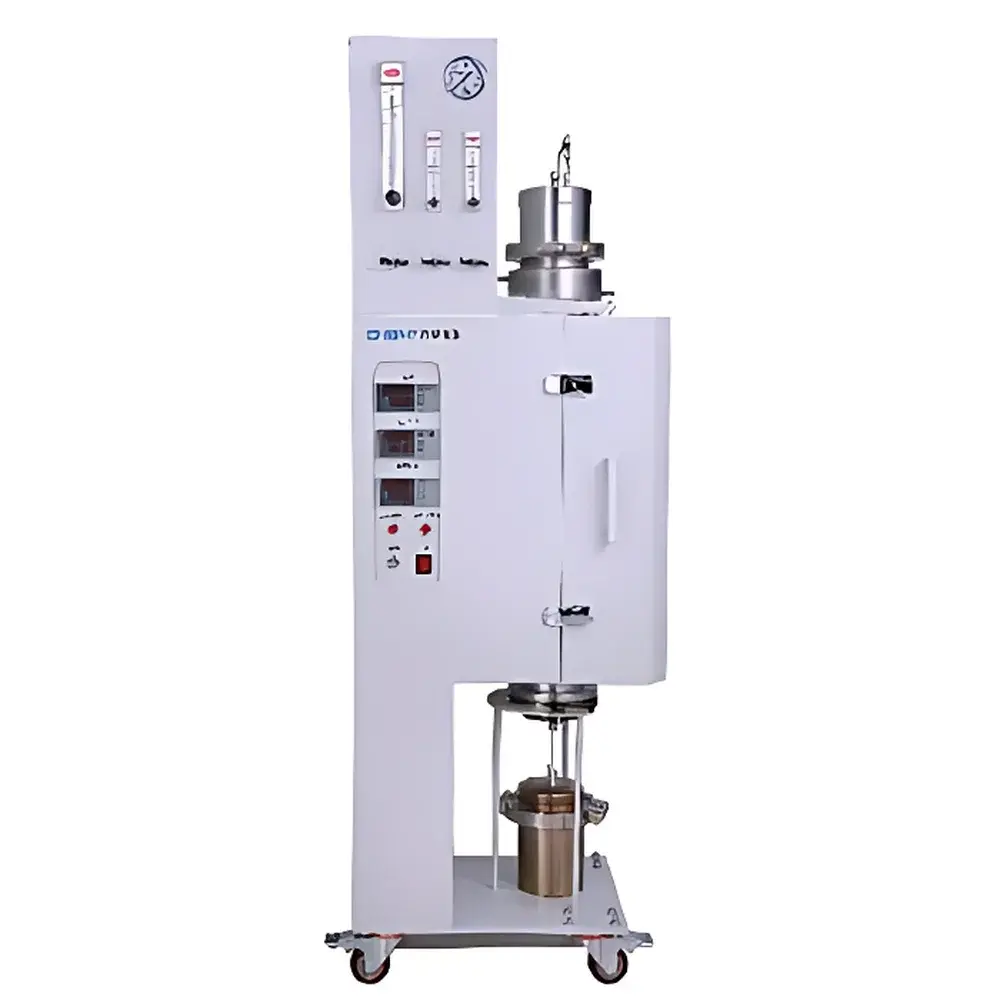
CHEMn TFG-1200-100-II-300 Catalytic Calcination and Reduction System
| Brand | CHEMn |
|---|---|
| Origin | Anhui, China |
| Model | TFG-1200-100-II-300 |
| Max. Operating Temperature | 1200 °C |
| Max. Working Pressure | 100 kPa (gauge) |
| Catalyst Loading Capacity | Customizable |
| Compliance | Designed for laboratory-scale catalyst activation under controlled atmospheres |
Overview
The CHEMn TFG-1200-100-II-300 Catalytic Calcination and Reduction System is a precision-engineered thermal processing platform designed for the controlled thermal activation, calcination, and reduction of heterogeneous catalysts under programmable gas atmospheres. It operates on the principle of uniform resistive heating within a high-stability alumina or quartz tube furnace, coupled with integrated mass flow-controlled gas delivery, pressure regulation, and real-time thermal profiling. Unlike conventional muffle furnaces or static tube reactors, this system incorporates axial gas distribution manifolds, optimized thermal zoning, and a vertically oriented reaction zone to mitigate radial temperature gradients and ensure consistent thermal exposure across the entire catalyst bed—critical for preserving structural integrity and catalytic phase homogeneity during high-temperature treatment.
Key Features
- High-temperature capability up to 1200 °C with ±1 °C thermal stability over 24-hour continuous operation, enabled by dual-zone PID-controlled heating elements and high-emissivity ceramic insulation.
- Integrated pressure-regulated gas handling system supporting up to three independent mass flow controllers (MFCs), enabling precise switching between inert (N₂, Ar), oxidizing (air, O₂), and reducing (H₂, CO, NH₃) atmospheres with ramped partial pressure profiles.
- Modular vertical reactor configuration with removable quartz or high-purity alumina reaction tubes (ID: 100 mm standard; custom diameters available), facilitating rapid catalyst loading/unloading and minimizing powder entrainment during gas purging.
- Active venting and condensate management pathway integrated into the downstream gas train, allowing continuous removal of volatile decomposition products, water vapor, or solvent residues without manual intervention or system shutdown.
- Touchscreen HMI with preloaded thermal programs (e.g., ramp-hold-cool sequences), data logging at 1-second intervals, and USB export of time-stamped temperature/pressure/flow datasets compliant with GLP documentation requirements.
- Compact footprint (W × D × H: 850 × 720 × 1650 mm) with front-access service paneling, ergonomic height-adjustable loading port, and optional fume hood integration kit for safe handling of reactive or toxic process gases.
Sample Compatibility & Compliance
The system accommodates powdered, extruded, pelleted, or monolithic catalyst forms across a wide compositional range—including transition metal oxides (e.g., Co₃O₄, NiO), supported noble metals (Pt/Al₂O₃, Pd/C), zeolites, MOFs, and perovskite-type oxides. Catalyst loading volume is fully customizable based on tube geometry and required GHSV (gas hourly space velocity), with typical configurations supporting 5–100 g batches under dynamic flow conditions. All wetted components comply with ASTM F86 for surface passivation of metallic gas fittings and ISO 8573-1 Class 2 compressed air purity standards where applicable. The control firmware supports audit trail generation and user-level access permissions aligned with FDA 21 CFR Part 11 readiness for regulated environments.
Software & Data Management
The embedded controller runs CHEMn’s CatalystTherm™ v3.2 firmware, offering sequence-based program editing, real-time overlay of up to four process variables (T₁, P, MFC₁, MFC₂), and automatic fault detection (e.g., thermocouple open-circuit, pressure deviation >±5 kPa). Raw data are stored in CSV format with metadata headers (operator ID, program name, timestamp, calibration IDs). Optional Ethernet connectivity enables remote monitoring via secure HTTPS interface and integration into centralized LIMS or MES platforms using Modbus TCP protocol. All thermal profiles can be exported in .xml format for cross-platform validation against ASTM E2550 (standard test method for decomposition kinetics by thermogravimetry).
Applications
- Thermal stabilization of impregnated catalyst precursors prior to sulfidation or carburization.
- Controlled oxide reduction under dilute H₂/N₂ mixtures for selective formation of metallic nanoparticles without sintering.
- Decomposition studies of nitrate- or carbonate-based catalyst precursors to determine optimal calcination onset temperatures.
- Regeneration of spent FCC or hydrodesulfurization catalysts under simulated industrial conditions (T, P, gas composition).
- Multi-step activation protocols involving sequential oxidation-reduction cycles to engineer surface oxygen vacancies in mixed-metal oxides.
- Method development for catalyst qualification per ISO 11912-1 (determination of active surface area by chemisorption) and ASTM D3907 (fluid catalytic cracking activity testing).
FAQ
What types of gases are compatible with the TFG-1200-100-II-300 system?
The system supports N₂, Ar, O₂, H₂, CO, NH₃, and synthetic air. Optional corrosion-resistant MFCs and stainless-316L gas lines are recommended for H₂S or Cl₂-containing mixtures.
Can the system operate under vacuum or sub-atmospheric pressure?
No—it is rated for gauge pressures from ambient up to +100 kPa. Vacuum operation requires external pumping and is not part of the standard configuration.
Is catalyst loading performed horizontally or vertically?
Loading is vertical through the top flange, enabling gravity-assisted packing and minimizing segregation in multi-component catalyst beds.
Does the system include temperature calibration traceability?
Yes—each unit ships with NIST-traceable calibration certificate for the main furnace thermocouple (Type S) and optional secondary sensor (Type K) for gradient verification.
How is safety managed during exothermic reduction steps?
The controller implements dynamic flow throttling and temperature hold-back logic if rate-of-rise exceeds user-defined thresholds (e.g., >5 °C/min), and all gas lines feature fail-safe solenoid valves with purge interlocks.



