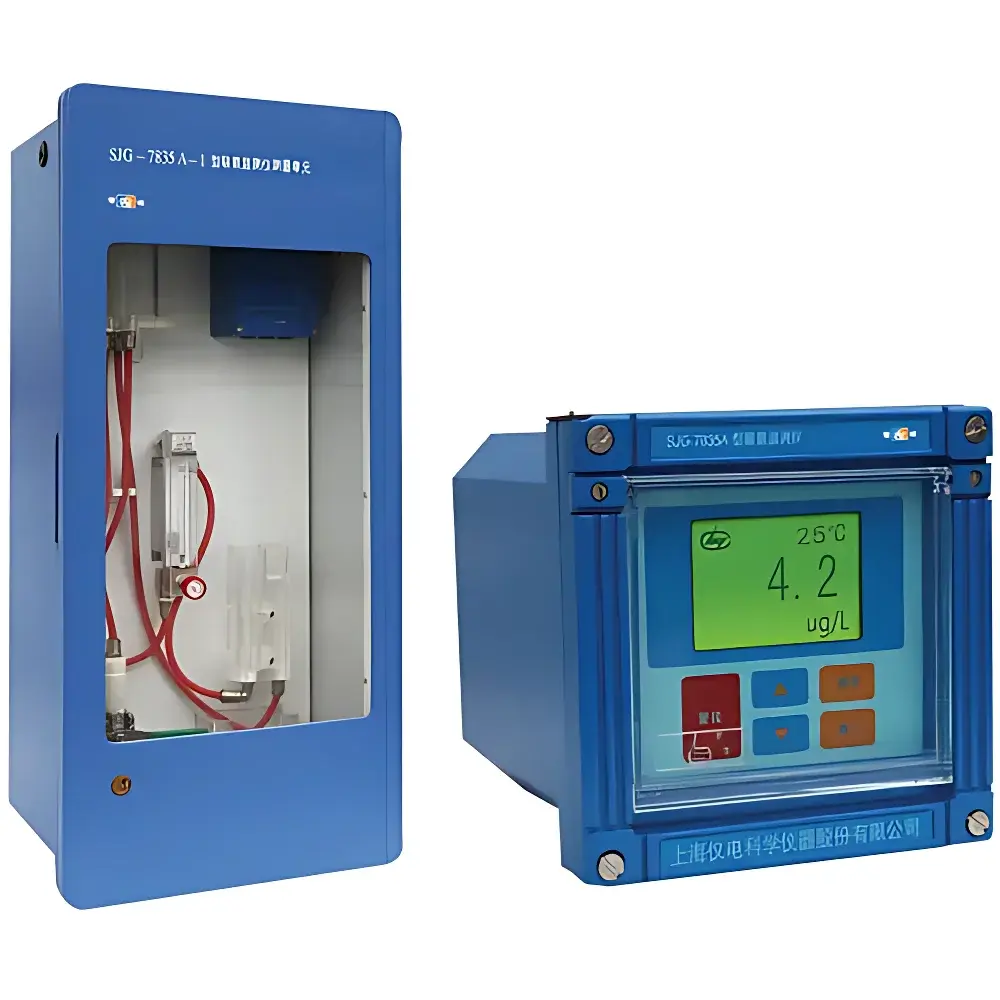
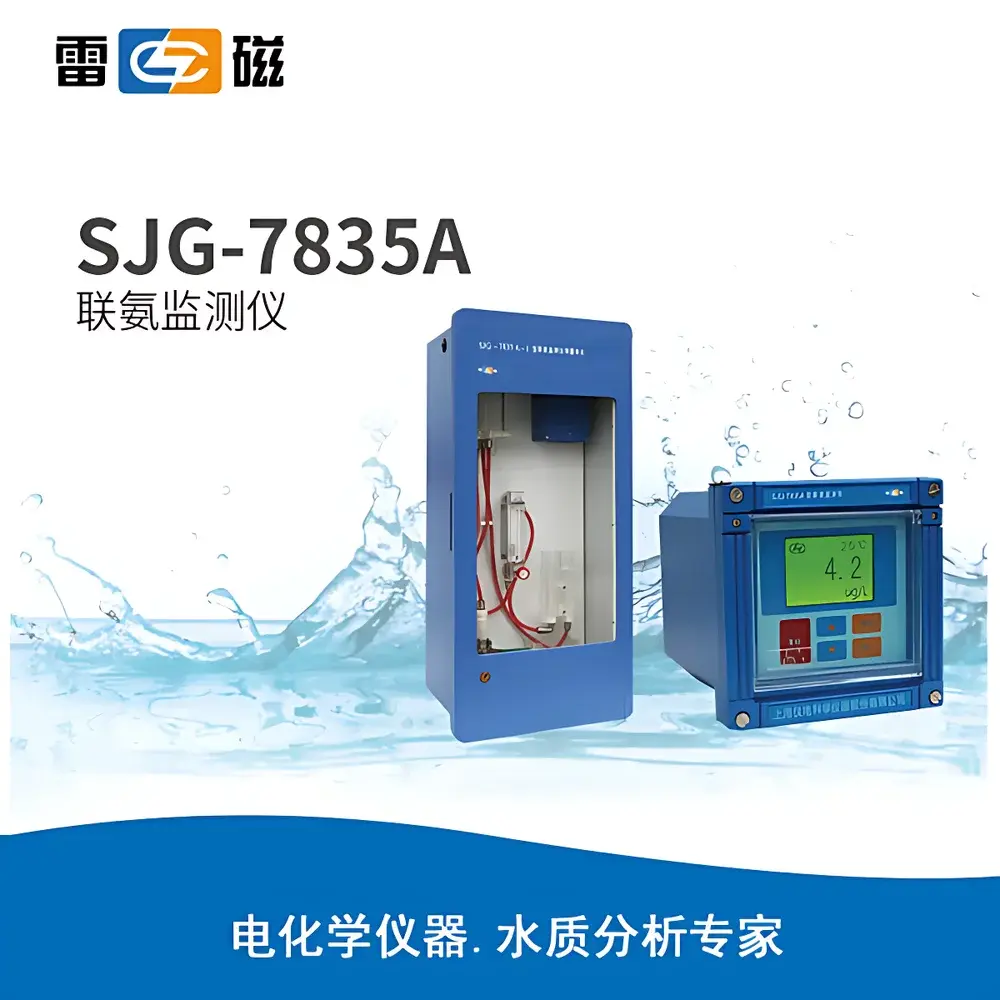
Leichi SJG-7835A Hydrazine Online Monitor
| Brand | Leichi |
|---|---|
| Origin | Shanghai, China |
| Manufacturer Type | Manufacturer |
| Country of Origin | China |
| Model | SJG-7835A |
| Price | Upon Request |
| Measurement Range (N₂H₄) | 0–199.9 µg/L |
| Temperature Range | −10.0–120.0 °C |
| N₂H₄ Resolution | 0.1 µg/L |
| Temperature Resolution | 0.1 °C |
| Basic Instrument Error (N₂H₄) | ±5.0 µg/L |
| Basic Instrument Error (Temperature) | ±0.5 °C (0.0–60.0 °C), ±1.0 °C (other) |
| Electronic Unit Error (N₂H₄) | ±2.0 µg/L |
| Electronic Unit Error (Temperature) | ±0.3 °C |
| Repeatability | ≤2.5 µg/L |
| Electronic Unit Stability | ±2.0 µg/L / 24 h |
| 90% Response Time | 3 min |
| Enclosure Rating | IP65 |
| Power Supply | AC (220 ± 22) V, (50 ± 0.5) Hz |
| Dimensions (Electronic Unit) | 144 × 144 × 150 mm |
| Weight (Electronic Unit) | 2 kg |
| Dimensions (Measurement Unit) | 224 × 288 × 628 mm |
| Weight (Measurement Unit) | 10 kg |
| Output | Isolated 4–20 mA DC (configurable upper/lower limits) |
| Communication Interface | RS-232 or RS-485 (user-selectable) |
| Auto Temperature Compensation | Yes |
| Alarm Function | Programmable high/low limit alarm |
| Power Failure Protection | Yes |
Overview
The Leichi SJG-7835A Hydrazine Online Monitor is an industrial-grade, continuous online analyzer engineered for precise, real-time quantification of hydrazine (N₂H₄) concentration in boiler feedwater systems within thermal power plants. It operates on the principle of amperometric electrochemical detection—utilizing a selective membrane-covered sensor that generates a current proportional to dissolved hydrazine concentration under controlled polarization conditions. This measurement methodology ensures high specificity in complex aqueous matrices containing common interferences such as dissolved oxygen, iron oxides, and trace copper ions. The instrument integrates dual-sensor architecture with built-in temperature compensation to maintain accuracy across dynamic operating conditions—from cold start-up to full-load steam generation (−10.0 to 120.0 °C). Designed for uninterrupted operation in demanding plant environments, the SJG-7835A supports closed-loop chemical dosing control by delivering stable, low-drift analog output signals compliant with standard DCS integration protocols.
Key Features
- Microcontroller-based embedded system with intuitive Chinese-language menu interface—optimized for operator efficiency in localized utility environments
- Simultaneous real-time display of hydrazine concentration (µg/L) and process temperature (°C) on a high-contrast LCD screen
- Automatic temperature compensation algorithm calibrated per ASTM D859 and IAPWS TR-10-01 guidelines to correct for kinetic and thermodynamic effects on sensor response
- Configurable high/low limit alarms with relay outputs for integration into plant-wide safety interlock systems
- Isolated 4–20 mA DC analog output with fully programmable zero/span settings—enabling seamless interfacing with distributed control systems (DCS) and PLCs
- Standard serial communication via user-selectable RS-232 or RS-485 interface—supporting Modbus RTU protocol for remote configuration and diagnostics
- IP65-rated enclosure for both electronic and measurement units—ensuring resistance to dust ingress and water jets during routine washdown or humid ambient exposure
- Non-volatile memory with power-fail protection retains calibration coefficients, alarm thresholds, and operational history during unexpected outages
Sample Compatibility & Compliance
The SJG-7835A is validated for use in deaerated, high-purity boiler feedwater streams with conductivity < 1 µS/cm and pH 8.8–9.6—conditions typical of drum-type and once-through supercritical boilers. It meets mechanical and environmental requirements specified in IEC 61000-6-2 (immunity) and IEC 61000-6-4 (emissions). While not certified to UL 61010-1 or ATEX for hazardous locations, its design conforms to general-purpose industrial safety practices outlined in GB/T 18268.1–2010 (Chinese national standard equivalent to IEC 61326-1). Calibration traceability follows NIST-traceable hydrazine reference standards; routine verification aligns with ISO/IEC 17025-compliant laboratory procedures when performed by authorized service providers.
Software & Data Management
The device does not include proprietary PC software but supports direct parameter configuration and data logging via terminal emulation (e.g., PuTTY) over serial connection. All configuration changes—including span adjustment, alarm setpoints, and temperature compensation parameters—are logged with timestamp and user ID (if enabled via external authentication layer). The 4–20 mA output signal is linearly mapped to the full 0–199.9 µg/L range, enabling straightforward integration into SCADA historians. For regulatory compliance in GxP environments, third-party data acquisition systems may be configured to capture audit trails meeting FDA 21 CFR Part 11 requirements—including electronic signatures, change history, and read-only archive export.
Applications
- Continuous monitoring of hydrazine residual in high-pressure boiler feedwater circuits to optimize oxygen scavenging without overfeed-induced corrosion or carryover risks
- Feedwater treatment optimization in fossil-fueled and combined-cycle power plants—supporting ASME PTC 19.11 and EPRI TR-102091 recommendations for feedwater chemistry control
- Validation of hydrazine injection pump performance and dosing valve integrity through trend analysis of concentration stability over time
- Supporting root cause analysis during tube leak investigations by correlating transient N₂H₄ spikes with condensate polisher breakthrough events
- Integration into digital twin models of feedwater systems where real-time hydrazine data feeds predictive maintenance algorithms for economizer and superheater tube life estimation
FAQ
What is the recommended calibration frequency for the SJG-7835A in continuous operation?
Calibration should be verified weekly using certified hydrazine standard solutions (e.g., 50 µg/L and 150 µg/L); full two-point calibration is advised every 30 days or after sensor replacement.
Can the instrument operate reliably at elevated temperatures above 100 °C?
Yes—the measurement unit is rated for continuous exposure up to 120.0 °C; however, long-term drift increases above 105 °C, necessitating more frequent verification per ASME B31.1 Annex F guidance.
Is the sensor compatible with phosphate-treated or AVT-R (reducing) chemistry regimes?
The amperometric sensor demonstrates robust performance in AVT-R environments; for phosphate-based programs, verify absence of catalytic metal ions (e.g., Cu²⁺ > 5 ppb) which may accelerate electrode fouling.
Does the SJG-7835A support HART communication protocol?
No—only RS-232/RS-485 serial interfaces are provided; HART-capable transmitters require external signal converters for integration.
How is sensor maintenance performed in situ?
The flow-through sensor cell allows wet-maintenance without system isolation; cleaning is performed using dilute citric acid (2% w/w) followed by DI water flush—per manufacturer’s Maintenance Manual Rev. 3.2.