
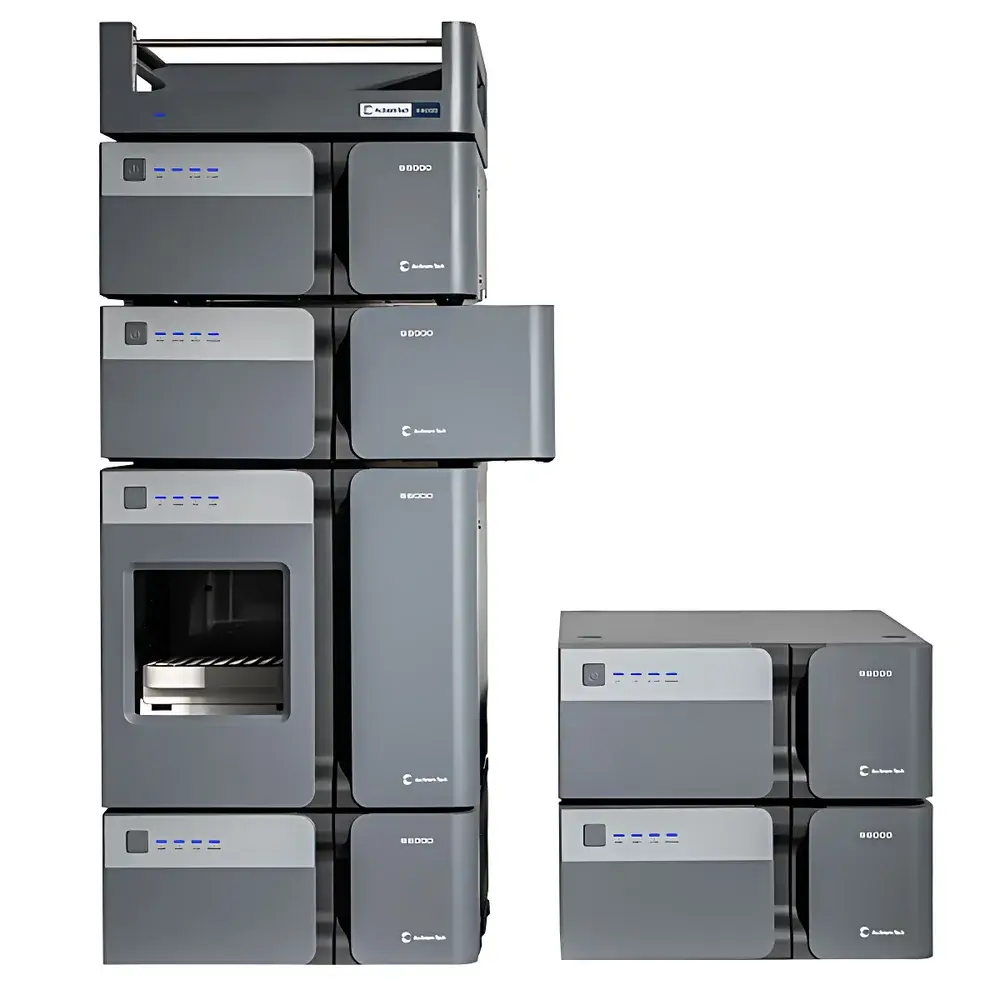
Acchrom-Tech S6000 Comprehensive Two-Dimensional Liquid Chromatography System
| Brand | Acchrom-Tech |
|---|---|
| Origin | Liaoning, China |
| Manufacturer Type | Original Equipment Manufacturer (OEM) |
| Country of Origin | China |
| Model | S6000 Comprehensive 2D-LC System |
| Instrument Type | Conventional High-Performance Liquid Chromatograph (HPLC) |
| Application Scope | General-purpose complex matrix analysis |
| Regulatory Compliance | Supports GB 5009.296–2023 and GB 5009.82–2016 for fat-soluble vitamins |
Overview
The Acchrom-Tech S6000 Comprehensive Two-Dimensional Liquid Chromatography (2D-LC) System is an engineered solution for high-resolution separation of chemically complex samples where conventional one-dimensional HPLC reaches resolution limits. It operates on the principle of orthogonal separation—utilizing two independent chromatographic dimensions with distinct retention mechanisms (e.g., reversed-phase in the first dimension and hydrophilic interaction or size exclusion in the second), connected via a precise, low-dead-volume interface. This architecture enables significant expansion of peak capacity (nc = n1 × n2), improved selectivity, and enhanced detection sensitivity for co-eluting analytes. Unlike serial “heart-cutting” 2D-LC configurations, the S6000 supports both comprehensive (LC×LC) and selective heart-cutting (LC-LC) modes, allowing users to configure method strategies based on analytical objectives—whether broad profiling of unknown components or targeted isolation and purification of specific fractions.
Key Features
- Modular dual-pump architecture with independently programmable flow rates and gradient profiles for each dimension, ensuring precise solvent delivery and reproducible retention time alignment.
- Integrated switching valve system with sub-200 ns actuation timing and <1.2 µL internal volume, minimizing band broadening during fraction transfer between dimensions.
- Temperature-controlled column compartments (±0.1 °C stability) for both dimensions to maintain retention time reproducibility across extended runs.
- Dual UV/Vis detectors (optional diode array upgrade) with configurable wavelength settings per dimension, enabling simultaneous spectral verification and peak purity assessment.
- Hardware-level synchronization between data acquisition, valve actuation, and gradient initiation—critical for accurate modulation period definition in comprehensive 2D-LC.
Sample Compatibility & Compliance
The S6000 is validated for routine analysis of fat-soluble vitamins (A, D, E, K) in food, dietary supplements, and biological matrices. It fully supports Chinese national standard methods including GB 5009.82–2016 (determination of vitamin A and E in foods) and GB 5009.296–2023 (determination of vitamin D2 and D3 in foods). The system’s hardware design meets ISO/IEC 17025 general requirements for testing laboratories, and its operational parameters are traceable to NIST-traceable reference standards. All fluidic pathways employ biocompatible stainless steel and PEEK components rated for pH 1.5–12.5 and pressures up to 600 bar, accommodating a wide range of mobile phase chemistries—including aqueous-organic gradients, ion-pairing reagents, and volatile buffers compatible with downstream LC-MS coupling.
Software & Data Management
The Acchrom-Tech ChromaSight™ workstation is a GxP-ready software platform developed in accordance with ICH-GCP and FDA 21 CFR Part 11 requirements. It provides full electronic signature capability, role-based user access control, and immutable audit trails for all method edits, sequence changes, and raw data processing events. The software features dedicated 2D-LC visualization tools—including contour plot generation, cross-correlation peak tracking, and automated modulation period calibration. All chromatograms, 2D heatmaps, and integration reports are stored in vendor-neutral .cdf (NetCDF) format, ensuring long-term data integrity and interoperability with third-party chemometric packages (e.g., MATLAB, SIMCA, R). Raw data files include embedded metadata (instrument configuration, environmental conditions, operator ID) to satisfy GLP/GMP documentation requirements.
Applications
- Simultaneous quantification of retinol (vitamin A), α-tocopherol (vitamin E), cholecalciferol (vitamin D3), and ergocalciferol (vitamin D2) in fortified dairy products and infant formula.
- Separation and identification of vitamin isomers (e.g., 25(OH)D2/25(OH)D3) in human serum using heart-cut 2D-LC coupled to tandem mass spectrometry.
- Removal of phospholipid interferences from plasma extracts prior to LC-MS/MS analysis of lipid-soluble antioxidants.
- Method development for regulatory compliance testing under CNAS-accredited laboratory workflows.
- High-throughput screening of natural product extracts where overlapping peaks hinder accurate peak assignment in 1D-HPLC.
FAQ
Does the S6000 support both comprehensive and heart-cut 2D-LC modes?
Yes—the system includes configurable valve routing logic and software-defined modulation timing to implement either LC×LC or selective LC-LC workflows without hardware modification.
Is the ChromaSight™ software compliant with 21 CFR Part 11?
Yes—it includes electronic signatures, audit trail logging, and user permission hierarchies validated per FDA guidance for regulated environments.
Can the S6000 be interfaced with mass spectrometers?
Yes—its low-flow split capabilities, pulse-free eluent delivery, and compatibility with volatile mobile phases enable seamless coupling to single-quadrupole, triple-quadrupole, and Q-TOF mass spectrometers.
What column chemistries are recommended for vitamin analysis?
Typical configurations include C30 reversed-phase (1st dimension) for vitamin isomer separation and C18 or HILIC (2nd dimension) for orthogonal resolution of polar metabolites or degradation products.
Is remote monitoring and method transfer supported?
Yes—ChromaSight™ supports secure TLS-encrypted remote access, centralized method library management, and exportable method templates for cross-instrument deployment across multi-site laboratories.
Related Products






