
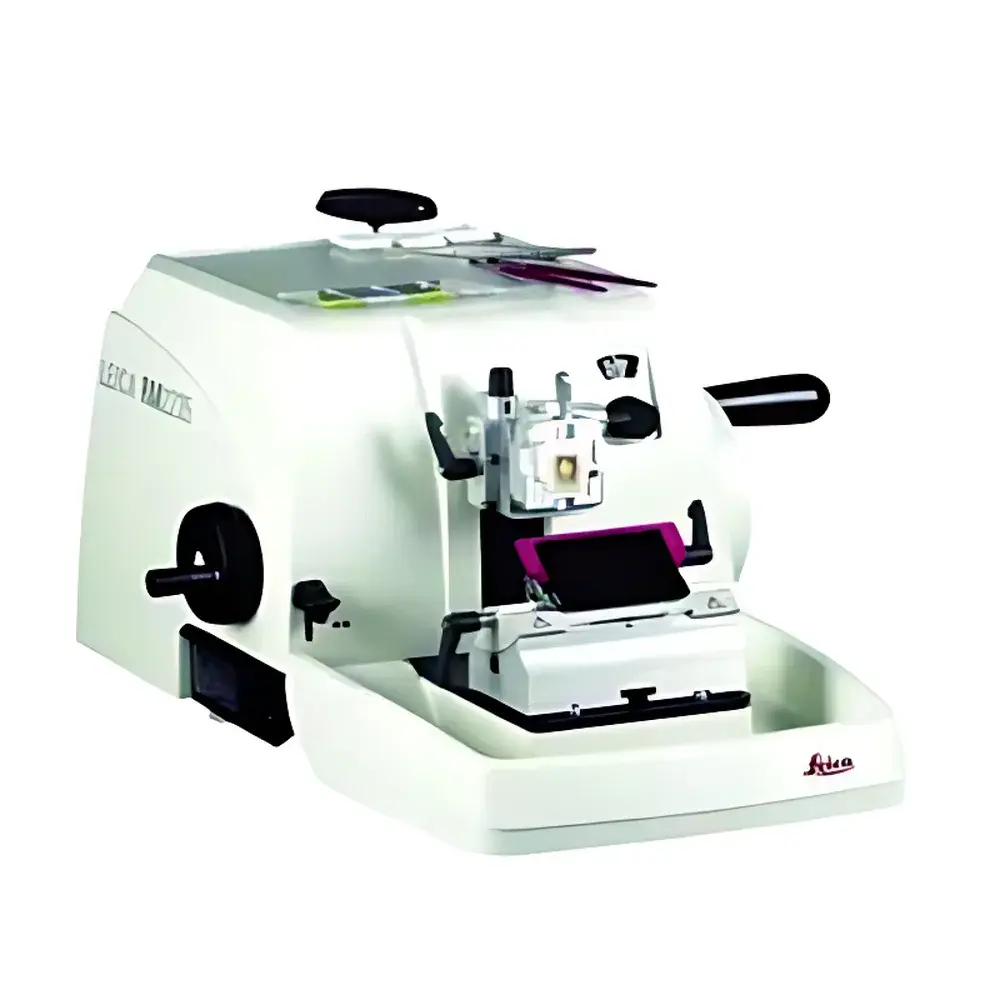
Leica RM2235 Manual Rotary Microtome
| Brand | Leica |
|---|---|
| Origin | Germany |
| Model | RM2235 |
| Type | Manual Rotary Microtome |
| Application | Routine Paraffin Sectioning, Hard Tissue Cutting |
| Construction | Integrated Safety Shield, Magnetic Waste Tray Base |
| Ergonomics | Optimized Handwheel Geometry, Adjustable Specimen Orientation |
Overview
The Leica RM2235 is a precision-engineered manual rotary microtome designed for consistent, high-fidelity sectioning of paraffin-embedded tissue specimens in routine histopathology laboratories. Operating on the fundamental principle of controlled linear advancement of the specimen block against a stationary sharp blade—combined with precise rotational motion of the handwheel—the RM2235 delivers reproducible section thicknesses from 1 µm to 60 µm with mechanical accuracy and tactile feedback essential for skilled manual operation. Its robust cast-metal frame, vibration-damped base, and optimized kinematic linkage ensure minimal deflection during cutting, supporting diagnostic-grade morphology preservation. Unlike automated or semi-automated systems, the RM2235 prioritizes operator control, making it especially suited for laboratories where manual dexterity, adaptability to variable tissue hardness, and immediate real-time adjustment are critical to workflow integrity.
Key Features
- Manual rotary mechanism with dual-scale micrometer adjustment (coarse and fine) for precise section thickness selection across the full 1–60 µm range.
- Ergonomic handwheel with optimized diameter and surface texture to reduce operator fatigue during extended use—engineered for consistent torque transmission and smooth rotation.
- Integrated polycarbonate safety shield that fully encloses the knife area during operation, compliant with IEC 61000-6-2/6-4 electromagnetic compatibility and EN 61000-1-2 occupational safety guidelines.
- Compact, low-profile base incorporating a permanent magnetic waste tray—designed to capture metal shavings and paraffin debris without adhesives or consumables, facilitating rapid cleanup and minimizing cross-contamination risk.
- Specimen stage with three-axis adjustment (X/Y translation and tilt), enabling fine alignment of the tissue block relative to the knife edge—critical for oblique or angled sectioning protocols.
- Tool-free blade holder compatible with standard disposable steel knives and reusable tungsten-carbide blades, supporting both cost-efficient daily use and high-demand applications.
Sample Compatibility & Compliance
The RM2235 accommodates standard 30 mm × 30 mm × 50 mm paraffin blocks as well as harder materials including decalcified bone, resin-embedded samples, and certain polymer-based specimens—provided appropriate blade type and sectioning speed are selected. It meets CE marking requirements under the EU Medical Device Regulation (MDR 2017/745) as an ancillary device for in vitro diagnostic procedures. While not classified as an IVD device itself, its design supports GLP-compliant histology workflows when integrated into validated laboratory SOPs. The instrument’s mechanical repeatability and absence of electronic controllers simplify IQ/OQ documentation for regulated environments requiring traceable, non-software-dependent instrumentation.
Software & Data Management
As a purely mechanical manual microtome, the Leica RM2235 does not incorporate embedded software, firmware, or digital interfaces. This architecture eliminates dependencies on operating systems, cybersecurity patches, or data export protocols—making it inherently compatible with FDA 21 CFR Part 11–compliant environments where audit-trail generation is managed externally via laboratory information systems (LIS) or electronic lab notebooks (ELN). All operational parameters—including section thickness, orientation angle, and blade usage—are recorded manually in logbooks or imported into LIMS via standardized template entry. Optional accessories such as the Leica CM1950 cryostat integration kit allow coordinated cold-sectioning workflows without compromising mechanical reliability.
Applications
- Routine diagnostic histology in clinical pathology labs performing H&E and special stain preparation.
- Academic and pharmaceutical research requiring manual sectioning of heterogeneous or brittle tissues where motorized feed may induce compression artifacts.
- Training laboratories emphasizing development of manual sectioning technique, blade handling, and tissue-block trimming proficiency.
- Core facilities supporting multi-user access with minimal calibration overhead and long-term mechanical stability.
- Resource-constrained settings where electrical dependency, software licensing, or network connectivity pose operational limitations.
FAQ
Does the RM2235 support serial sectioning with automatic ribbon collection?
No—it is a manual rotary microtome without motorized feed or ribbon-handling mechanisms. Serial sections must be collected manually using standard forceps or brush techniques.
Is the specimen stage compatible with Leica’s standard cassette holders and orientation markers?
Yes—the stage accepts all Leica-compatible specimen chucks, including the universal “U”-type chuck and optional graduated orientation inserts for anatomical plane alignment.
Can the RM2235 be used for frozen sectioning?
Not directly—the instrument lacks cryogenic cooling capability. However, it may be placed inside a cold room (4 °C) for limited low-temperature paraffin work; dedicated frozen sectioning requires a cryomicrotome such as the Leica CM3050 S.
What maintenance intervals are recommended for long-term performance?
Daily cleaning of the waste tray and knife area; monthly lubrication of the advance mechanism with ISO VG 10 mineral oil; annual inspection of handwheel backlash and stage alignment by authorized Leica service personnel.
Is technical documentation available in English and compliant with ISO 13485 requirements?
Yes—Leica provides bilingual (EN/DE) user manuals, service schematics, and risk management files (ISO 14971) upon request through certified distributors, supporting quality system audits in GMP and CAP-accredited laboratories.



