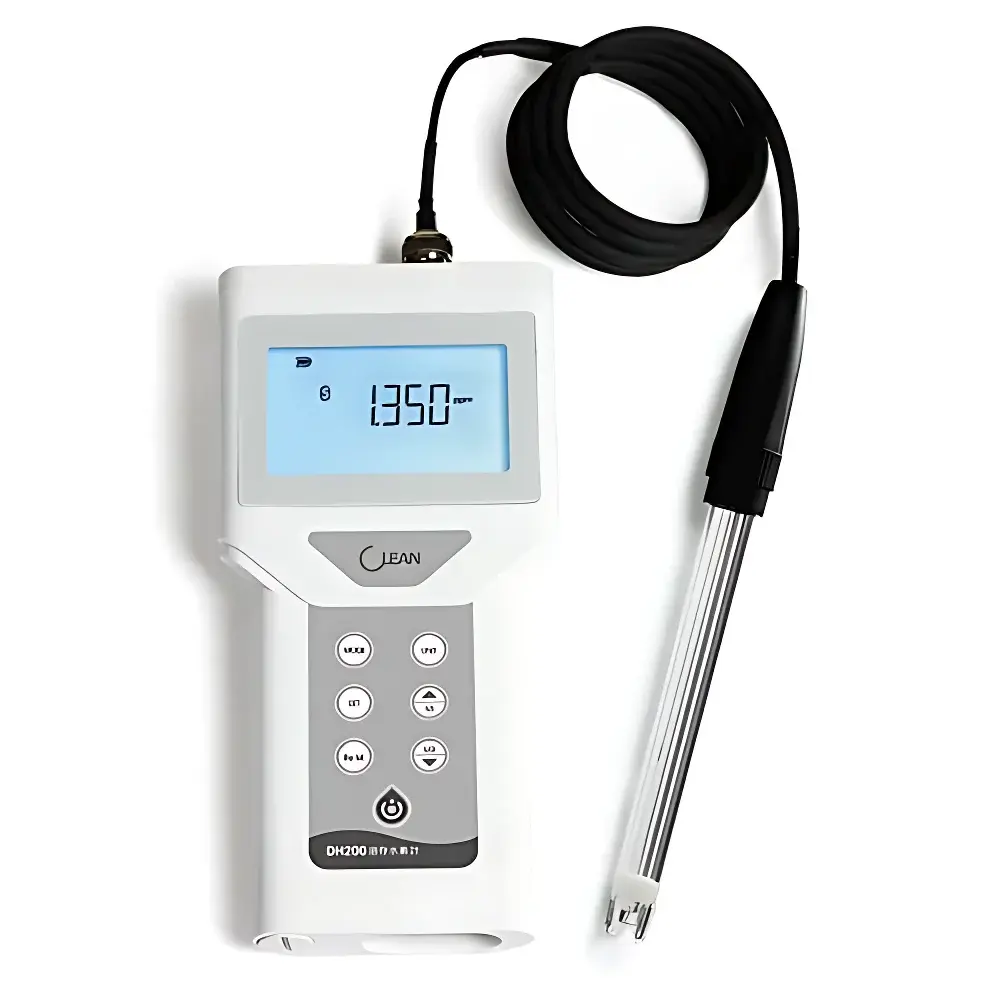
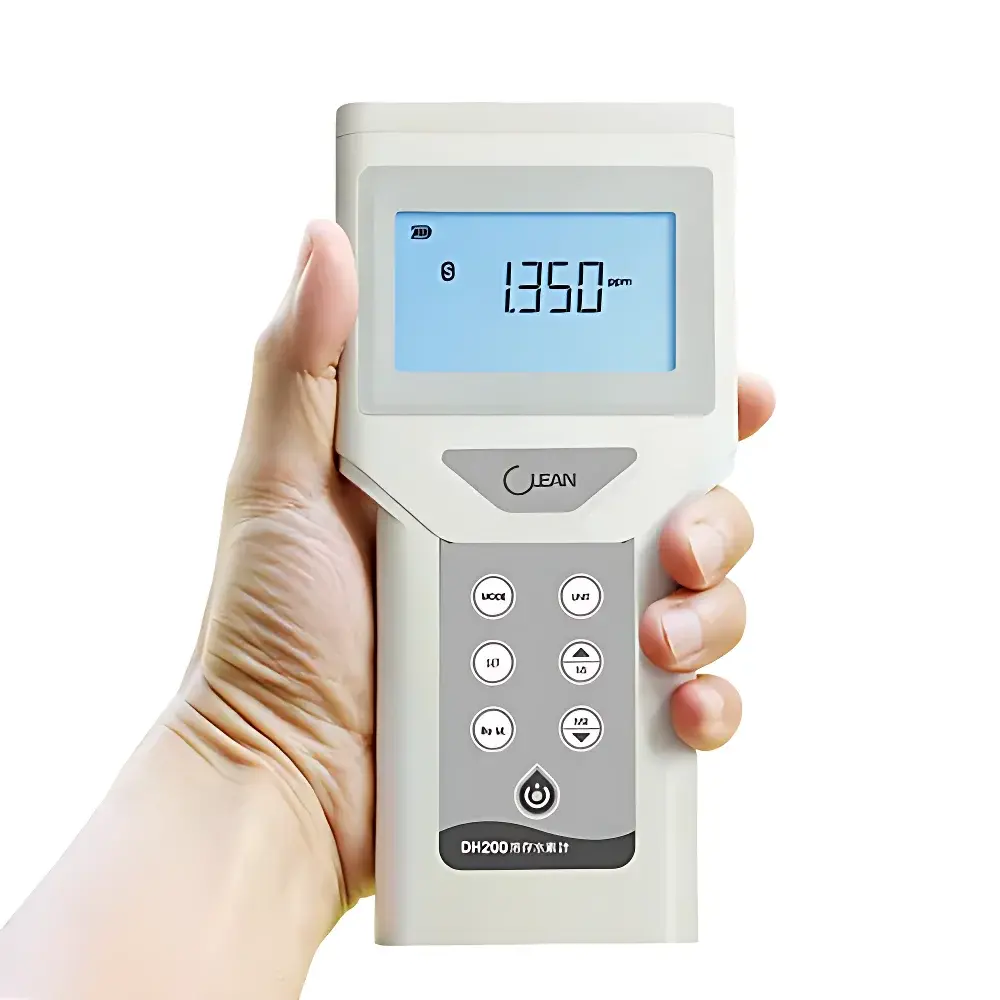
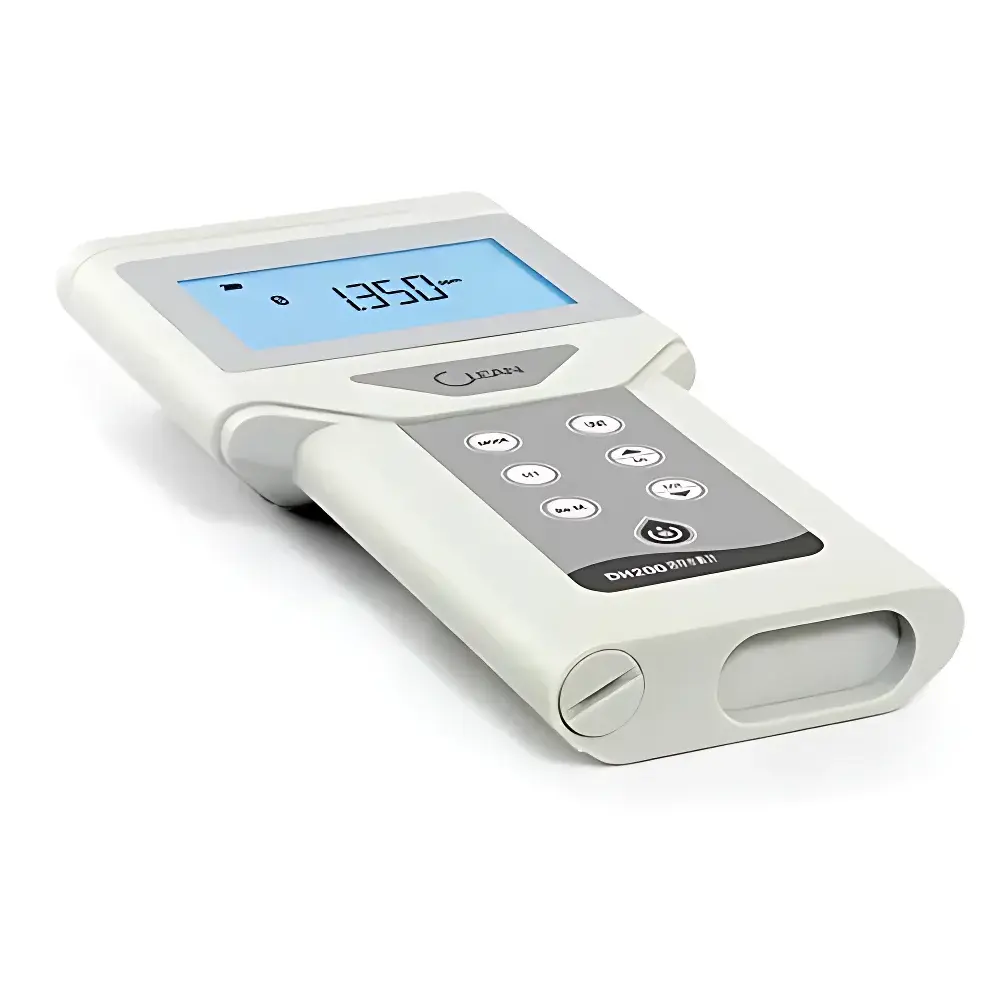
CLEAN DH200 Portable Dissolved Hydrogen Analyzer
| [Brand | CLEAN |
|---|---|
| Origin | Taiwan |
| Model | DH200 |
| Measurement Range (H₂) | 0.000–2.000 ppm (0–2000 ppb) |
| Resolution | 0.001 ppm |
| Accuracy | ±0.002 ppm |
| ORP Range | −2000 to +2000 mV |
| Power | 2 × AAA batteries |
| Operating Temp | −5 °C to 60 °C |
| Dimensions | 94 × 190 × 35 mm (W×L×H) |
| Weight | 250 g] |
Overview
The CLEAN DH200 Portable Dissolved Hydrogen Analyzer is a precision electrochemical instrument engineered for quantitative measurement of molecular hydrogen (H₂) concentration in aqueous solutions—specifically designed for hydrogen-rich water (HRW), electrolyzed reduced water (ERW), and laboratory-prepared H₂-saturated media. Unlike optical or gas-phase detection methods, the DH200 employs a proprietary Clark-type polarographic dissolved hydrogen sensor with a gas-permeable membrane and platinum working electrode, enabling direct, real-time quantification of dissolved H₂ via amperometric current response proportional to partial pressure. This principle ensures high specificity for H₂ over other reducing species (e.g., sulfides, ascorbate), critical for biomedical and process validation applications where interference must be minimized. The device operates without calibration drift under routine use due to its factory-calibrated, temperature-compensated sensor architecture and built-in reference electrode stability—making it suitable for field deployment, QC verification, and academic research environments requiring trace-level H₂ data integrity.
Key Features
- High-resolution dissolved hydrogen measurement: 0.001 ppm resolution across 0.000–2.000 ppm range (equivalent to 0–2000 ppb), meeting analytical requirements for distinguishing sub-saturation (≤0.8 ppm), therapeutic-range (≥1.0 ppm), and supersaturated (>1.6 ppm) HRW formulations.
- Integrated dual-parameter capability: Simultaneous measurement of dissolved hydrogen concentration and oxidation-reduction potential (ORP) from −2000 mV to +2000 mV—enabling correlation analysis between H₂ content and redox state, essential for evaluating electrolytic water generation efficiency and stability.
- Zero-maintenance sensor design: Factory-calibrated Clark-type H₂ electrode with 12-month functional warranty; no user recalibration required under normal operating conditions per ISO 15197:2013 Annex C guidelines for electrochemical biosensor stability.
- Rugged portable form factor: Compact dimensions (94 × 190 × 35 mm), lightweight construction (250 g), and battery-powered operation (2 × AAA) support benchtop, clinical, or on-site validation workflows without AC dependency.
- Environmental resilience: Certified operational performance from −5 °C to 60 °C and relative humidity <90%, validated for use in humidified laboratory enclosures, hospital hydration stations, and industrial HRW production line sampling points.
Sample Compatibility & Compliance
The DH200 is validated for direct immersion measurement in deionized water, mineral water, electrolyzed alkaline water, and stabilized nanobubble-enriched HRW matrices. It excludes turbid suspensions, viscous colloids, or highly chlorinated municipal tap water without pre-filtration (0.45 µm PVDF membrane recommended). Sensor response time (t₉₀) is ≤60 seconds in 25 °C DI water per ASTM D888-22 Section 7.2 for dissolved gas sensors. While not certified to IEC 61000-6-3 for EMC emissions, the device complies with CE marking requirements for low-voltage instrumentation (2014/35/EU) and meets RoHS 2011/65/EU material restrictions. Data output adheres to GLP-compliant documentation practices when paired with external logging software; however, the standalone unit does not include 21 CFR Part 11 audit trail functionality.
Software & Data Management
The DH200 operates as a self-contained measurement terminal with no embedded memory or USB interface. All readings are displayed in real time on a high-contrast LCD screen with auto-hold function. For traceable data capture, users may manually record values alongside timestamps and sample identifiers in standardized lab notebooks or LIMS-compatible spreadsheets. When deployed in regulated research settings (e.g., university IRB-approved hydrogen therapy trials), the instrument supports ALCOA+ data integrity principles through documented operator training, controlled environmental monitoring during use, and periodic sensor performance verification using certified H₂-spiked reference standards (e.g., NIST-traceable 1.0 ppm H₂ in ultrapure water).
Applications
- Validation of HRW generation systems: Quantitative assessment of hydrogen yield from PEM electrolyzers, magnesium-based reactors, and nanobubble infusion units prior to clinical or commercial distribution.
- Pharmaceutical and nutraceutical R&D: Monitoring H₂ decay kinetics in packaged HRW under accelerated aging conditions (40 °C/75% RH) per ICH Q1A(R2) stability protocols.
- Academic hydrogen biology studies: Acquisition of baseline H₂ concentration data in cell culture media, animal drinking water, and ex vivo tissue perfusates for dose-response correlation modeling.
- Quality assurance in manufacturing: In-process verification of dissolved H₂ levels at filling lines for bottled HRW products, supporting compliance with internal SOPs aligned with ISO 22000 food safety management criteria.
- Educational demonstration: Real-time visualization of H₂ solubility limits, temperature-dependent saturation curves, and ORP shifts during electrolysis experiments in undergraduate chemistry and biomedical engineering labs.
FAQ
Does the DH200 require daily calibration?
No. The sensor is factory-calibrated and maintains accuracy within ±0.002 ppm over 12 months under standard storage and usage conditions. A one-point verification using a known H₂ standard is recommended before critical measurements.
Can it measure hydrogen in carbonated or flavored water?
Not reliably. Dissolved CO₂ and organic additives may interfere with membrane permeability and electrode kinetics. Use only with purified, non-carbonated, low-conductivity aqueous matrices.
What is the expected sensor lifetime?
The polarographic electrode is warranted for 12 months of continuous use or 500 measurement cycles, whichever occurs first, assuming proper storage in moistened protective cap and avoidance of drying or mechanical abrasion.
Is temperature compensation automatic?
Yes. The internal thermistor provides real-time temperature correction per the Henry’s law-derived solubility coefficient for H₂ in water (0.00077 mol·kg⁻¹·bar⁻¹ at 25 °C), ensuring ppm values reflect true dissolved concentration independent of ambient fluctuations.
How does it differ from ORP-only meters?
ORP measures overall redox tendency but cannot distinguish H₂ from other reductants (e.g., vitamin C, polyphenols). The DH200 specifically detects molecular H₂ via selective membrane diffusion and electrochemical reduction—providing analyte-specific quantification essential for mechanistic hydrogen research.