
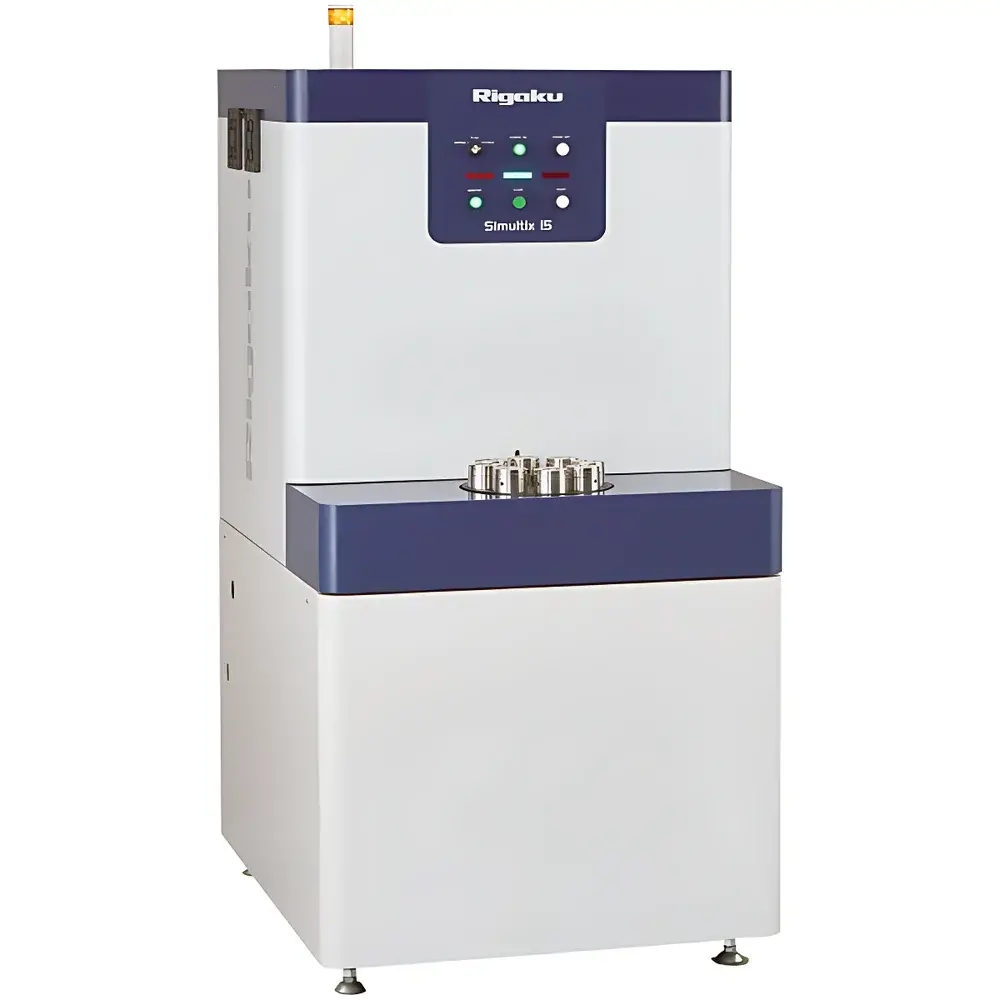
Rigaku Simultix15 Wavelength Dispersive X-Ray Fluorescence Spectrometer
| Brand | Rigaku |
|---|---|
| Origin | Japan |
| Model | Simultix15 |
| Instrument Type | Simultaneous Multi-Channel WDXRF |
| X-ray Tube Power | 4 kW |
| Elemental Range | Beryllium (Be, Z=4) to Uranium (U, Z=92) |
| Simultaneous Channels | Up to 40 elements |
| Detector System | High-speed pulse-height-analyzed proportional counters with background subtraction circuitry |
| Vacuum System | Dual-stage vacuum pump with auto-stabilized vacuum control |
| Software | Multi-tasking, multi-window FP (Fundamental Parameters) quantification software with Chinese GUI (localized for operator interface only) |
Overview
The Rigaku Simultix15 is a high-performance wavelength dispersive X-ray fluorescence (WDXRF) spectrometer engineered for routine and research-grade elemental analysis of solid, powder, and fused-bead samples. Operating on Bragg diffraction principles, the instrument utilizes crystal monochromators to separate characteristic X-ray emissions by wavelength—enabling precise, interference-free detection of emitted photons from elements across the periodic table (Z = 4 to Z = 92). Unlike energy dispersive (EDXRF) systems, WDXRF delivers superior spectral resolution (<10 eV at Mn Kα), lower detection limits (sub-ppm for many matrix-matched standards), and exceptional long-term stability—making it the preferred platform for certified reference material (CRM) validation, regulatory compliance testing, and high-accuracy compositional certification in metallurgy, cement, geology, and advanced materials R&D.
Key Features
- Simultaneous multi-channel detection architecture supports real-time quantification of up to 40 elements in a single measurement cycle—eliminating sequential scanning delays and enhancing throughput in high-volume QA/QC environments.
- Fixed-channel background subtraction technology minimizes spectral overlap and matrix-induced continuum interference, significantly improving accuracy for trace-level light elements (e.g., Na, Mg, Al, Si) and heavy-element line overlaps (e.g., Pb L-lines vs. As K-lines).
- 4 kW high-power X-ray tube with dual-anode configuration (Rh/Sc) ensures optimized excitation efficiency across light-to-heavy element ranges, while thermally stabilized optics maintain angular reproducibility within ±0.0005° over extended operation.
- Dual-stage vacuum system combines a rotary vane pump and turbomolecular pump to achieve and sustain <1 Pa operating pressure in the goniometer chamber—critical for stable Be–F line detection and minimizing air absorption losses below 1 keV.
- Integrated auto-vacuum stabilization algorithm continuously monitors chamber pressure and dynamically adjusts pumping rates, ensuring consistent spectral response without manual intervention or calibration drift.
Sample Compatibility & Compliance
The Simultix15 accommodates standard 32 mm and 40 mm diameter pressed pellets, fused borate beads, and polished metal blocks—compatible with ASTM E1361, ISO 21087, and JIS Z 3211 protocols for XRF sample preparation. Its optical path design conforms to IEC 61000-6-3 EMC requirements and incorporates interlocked radiation shielding meeting IEC 61010-1 safety standards. For regulated industries—including pharmaceutical excipient testing (USP ), RoHS-compliant electronics screening (IEC 62321-5), and GLP-certified geochemical laboratories—the system supports audit-ready data logging, user access controls, and electronic signature workflows when paired with optional 21 CFR Part 11–compliant software modules.
Software & Data Management
The Simultix15 runs on Rigaku’s proprietary multi-tasking, multi-window FP quantification software—localized in Chinese for operator interface but fully compliant with international reporting formats (ASTM E1621, ISO 12844). The software implements fundamental parameter algorithms with matrix correction libraries for common industrial matrices (steels, silicates, polymers, catalysts), enabling accurate calibration-free analysis where certified standards are unavailable. All raw intensity data, peak deconvolution parameters, vacuum logs, and tube operating conditions are stored in vendor-neutral ASCII and XML formats. Built-in report templates support customizable PDF export with embedded metadata (sample ID, analyst, timestamp, instrument serial number), and optional database integration enables direct linkage to LIMS platforms via ODBC drivers.
Applications
- Quantitative bulk analysis of alloy composition in aerospace-grade Ni-based superalloys and Ti-6Al-4V feedstock powders.
- High-precision determination of CaO/SiO₂/Al₂O₃/Fe₂O₃ ratios in Portland cement clinker for kiln process optimization.
- Trace contaminant screening (Pb, Cd, Hg, Cr⁶⁺, Br) in polymer components per EU RoHS Directive Annex II thresholds.
- Geochemical mapping of rare earth element (REE) distribution in monazite and bastnäsite concentrates for critical mineral resource assessment.
- Verification of coating thickness and composition in multilayer thin-film solar absorbers using FP-based layer modeling.
FAQ
Does the Simultix15 require daily recalibration?
No—its fixed-channel optics and temperature-compensated goniometer maintain alignment stability for ≥6 months under typical lab conditions; annual verification against NIST SRM 2711a is recommended.
Can it analyze liquids or loose powders directly?
Yes, with optional vacuum-compatible sample cups and spin-table accessories; however, quantitative accuracy requires matrix-matched standards or FP modeling with proper particle-size correction.
Is remote diagnostics supported?
Yes—Rigaku Remote Service (RRS) provides secure TLS-encrypted access for firmware updates, spectral diagnostics, and real-time troubleshooting by certified field engineers.
What maintenance intervals apply to the X-ray tube and vacuum pumps?
The 4 kW Rh-target tube has a rated lifetime of ≥20,000 hours; the turbomolecular pump requires bearing inspection every 18 months, and the rotary vane pump oil should be replaced quarterly under continuous operation.
How does the background subtraction patent improve light-element detection?
It employs dedicated anti-coincidence channels adjacent to each primary analyte channel to dynamically subtract Bremsstrahlung and scatter contributions—raising effective signal-to-background ratio by 3–5× for Be, B, C, N, and O lines.
Related Products




