
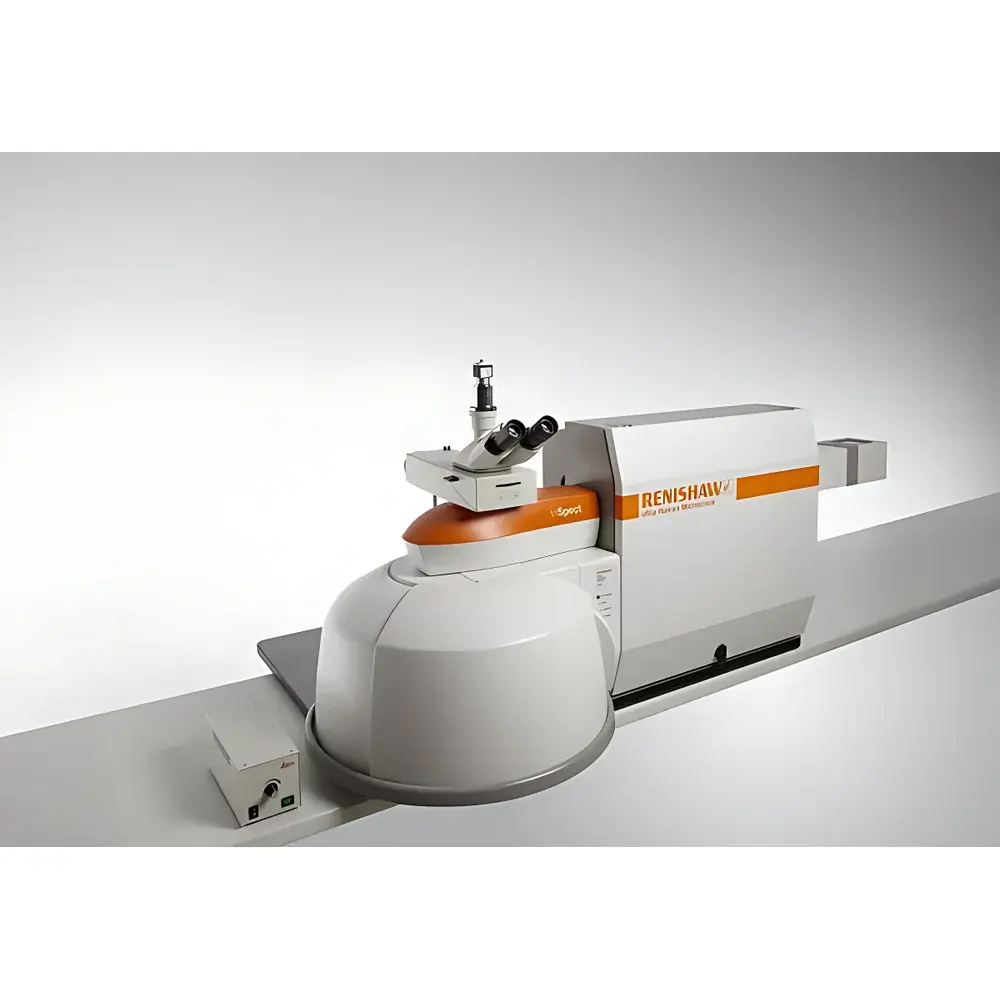
Renishaw inVia™ InSpect Confocal Raman Microscope
| Brand | Renishaw |
|---|---|
| Origin | United Kingdom |
| Model | inVia™ InSpect |
| Instrument Type | Confocal Raman Microspectrometer |
| Spectral Range | 100–4000 cm⁻¹ |
| Spectral Resolution | ≤1 cm⁻¹ |
| Spatial Resolution | XY ≈ 1 µm, Z ≈ 2 µm |
| Low-Wavenumber Capability | down to 10 cm⁻¹ |
| Spectral Reproducibility | < ±0.1 cm⁻¹ |
Overview
The Renishaw inVia™ InSpect Confocal Raman Microscope is a purpose-engineered analytical platform designed for forensic science laboratories requiring high-fidelity, non-destructive chemical identification at microscopic spatial scales. Built upon the proven optical and mechanical architecture of the inVia series, the InSpect variant integrates optimized excitation pathways, enhanced signal collection efficiency, and forensic-specific automation to address the unique challenges of trace evidence analysis—where sample integrity, minimal preparation, and unambiguous molecular fingerprinting are paramount. Operating on the principle of inelastic light scattering (Raman effect), the system delivers vibrational spectra that serve as chemically specific signatures for organic residues, inorganic pigments, glass compositions, crystalline polymorphs, and micro-particles. Its confocal optical design enables axial sectioning with sub-micron depth discrimination, allowing selective interrogation of individual layers, inclusions, or interfaces within heterogeneous specimens without physical sectioning.
Key Features
- Forensic-Optimized Automation: Fully automated data acquisition workflows—including auto-focus, laser power optimization, spectral calibration, and stage navigation—reduce operator dependency and ensure consistent, audit-ready results across shifts and personnel.
- Dual-Laser Excitation (532 nm & 785 nm): Integrated wavelength selection without optical realignment; enables optimal resonance enhancement or fluorescence suppression depending on sample matrix—critical for dyed fibers, aged paints, or biological residues.
- True Confocal Architecture: Motorized pinhole control and precision Z-stage enable depth-resolved spectroscopy with <2 µm axial resolution, essential for layered paint chips, coated pharmaceutical tablets, or multi-stratum trace deposits.
- Multi-Modal Microscopy Integration: Seamless switching between brightfield, darkfield, and polarized light imaging modes—correlated in real time with Raman mapping—supports morphological context for spectral interpretation per ASTM E2849 and ISO/IEC 17025-compliant reporting.
- High-Sensitivity Detection: Back-illuminated deep-depletion CCD detector with thermoelectric cooling (−70 °C) ensures low-noise performance for weak scatterers such as carbon nanotubes or low-concentration illicit substances.
- Particle Analysis Suite: Automated particle detection, size distribution quantification, and component classification via multivariate curve resolution (MCR) and hierarchical cluster analysis (HCA), compliant with FBI’s SWGMAT guidelines for microtrace characterization.
Sample Compatibility & Compliance
The inVia InSpect accepts intact, uncoated, and unlabeled specimens—including fragile glass fragments, sintered ceramics, crystalline powders, polymer films, and embedded textile fibers—without vacuum requirements or conductive coating. Its low-wavenumber capability (down to 10 cm⁻¹) supports analysis of lattice modes in minerals and heavy-metal oxides relevant to soil or gunshot residue profiling. The system conforms to ISO/IEC 17025:2017 requirements for test method validation, supports 21 CFR Part 11-compliant electronic signatures and audit trails when used with WiRE™ 6 software, and meets GLP documentation standards for chain-of-custody integrity in evidentiary workflows.
Software & Data Management
WiRE™ 6 software provides a unified interface for instrument control, spectral processing, hyperspectral imaging, and statistical analysis. It includes built-in spectral libraries (e.g., NIST RM 8010, Forensic Spectral Database v3.2), peak deconvolution tools, and PCA/MCR-based chemometric modeling. All raw spectra, metadata (operator ID, timestamp, environmental conditions), and processing history are stored in vendor-neutral HDF5 format, ensuring long-term readability and interoperability with LIMS platforms. Software validation packages—including IQ/OQ documentation and change control logs—are available to support laboratory accreditation under EN ISO/IEC 17025 and UKAS M3001 frameworks.
Applications
- Identification of unknown particulates in latent print residues or explosive post-blast debris
- Layer-by-layer chemical stratigraphy of automotive paint chips for vehicle association
- Non-destructive verification of counterfeit pharmaceutical tablet coatings and active ingredient distribution
- Crystal phase differentiation in illicit drug seizures (e.g., distinguishing fentanyl citrate from fentanyl hydrochloride)
- Micro-spatial mapping of pigment degradation products in questioned document inks
- Compositional analysis of glass refractive index correlates via Raman shift ratios (SiO₂ network modes)
FAQ
Is the inVia InSpect compatible with existing forensic LIMS systems?
Yes—via configurable API endpoints and standardized output formats (CSV, HDF5, JCAMP-DX), enabling bidirectional data exchange with major LIMS vendors including Thermo Fisher SampleManager and LabVantage.
Can the system perform quantitative analysis for mixture composition?
Quantitative assessment is supported through internal standard calibration, partial least squares (PLS) regression models, and certified reference materials (e.g., NIST SRM 2241); accuracy is validated per ISO 11843-2 for limit-of-detection determination.
Does the instrument require routine recalibration by service engineers?
No—fully automated daily self-calibration using integrated neon and argon emission lines ensures wavenumber stability within ±0.05 cm⁻¹; only annual performance verification is recommended per manufacturer’s service schedule.
What training options are available for new forensic analysts?
Renishaw offers tiered training: Level 1 (2-day fundamentals), Level 2 (3-day advanced chemometrics), and Level 3 (customized method development workshops), all aligned with ASCLD/LAB competency assessment criteria.




