
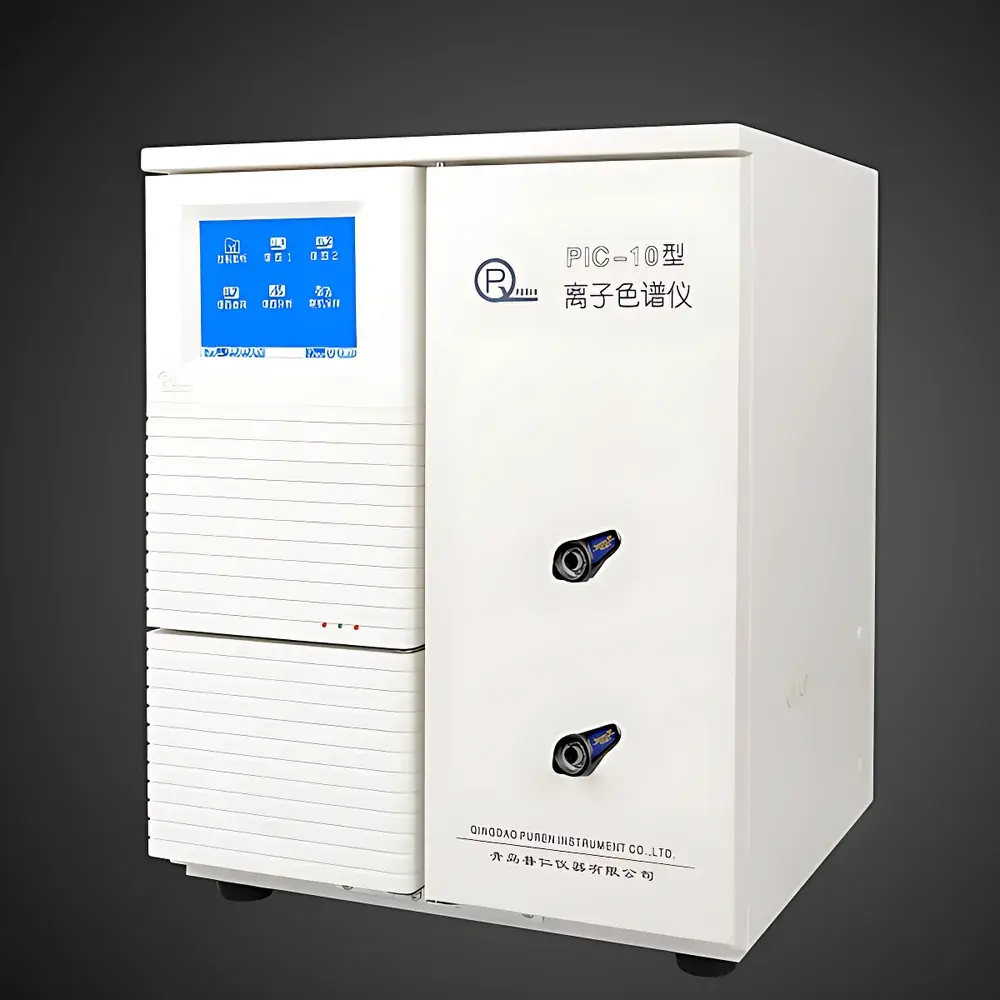
PUREN PIC-10 Dual-Channel Ion Chromatograph
| Brand | PUREN |
|---|---|
| Model | PIC-10 Dual-System |
| Origin | Shandong, China |
| Manufacturer Type | Direct Manufacturer |
| Instrument Type | Laboratory Benchtop Ion Chromatograph |
| Application Scope | General-Purpose Anion/Cation Analysis |
| Pump Max Pressure | 0–42.0 MPa (Stainless Steel), 0–36 MPa (PEEK) |
| Flow Rate Range | 0.001–9.999 mL/min (0.001 mL/min increments) |
| Eluent Flow Rate | 0.7–1.5 mL/min |
| Max Operating Pressure | 10 MPa (1500 psi) |
| Temperature Control Range | 5–65 °C |
| Temperature Stability | ±0.004 °C |
| Eluent Concentration Range | 1.92–4.8 mM |
Overview
The PUREN PIC-10 Dual-Channel Ion Chromatograph is a high-integrity, dual-system benchtop instrument engineered for simultaneous, independent analysis of inorganic anions and cations in complex aqueous matrices. Based on suppressed conductivity detection and high-pressure eluent delivery, the system employs classical ion-exchange chromatography principles—separation via electrostatic interaction between analyte ions and functionalized stationary phase, followed by quantitative detection using a low-noise, temperature-stabilized dual-electrode conductivity detector. Its integrated dual-pump, dual-valve, dual-detection architecture eliminates cross-contamination risks and enables true parallel operation—allowing one channel to run anion analysis while the other concurrently performs cation separation under optimized conditions. Designed for compliance-critical environments, the PIC-10 meets fundamental operational requirements for GLP-aligned laboratories and supports method validation per ISO 17025 and EPA Method 300.0/317.0 frameworks.
Key Features
- Dual independent flow paths with synchronized high-precision PEEK and stainless-steel dual-plunger reciprocating pumps, each controlled by adaptive microprocessor algorithms to minimize pulsation (<0.1% RSD) across the full 0.001–9.999 mL/min range.
- Integrated column-oven and detector-cell thermostatic module (patent CN200820019630.3), maintaining ±0.004 °C temperature stability over 5–65 °C—critical for retention time reproducibility and baseline drift control.
- Chemically resistant PEEK fluidic path (imported components), compatible with pH 0–14 eluents—including strong acids (e.g., HNO₃), strong bases (e.g., KOH), and 100% organic modifiers (e.g., methanol, acetonitrile)—enabling robust gradient elution and column regeneration protocols.
- Continuous electrochemical membrane suppressor with auto-regeneration capability; delivers stable background conductance (<0.3 µS), low noise (10,000 injections lifetime without manual maintenance or chemical replacement.
- 24-bit high-resolution analog-to-digital conversion with real-time baseline correction, negative peak recognition, and automated integration parameter optimization—ensuring consistent quantitation across diverse sample types.
Sample Compatibility & Compliance
The PIC-10 accepts liquid samples within standard IC-compatible concentration ranges: environmental waters (tap, surface, wastewater), biological extracts (urine, serum digests), pharmaceutical excipients, petrochemical process streams, and geological leachates. It supports direct injection of filtered (0.22 µm nylon) aqueous samples with total dissolved solids <100 ppm. Regulatory alignment includes support for USP , ASTM D4327 (anions in water), ISO 10304-1 (determination of dissolved anions), and FDA 21 CFR Part 11-compliant audit trail functionality when paired with validated software configurations. All hardware components meet CE/IEC 61010-1 safety standards for laboratory instrumentation.
Software & Data Management
The dedicated PUREN IC Workstation operates via high-speed USB 2.0 digital interface and provides full instrument control—including pump gradient programming, valve sequencing, oven setpoint adjustment, and detector gain calibration—from a single Windows-based GUI. The software implements role-based user access control, electronic signature capture, and immutable audit trails for all method changes, data processing events, and report generation actions—meeting core requirements for GMP/GLP documentation integrity. Raw chromatograms are stored in vendor-neutral .cdf format (compatible with third-party chemometric tools), while reports export to PDF/XLS with customizable templates adhering to ISO/IEC 17025 reporting clauses. Automatic system suitability checks (e.g., resolution ≥1.5 between Cl⁻/NO₂⁻, RSD ≤1.5% for retention time) are embedded into sequence execution logic.
Applications
- Environmental monitoring: Quantification of regulated anions (F⁻, Cl⁻, NO₃⁻, SO₄²⁻, ClO₃⁻, BrO₃⁻) and cations (Na⁺, NH₄⁺, Ca²⁺, Mg²⁺) in drinking water per WHO/EPA guidelines.
- Pharmaceutical QC: Counterion profiling of APIs (e.g., Na⁺ in sodium heparin, Cl⁻ in ampicillin sodium), residual catalyst analysis (e.g., Pt²⁺, Pd²⁺), and excipient purity verification (e.g., citrate, phosphate).
- Food & beverage safety: Detection of preservative anions (nitrite, benzoate), adulterant markers (thiocyanate), and mineral cations (K⁺, Ca²⁺) in dairy, juice, and infant formula.
- Industrial process control: Monitoring of corrosion inhibitors (e.g., molybdate, phosphate) in cooling water circuits and electrolyte composition in battery manufacturing.
- Research applications: Speciation studies of redox-active ions (e.g., Fe²⁺/Fe³⁺, Cr³⁺/Cr⁶⁺) using optional pulsed amperometric detection (PAD) module.
FAQ
Can the PIC-10 perform simultaneous anion and cation analysis in a single run?
Yes—the dual-channel architecture allows fully independent method programming for each channel, enabling concurrent anion and cation separations without compromise in resolution or sensitivity.
Is the suppressor compatible with potassium hydroxide (KOH) eluents?
Yes—the continuous electrochemical suppressor operates across pH 0–14 and is fully compatible with high-pH KOH gradients used for carbonate-free anion separation.
What data security features are included for regulated laboratories?
The workstation supports 21 CFR Part 11-compliant electronic signatures, audit-trail logging of all user actions, and password-protected method locking—configurable per organizational SOPs.
Does the system support method transfer from legacy IC platforms?
Column dimensions, eluent compositions, and flow rates are standardized per ISO 10304; migration from Dionex, Metrohm, or Thermo systems is achievable with minor gradient re-optimization.
What maintenance intervals are recommended for routine operation?
Pump seals require replacement every 12 months at 1 mL/min average flow; suppressor lifetime exceeds 10,000 injections; column lifetime averages 2,000–3,000 injections under proper sample filtration and eluent degassing protocols.






