
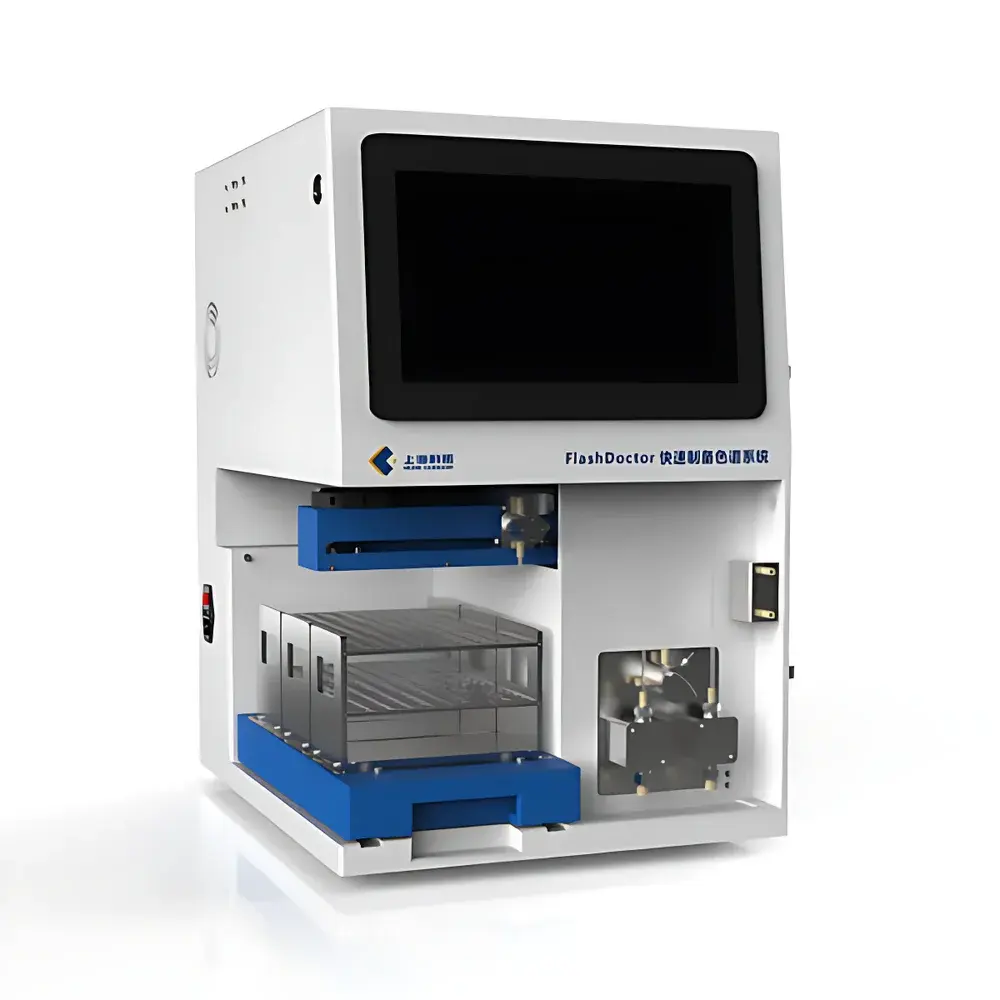
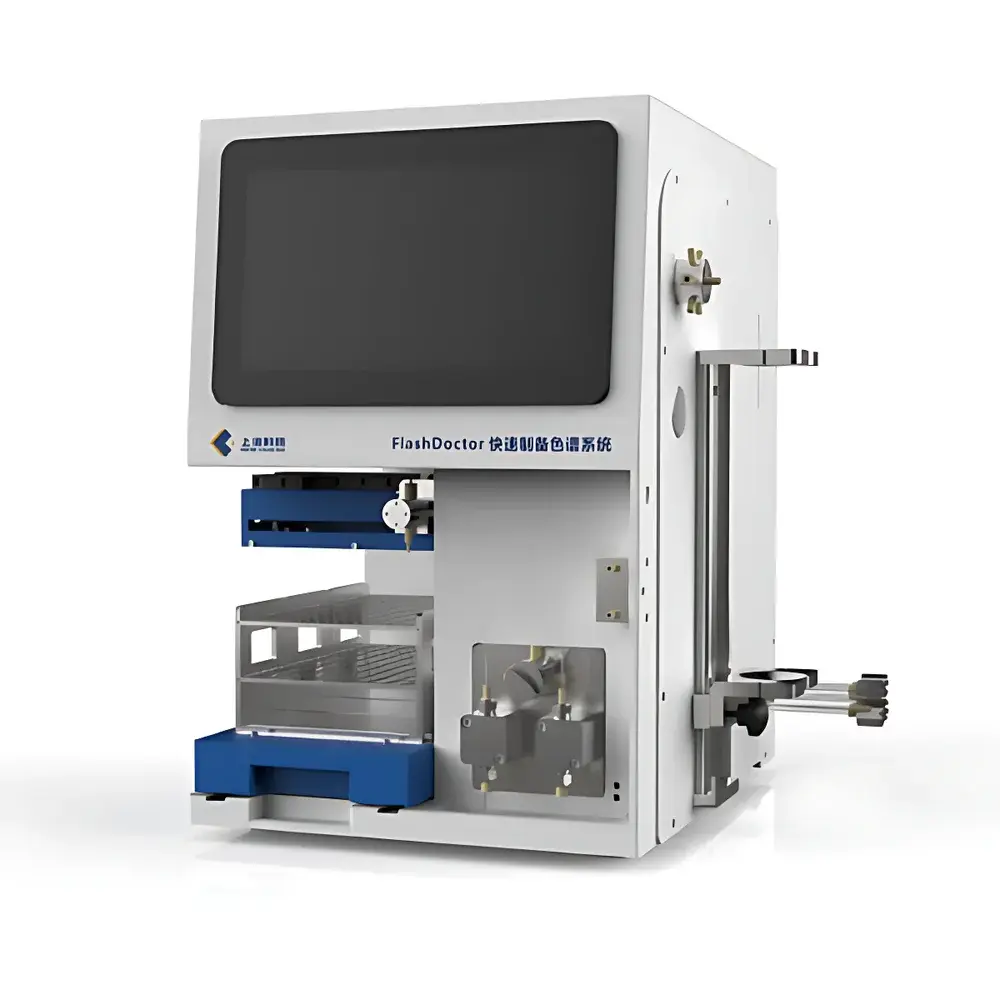
FlashDoctor-1500 Fast Prep Purification System by KEZHE Shanghai
| Brand | KEZHE Shanghai |
|---|---|
| Origin | Shanghai, China |
| Manufacturer Type | Original Equipment Manufacturer (OEM) |
| Product Category | Domestic Instrument |
| Model | FlashDoctor-1500 |
| Instrument Type | Medium-Pressure Flash Chromatography System |
| Application Scope | General-Purpose Preparative Purification |
| Flow Rate Range | 0–200 mL/min |
| Maximum Operating Pressure | 200 psi (1.38 MPa) |
| Flow Accuracy | ±1.5% |
| Injection Capacity | Manual or Optional Autosampler |
| Injection Volume Range | 0.1–50 mL (via syringe or loop) |
| Temperature Control | Ambient-only (no active column oven) |
| Wavelength Range (DAD) | 200–800 nm |
| Data Acquisition Rate | Up to 20 Hz |
Overview
The FlashDoctor-1500 Fast Prep Purification System is a medium-pressure, benchtop flash chromatography platform engineered for reproducible, scalable purification of organic compounds across synthetic chemistry, natural product isolation, and pharmaceutical development workflows. Unlike analytical HPLC systems, the FlashDoctor-1500 operates under controlled low-to-medium pressure conditions (up to 200 psi), leveraging gradient-capable quaternary solvent delivery and diode-array detection (DAD) to support method development, fractionation, and process transfer from discovery through early-stage process R&D. Its architecture follows established principles of liquid chromatographic separation—based on differential partitioning of analytes between mobile and stationary phases—and is validated for compliance with standardized purification protocols including GB 5009.202–2016 for polar compound analysis in edible oils. Designed as an integrated, space-efficient unit, it fits within standard fume hoods and supports seamless transition from TLC-based method scouting to automated column-based purification.
Key Features
- Quaternary solvent delivery system with four independent solvent channels, enabling precise binary to quaternary gradient elution for complex sample matrices.
- DAD detector with dual light sources (deuterium lamp + tungsten-halogen lamp), covering 200–800 nm spectral range; 8 nm bandwidth, ±1 nm wavelength accuracy, and baseline noise ≤ ±0.2 mAU at 254 nm.
- Two-dimensional (X–Y) fraction collector with 135-position capacity (standard 15 × 150 mm test tube format); supports full-collection, peak-triggered, time-window, and manual collection modes.
- High-speed, low-dead-volume switching valves optimized for minimal band broadening and >95% recovery efficiency during fraction transfer.
- Solvent level monitoring with real-time bubble-detection logic to prevent air ingress and maintain hydraulic integrity during extended runs.
- Reversible polarity capability—switch between normal-phase (e.g., hexane/EtOAc) and reversed-phase (e.g., water/acetonitrile) separations without hardware modification.
- Touchscreen control interface with workflow-driven GUI; optional PC-based software with audit trail, electronic signatures, and 21 CFR Part 11–compliant user access management.
- Integrated method recommendation engine that interprets input Rf values from thin-layer chromatography (TLC) plates to propose initial gradient profiles and column dimensions.
- Modular design: pump, detector, column rack, fraction collector, and controller are functionally decoupled yet mechanically co-located—facilitating maintenance, calibration, and component-level replacement.
Sample Compatibility & Compliance
The FlashDoctor-1500 accommodates a broad spectrum of sample types—including small-molecule APIs, synthetic intermediates, plant extracts, lipids, carbohydrates, and peptides—when paired with compatible flash columns (e.g., silica, C18, amino, cyano, diol). Its pressure and flow specifications align with ISO 17025–recommended operational envelopes for preparative LC systems used in GLP-compliant laboratories. The DAD module meets photometric performance criteria outlined in USP for UV-Vis detection in quantitative purification. When configured with optional ELSD, the system extends detectability to non-chromophoric analytes such as sugars and glycerides, supporting applications referenced in AOAC Official Methods and IUPAC technical guidelines. All firmware and software modules comply with data integrity requirements per FDA Guidance for Industry: Data Integrity and Compliance With Drug CGMP (2018), including secure user authentication, immutable audit logs, and version-controlled method storage.
Software & Data Management
Control and data acquisition are managed via FlashDoctor Control Suite—a Windows-based application supporting method creation, real-time chromatogram visualization, peak integration, purity assessment, and fraction mapping. The software implements role-based access control (RBAC) with administrator, operator, and reviewer permissions. Each run generates a timestamped, digitally signed raw data file (.fdcr) containing chromatographic traces, collection event logs, instrument status parameters, and environmental metadata. Built-in tools include spectral library matching, peak deconvolution, and comparative overlay for method optimization. All electronic records adhere to ALCOA+ principles (Attributable, Legible, Contemporaneous, Original, Accurate, Complete, Consistent, Enduring, Available) and support retrospective review during internal audits or regulatory inspections.
Applications
- Purification of reaction mixtures in medicinal chemistry labs, especially for parallel synthesis campaigns requiring rapid isolation of mono-substituted aryl derivatives or heterocyclic scaffolds.
- Isolation of bioactive constituents from botanical extracts—e.g., flavonoids, alkaloids, terpenoids—prior to NMR characterization or biological screening.
- Removal of residual catalysts (e.g., Pd, Ru) and ligands from cross-coupling products, meeting ICH Q3D elemental impurity thresholds.
- Preparative-scale cleanup of peptide synthesis crude mixtures prior to lyophilization or formulation studies.
- Compliance-driven purification of food-grade polar compounds per GB 5009.202–2016, including polymerized triglycerides and oxidized lipid species in frying oils.
- Method development bridge between TLC and preparative HPLC—enabling scalable gradient translation and retention time prediction.
FAQ
What column formats are supported?
The system accepts standard flash cartridges (10–100 g) and glass columns (15–50 mm ID) with compatible end-fittings; both disposable and reusable configurations are validated.
Can the FlashDoctor-1500 be integrated into a LIMS environment?
Yes—via optional OPC UA or CSV export modules, enabling bidirectional data exchange with laboratory information management systems compliant with ASTM E1578 and ISO/IEC 17025 Annex A.2.
Is method validation documentation available?
KEZHE provides IQ/OQ documentation templates aligned with GAMP 5, plus instrument-specific performance qualification (PQ) protocols for flow accuracy, pressure stability, wavelength calibration, and fraction positioning repeatability.
What maintenance intervals are recommended?
Pump seals: every 6 months or 1,000 hours; DAD lamp: 1,000–2,000 hours depending on usage; system leak checks and gradient verification: quarterly.
Does the system support method transfer to analytical or preparative HPLC platforms?
Yes—the software includes retention time normalization tools and scaling algorithms (based on column volume and linear velocity) to facilitate robust transfer to Agilent 1260, Waters Prep 150, or similar platforms.




