
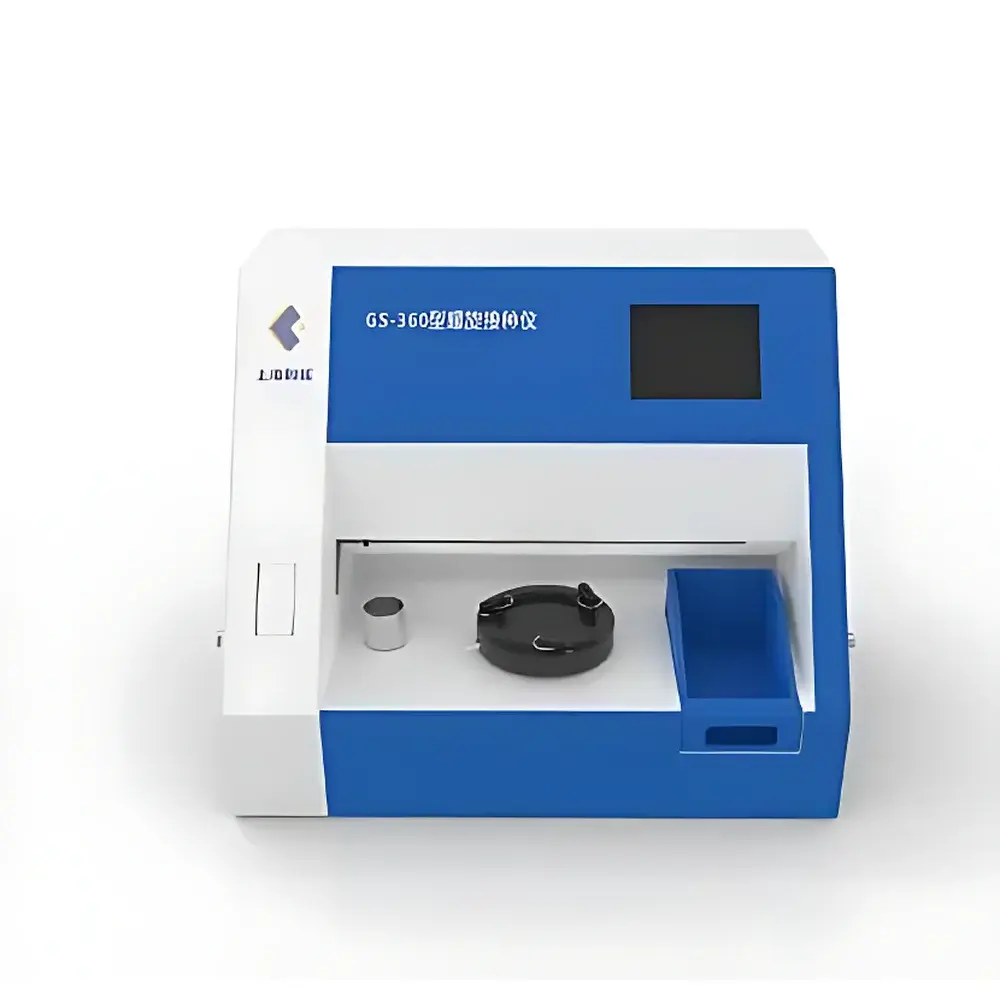
KEZHE SHANGHAI GS-360 Fully Automated Spiral Plater
| Brand | KEZHE SHANGHAI |
|---|---|
| Origin | Shanghai, China |
| Manufacturer Type | Direct Manufacturer |
| Country of Origin | China |
| Model | GS-360 |
| Price Range | USD 14,000–28,000 |
| Inoculation Volume | 30, 50, 80, 100 µL |
| Flow Rate | 10–50 µL/sec |
| Tip Type | Standard 200-µL Pipette Tips (Polypropylene) |
| Petri Dish Diameter | 90 mm (customizable) |
| Reproducibility | >99% |
| Calibration Functions | Position & Volume |
| Power Supply | 220 V AC |
| Power Consumption | 350 W |
| Dimensions | 520 × 385 × 435 mm |
| Weight | 22 kg |
Overview
The KEZHE SHANGHAI GS-360 Fully Automated Spiral Plater is an engineered solution for high-throughput, quantitative microbial colony enumeration in clinical microbiology, food safety testing, pharmaceutical quality control, and environmental monitoring laboratories. Based on the Archimedean spiral dispensing principle, the system deposits a continuous, logarithmically decreasing volume of sample across a rotating Petri dish—enabling viable count determination over a dynamic range of up to 1,000-fold concentration gradient within a single agar plate. Unlike conventional spread-plating or pour-plating methods—which require multiple dilutions, manual handling, and separate plates per dilution—the GS-360 eliminates serial dilution steps while maintaining ISO 4833-1:2013 and FDA Bacteriological Analytical Manual (BAM) compliance for colony-forming unit (CFU) quantification. Its closed-loop fluid path, disposable tip-based architecture, and programmable dispensing kinetics ensure traceable, operator-independent results aligned with GLP and GMP documentation requirements.
Key Features
- Archimedean spiral dispensing algorithm enabling precise, reproducible logarithmic dilution across one 90-mm Petri dish—with CFU counts quantifiable from 10¹ to 10⁶ CFU/mL without manual dilution series.
- Standard 200-µL polypropylene pipette tips used as disposable inoculation heads—eliminating need for proprietary nozzles, reducing consumable cost, and preventing cross-contamination between samples.
- Full automation sequence: automatic tip pickup, aspiration, spiral deposition, tip ejection, and deck positioning—minimizing hands-on time and human error.
- Integrated 7-inch capacitive touchscreen interface with intuitive icon-driven workflow navigation; pre-configured protocols for common standards (e.g., ISO 4833-1, USP <61>, AOAC 977.27) are stored onboard.
- On-device calibration for dispensing position accuracy and volumetric delivery—traceable to gravimetric verification procedures per ISO/IEC 17025 guidelines.
- Modular design supports optional integration with downstream colony counters (e.g., Synbiosis ProtoCOL, iQ-Scan) via RS-232 or Ethernet for end-to-end digital workflow.
Sample Compatibility & Compliance
The GS-360 accommodates viscous and particulate-containing suspensions—including bacterial cultures in saline, buffered peptone water, or tryptic soy broth—without clogging, thanks to its optimized tip geometry and positive-displacement aspiration. It accepts standard polystyrene, polypropylene, or glass Petri dishes (90 mm diameter), with mechanical adaptability for custom diameters (85–100 mm) upon request. The system meets essential regulatory expectations for microbiological enumeration: it supports audit-ready operation under FDA 21 CFR Part 11 when paired with compliant LIMS or ELN systems (electronic signature, audit trail, and user access control enabled via external software). All dispensing parameters—including volume, speed, rotation rate, and start radius—are logged with timestamp and operator ID, fulfilling ISO 15189 and CLIA documentation requirements.
Software & Data Management
The embedded firmware provides local storage of ≥1,000 protocol records and ≥5,000 run logs, each containing full metadata: tip lot number, aspirated volume, dispensing duration, plate ID, operator tag, and calibration status. Export options include CSV and PDF reports compatible with laboratory information management systems (LIMS). While the GS-360 does not include proprietary cloud connectivity, its ASCII-based serial output (RS-232) and Modbus TCP support allow seamless integration into enterprise-scale data ecosystems. For regulated environments, raw log files may be archived externally to satisfy ALCOA+ principles (Attributable, Legible, Contemporaneous, Original, Accurate, Complete, Consistent, Enduring, Available).
Applications
- Quantitative aerobic plate counts in food and beverage QC labs per ISO 4833-1 and ISO 4833-2.
- Antimicrobial efficacy testing (e.g., ISO 22196, JIS Z 2801) requiring controlled inoculum density gradients.
- Environmental monitoring in cleanrooms (ISO 14644-1) and aseptic processing suites (USP <1116>).
- Pharmaceutical sterility test method development and validation (USP <71>, EP 2.6.1).
- Research applications involving mutant library screening, phage titering, or antibiotic gradient assays where reproducible spatial distribution is critical.
FAQ
Does the GS-360 require specialized tips or consumables?
No—only commercially available, certified 200-µL polypropylene pipette tips are required. No custom nozzles or proprietary cartridges are needed.
Can the instrument be validated for GMP use?
Yes. Its deterministic dispensing logic, onboard calibration logging, and electronic record generation support IQ/OQ/PQ execution per ASTM E2500 and Annex 11. Full validation documentation templates are provided upon request.
Is remote monitoring or network integration supported?
The GS-360 features RS-232 and Ethernet ports for bidirectional communication with LIMS or SCADA systems. Remote diagnostics require local IT infrastructure configuration.
What maintenance is required for long-term reliability?
Routine cleaning of the tip ejector mechanism and periodic gravimetric verification of dispensing accuracy (recommended every 100 runs or monthly) constitute the primary maintenance schedule.
Are custom plate sizes supported beyond 90 mm?
Yes—mechanical adapters for 85 mm and 100 mm dishes are available as factory-installed options; other dimensions may be accommodated subject to engineering review.





