
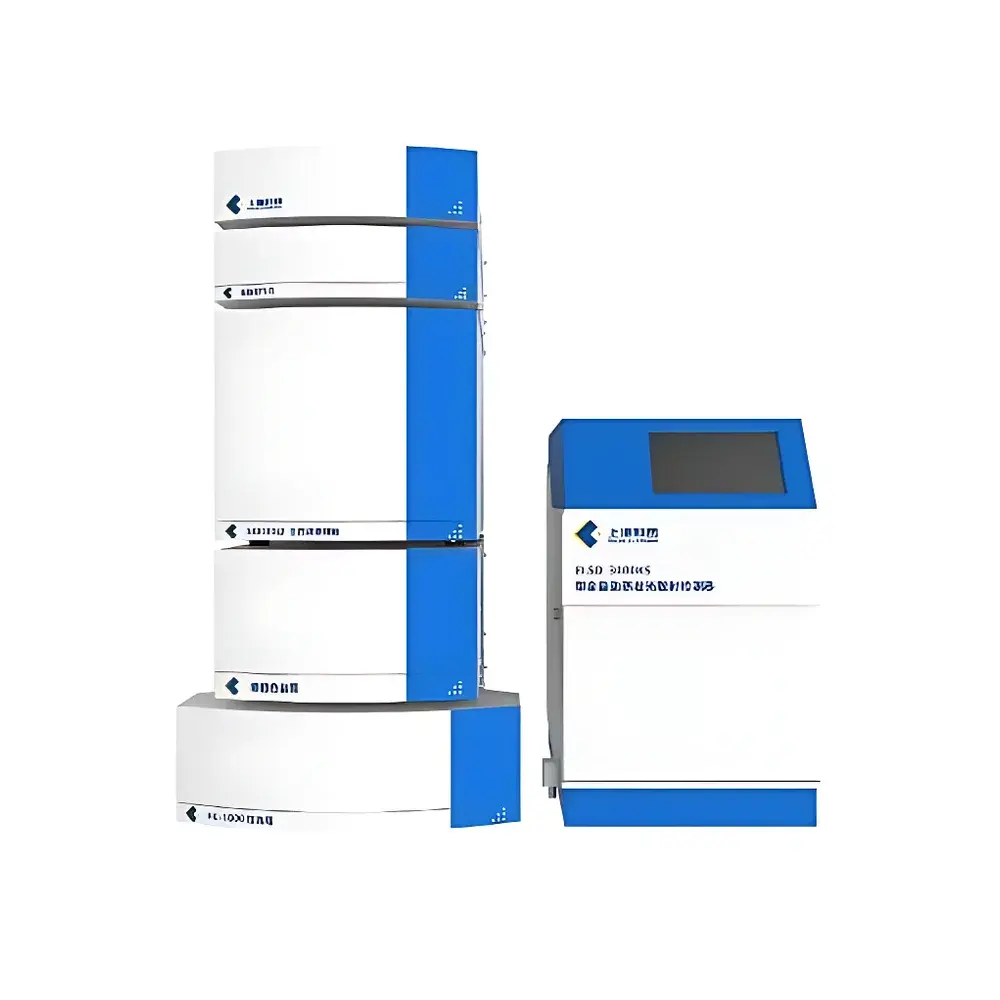
KEZHE SHANGHAI Anters-1200E High-Performance Liquid Chromatograph (HPLC) System with Evaporative Light Scattering Detection (ELSD)
| [Brand | KEZHE SHANGHAI |
|---|---|
| Origin | Shanghai, China |
| Manufacturer Type | Original Equipment Manufacturer (OEM) |
| Instrument Type | Conventional HPLC System |
| Model | Anters-1200E |
| Flow Rate Range | 0.001–5 mL/min |
| Maximum Pressure | 40 MPa |
| Sample Capacity | 144 × 2 mL vials |
| Injection Volume Range | 0.1–100 µL |
| Column Oven Temperature Range | 10–80 °C |
| UV-Vis Wavelength Range | 190–700 nm |
| Data Acquisition Rate | 100 Hz] |
Overview
The KEZHE SHANGHAI Anters-1200E is a fully integrated high-performance liquid chromatograph engineered for robustness, method transfer fidelity, and compliance-ready operation in regulated analytical laboratories. Designed around core principles of isocratic and gradient elution chromatography, the system employs dual-piston reciprocating high-pressure pumps to deliver precise solvent delivery across a wide flow range (0.001–5 mL/min) at pressures up to 40 MPa—enabling compatibility with sub-2 µm particle-packed columns and UHPLC-capable methods. Its modular architecture supports seamless integration of multiple detection modalities, with standard configuration including an evaporative light scattering detector (ELSD), making it uniquely suited for analytes lacking chromophores—such as carbohydrates, lipids, saponins, terpenoids, and other non-UV-absorbing natural products prevalent in traditional Chinese medicine (TCM), botanical extracts, and fermentation-derived antibiotics. The system complies with fundamental design expectations for GLP/GMP environments, including hardware-level pump pulse dampening, thermally stabilized optical paths, and temperature-controlled fluidic pathways.
Key Features
- High-precision binary gradient pump with flow accuracy <0.06% and RSD <0.3%—validated per ISO 11607-2 and ASTM D7213 protocols;
- Autosampler with 144-position 2 mL vial capacity, needle wash station, and vial presence sensing to prevent dry-injection and cross-contamination;
- Column oven with programmable range from 10 °C to 80 °C (±0.15 °C stability), supporting triple-column mounting and optional column-switching valve for multi-dimensional separations;
- Integrated ELSD featuring 650 nm laser source (standard), adjustable nebulizer gas flow (0–5 L/min), and drift tube temperature control (up to 150 °C, ±0.5 °C); optional 300 °C high-temp module available for volatile or thermally labile compounds;
- UV-Vis detector with monochromator-based optics, wavelength accuracy ±0.2 nm (self-calibrating), and real-time photodiode array acquisition at 100 Hz;
- Modular software platform supporting FDA 21 CFR Part 11-compliant audit trails, electronic signatures, role-based user management, and raw data integrity preservation;
- Full-system automation via unified control interface: synchronized gradient programming, autosampler sequencing, column oven ramping, and detector parameter scheduling within a single timeline view.
Sample Compatibility & Compliance
The Anters-1200E accommodates diverse sample matrices without derivatization—including aqueous plant extracts, ethanol-soluble fractions, lipid-rich supernatants, and low-UV-response fermentation broths. Its ELSD configuration eliminates reliance on UV chromophores, offering universal response for semi-volatile and non-chromophoric compounds. The system meets essential mechanical and electrical safety standards (IEC 61010-1), and its software architecture supports ALCOA+ data integrity principles. While not pre-certified for specific regulatory submissions, the platform is engineered to support validation activities aligned with USP , ICH Q2(R2), and ISO/IEC 17025 requirements. All firmware modules retain immutable timestamps, and method files are digitally signed to ensure traceability during GxP audits.
Software & Data Management
The Anters Workstation software provides a modular, bilingual (English/Chinese) interface built on a relational database backend. It features embedded chromatographic processing algorithms for peak detection, integration, baseline correction, and calibration curve generation (linear, quadratic, weighted). Audit trail functionality logs all user actions—including method edits, sequence modifications, and report exports—with immutable timestamps and operator ID linkage. Data export conforms to AIA (.cdf) and open CSV formats; raw data files are stored with SHA-256 checksums. The software supports LIMS connectivity via OPC UA and includes optional 21 CFR Part 11 modules for electronic signature enforcement, password complexity policies, and session timeout controls. Remote monitoring and diagnostic telemetry are available via secure HTTPS API endpoints.
Applications
- Quantitative analysis of polysaccharides, glycosides, and alkaloids in TCM preparations without UV-active functional groups;
- Stability-indicating assays for antibiotic formulations where degradation products lack UV absorbance;
- Quality control of botanical extracts under Chinese Pharmacopoeia (ChP) and European Pharmacopoeia (Ph. Eur.) monographs;
- Method development for preparative-scale fractionation using compatible column switching and fraction collector interfaces;
- Multi-detector hyphenation workflows—e.g., coupling ELSD with optional fluorescence or refractive index detection for orthogonal confirmation;
- Routine QC testing in contract research organizations (CROs) and pharmaceutical manufacturing sites requiring cost-effective, serviceable HPLC infrastructure.
FAQ
Is the Anters-1200E compliant with FDA 21 CFR Part 11?
Yes—the optional Part 11 software package enables electronic signatures, audit trail review, and user access controls required for regulated environments.
Can the system be upgraded to support mass spectrometry interfaces?
Yes—its front-panel ESI-compatible output port and analog/digital I/O connectors support integration with third-party LC-MS systems via standard TTL and RS-232 protocols.
What column dimensions and chemistries are supported?
All standard 1/16″ stainless steel or PEEK capillary fittings; compatible with C18, phenyl-hexyl, HILIC, and ion-exchange columns ranging from 2.1 mm to 4.6 mm ID and 30–250 mm length.
Does the ELSD require nitrogen gas?
No—compressed air is sufficient for routine operation; nitrogen is recommended only for enhanced sensitivity or when analyzing oxygen-sensitive analytes.
Is remote system monitoring available?
Yes—via encrypted web interface with real-time status dashboards, alarm notifications, and historical performance trending over TLS 1.2.






