
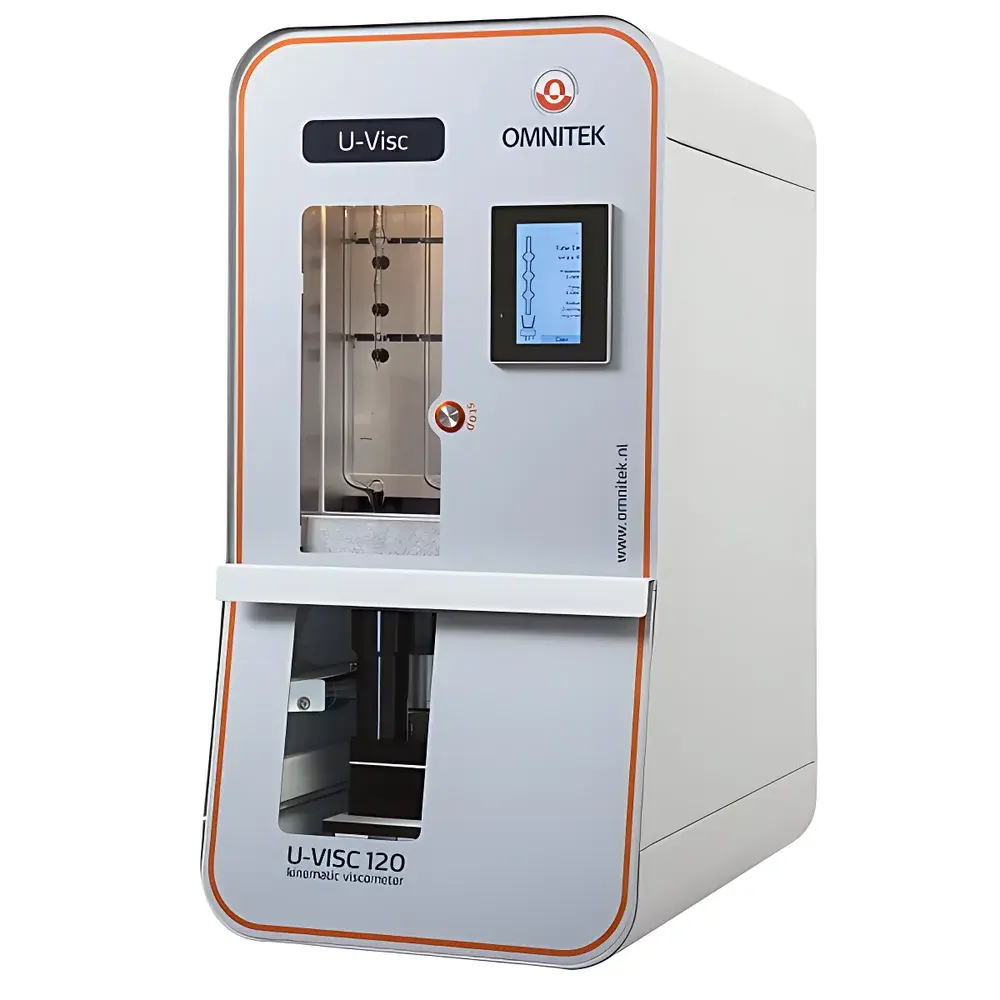
Omnitek U-Visc Series Fully Automated Kinematic Viscometer for Residual Fuels
| Brand | Omnitek |
|---|---|
| Origin | Netherlands |
| Model | U-Visc Series |
| Instrument Type | Capillary Viscometer (Fixed-Station) |
| Viscosity Range | 0.15–25,000 mm²/s |
| Temperature Range | 15–150 °C |
| Temperature Resolution | 0.01 °C |
| Temperature Accuracy | ±0.01 °C |
| Heating Rate | 4 °C/min |
| Standards Compliance | ASTM D445, ASTM D446, ISO 3104, ISO 3105, GB/T 265, GB/T 30515, GB/T 11137 |
| Sample Volume | 8–16 mL |
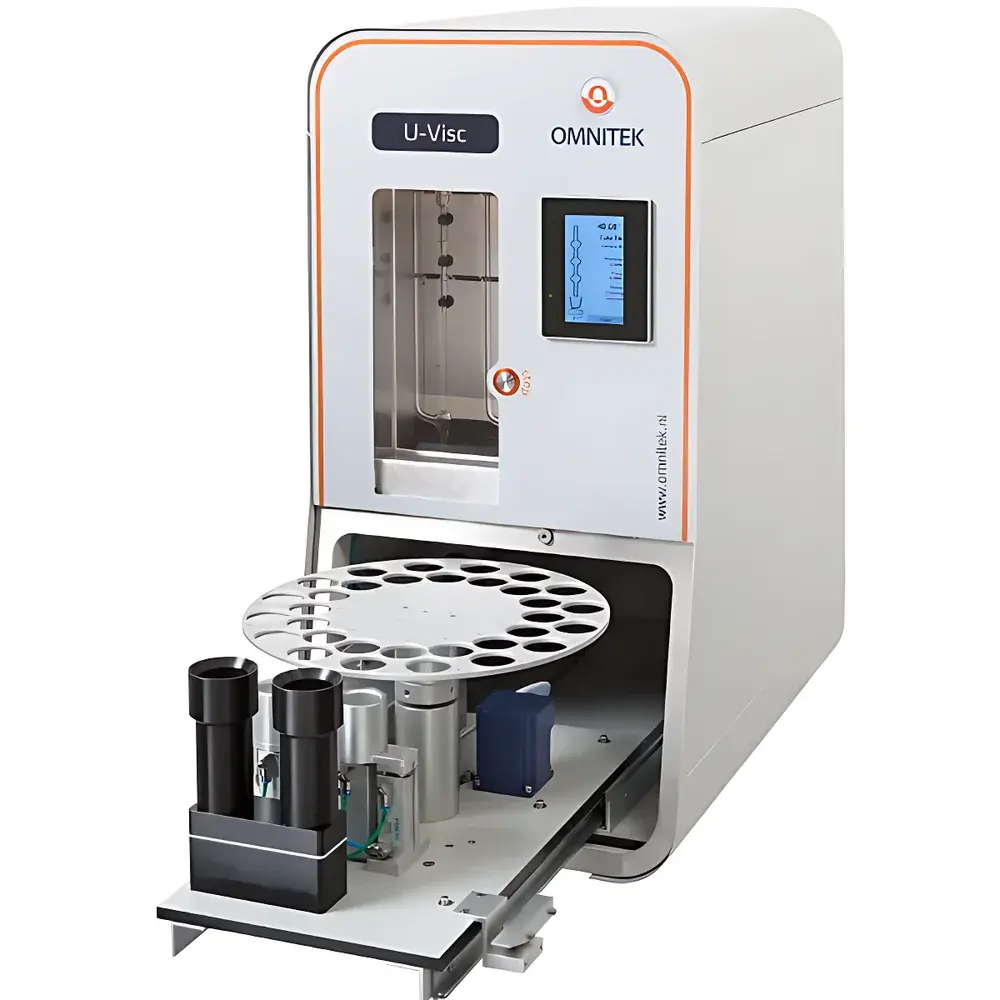
| Autosampler Capacity | 32 positions (dual 16-position rotating carousel, one per capillary) |
| Timing Resolution | 0.001 s |
| Cleaning System | Dual-solvent (high-dissolving + high-volatility), corrosion-resistant fluidic path, vacuum-assisted waste evacuation |
| Environmental Control | Sealed autosampler chamber with negative-pressure waste collection |
Overview
The Omnitek U-Visc Series is a fully automated, fixed-station kinematic viscometer engineered specifically for high-viscosity residual fuel oils—including atmospheric and vacuum residues, heavy fuel oils (HFO), marine bunker fuels, and bitumen blends. It operates on the principle of gravity-driven capillary flow, measuring the time required for a fixed volume of sample to flow between two calibrated optical sensors under precisely controlled thermal conditions. This method conforms rigorously to ASTM D445 and ISO 3104 for kinematic viscosity determination, delivering traceable, reproducible data essential for refinery process control, fuel specification compliance, and quality assurance in maritime and energy sectors. Unlike conventional manual or semi-automated capillary systems, the U-Visc eliminates operator intervention across the entire analytical workflow—sample introduction, thermal equilibration, flow timing, solvent cleaning, and drying—enabling unattended 24/7 operation in regulated laboratory environments.
Key Features
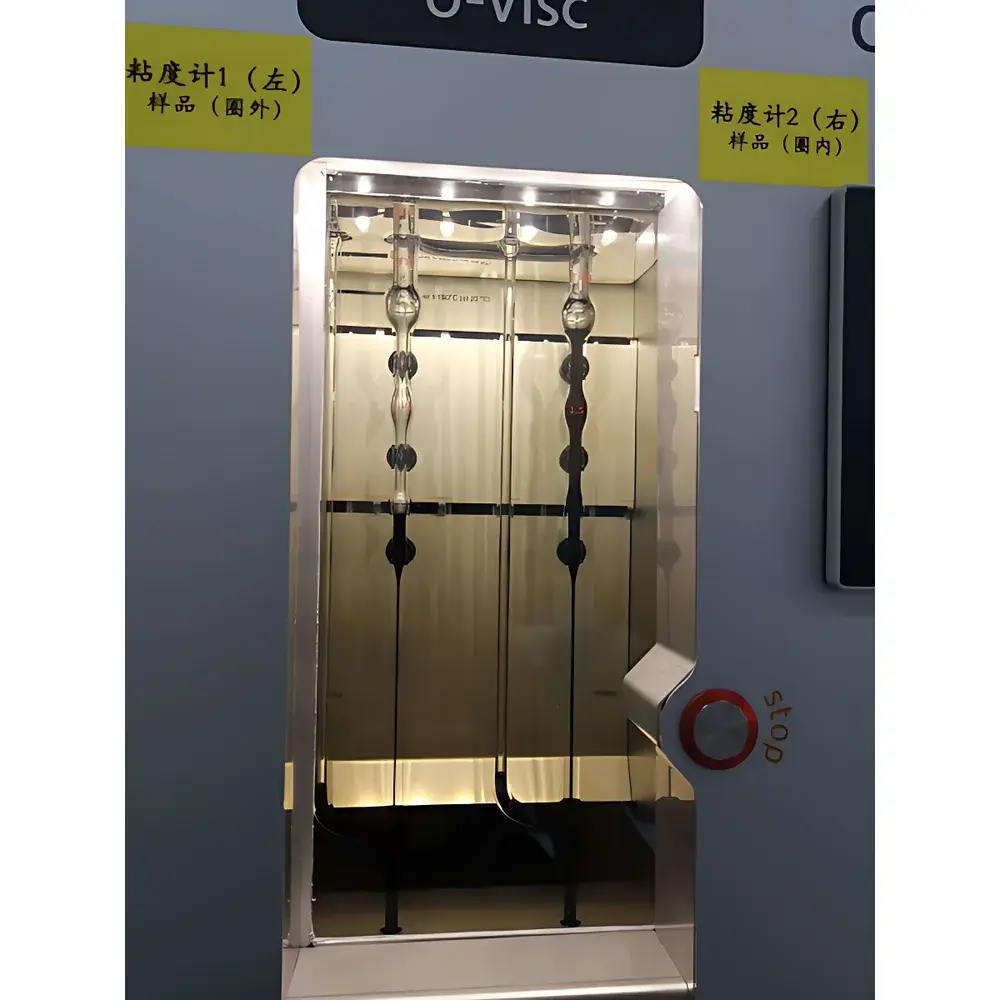
- Duplo Dual-Sensor Capillary Architecture: Each U-Visc unit integrates two parallel capillaries, each equipped with three optical sensors (upper, middle, lower). In Duplo mode, a single aspiration delivers sample into the reservoir, and simultaneous timing captures flow through two independent measurement zones (C1: upper-to-middle; C2: middle-to-lower). This yields two kinematic viscosity results per run, significantly improving statistical robustness—particularly critical for heterogeneous samples such as aged or thermally stressed residual fuels where phase separation or particulate suspension may compromise repeatability.
- Thermally Isolated Preheating System: A concentric sleeve heater surrounds each sample vial during aspiration, ensuring uniform thermal conditioning prior to injection. This minimizes temperature gradients within viscous samples and mitigates errors arising from incomplete thermal equilibration—a known source of bias in high-viscosity measurements per ASTM D446 Annex A1.
- Corrosion-Resistant Dual-Solvent Cleaning Protocol: The fluidic path employs chemically inert materials compatible with aggressive solvents including toluene, xylene, and acetone. Two independent solvent lines deliver: (1) a high-solvency solvent to dissolve carbonaceous deposits and asphaltene aggregates, followed by (2) a low-boiling-point solvent optimized for rapid capillary drying. Vacuum-assisted waste evacuation ensures complete removal of residual solvent and particulates without backflow or internal contamination.
- Physically Segregated Wash Station: During cleaning, the capillary assembly mechanically retracts from the thermostatted bath into a dedicated wash position. Solvent is delivered both axially (top-down interior rinse) and radially (annular jet at capillary tip), while spent fluids drain directly into a sealed waste reservoir under negative pressure—preventing aerosol release, valve clogging, and exposure of sensitive electronics to volatile organics.
Sample Compatibility & Compliance
The U-Visc Series is validated for use with residual hydrocarbon matrices exhibiting non-Newtonian behavior at low shear and elevated temperature sensitivity. Its extended viscosity range (0.15–25,000 mm²/s) accommodates both light distillates and highly viscous vacuum residues without hardware modification. All operational parameters—including temperature ramping profiles, dwell times, sensor thresholds, and cleaning cycles—are programmable and auditable, supporting full alignment with GLP and GMP documentation requirements. Data integrity is reinforced via time-stamped audit trails, user-access controls, and electronic signatures compliant with FDA 21 CFR Part 11 when integrated with validated LIMS or ELN platforms. The instrument’s mechanical design and calibration traceability meet the metrological requirements of ISO/IEC 17025 accredited testing laboratories.
Software & Data Management
U-Visc Control Software provides role-based access, method templating, and automated report generation in PDF and CSV formats. Each measurement record includes raw transit times, calculated kinematic viscosity (ν), dynamic viscosity (η) derived from input density, temperature logs, and cleaning cycle metadata. Calibration constants for each capillary are stored digitally with NIST-traceable certificate references. Batch processing supports statistical evaluation (e.g., %RSD, confidence intervals per ISO 4287), outlier detection, and trend analysis across multi-day campaigns. Exported datasets retain full audit trail linkage for regulatory submission or third-party review.
Applications
- Refinery QC/QA for atmospheric/vacuum residue blending and cutpoint verification
- Marine fuel certification per ISO 8217 (F-RME, RMB, RMK grades)
- Bitumen feedstock characterization in upgrading and coking units
- Research on thermal stability and aging effects in heavy fuel formulations
- Contract laboratory services requiring ISO 17025-compliant kinematic viscosity reporting
FAQ
Does the U-Visc Series support ASTM D7042 (HTHS viscosity) measurement?
No—the U-Visc is designed exclusively for kinematic viscosity per ASTM D445/D446 and ISO 3104. High-temperature, high-shear (HTHS) viscosity requires rotational rheometry and is outside this instrument’s operational scope.
Can the system be integrated into an existing LIMS environment?
Yes—U-Visc Control Software supports ASTM E1394 and ASTM E2500-compliant data export via secure FTP or direct database push. API documentation and validation support packages are available upon request.
What maintenance intervals are recommended for routine operation?
Capillary inspection and recalibration are advised every 6 months or after 500 runs, whichever occurs first. Solvent filters require replacement every 200 runs; vacuum pump oil should be changed quarterly under continuous operation.
Is density input required for kinematic viscosity calculation?
No—kinematic viscosity (mm²/s) is derived solely from flow time and capillary constant. Dynamic viscosity (mPa·s) is optionally calculated if sample density (g/mL) is entered manually or imported via external interface.
How is temperature uniformity verified across the bath during long-duration tests?
The system performs automated bath homogeneity mapping at startup and every 24 hours using embedded Pt100 sensors at multiple radial and axial positions. Deviations exceeding ±0.015 °C trigger automatic recalibration alerts.



