
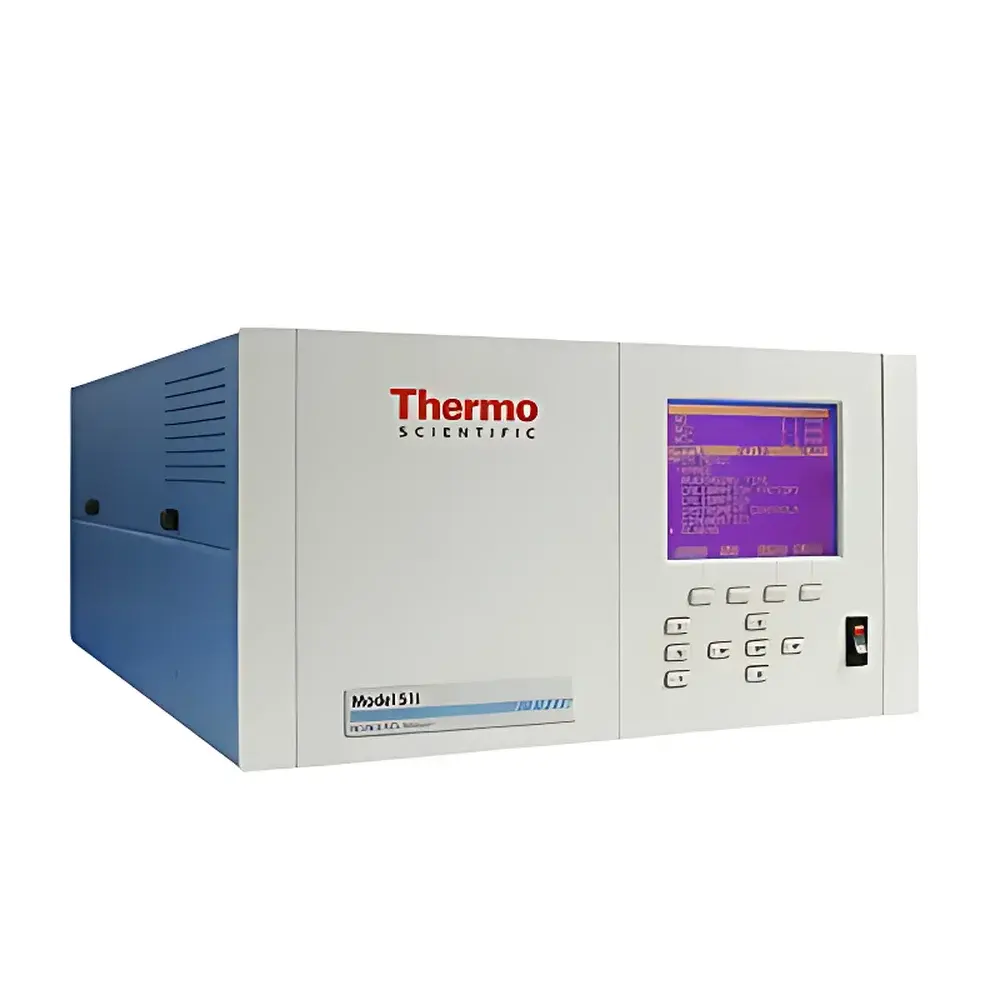
Thermo Scientific 51i Total Hydrocarbon Analyzer
| Brand | Thermo Fisher |
|---|---|
| Origin | USA |
| Manufacturer | Thermo Fisher Scientific |
| Instrument Type | Online Gas Analyzer |
| Detection Principle | Flame Ionization Detection (FID) |
| Configuration | Multi-range VOC Analyzer |
| Measurement Range | 1, 10, 100, 1000, 5000, 10000 ppmC |
| Resolution | 0.05 ppm carbon |
| Accuracy | ±2% of reading or ±0.1 ppm (whichever is greater) |
| Response Time | 15 s (to 90% of full scale, 1 s averaging time) |
| Noise | <0.025 ppmC (10 s averaging) |
| MDL | 0.05 ppm carbon |
| Zero Drift (24 h) | <0.50 ppmC |
| Sample Flow Rate | 0.75–1.5 LPM |
| Fuel Gas | 25 mL/min high-purity H₂ or 110 mL/min H₂/He mixture |
| Temperature Control Zones | Four independent zones |
| Diagnostic Capability | Real-time operational status monitoring |
Overview
The Thermo Scientific 51i Total Hydrocarbon Analyzer is a robust, online gas-phase analytical instrument engineered for continuous, real-time quantification of total hydrocarbons (THC) in ambient air, stack emissions, process streams, and environmental monitoring applications. It employs flame ionization detection (FID), a well-established and universally accepted technique for hydrocarbon measurement per ASTM D6348, ISO 8573-5, and EPA Method 25A. The FID operates on the principle that organic compounds—when combusted in a hydrogen-air flame—produce ions proportional to their carbon content; these ions are collected at an electrode, generating a current linearly correlated with hydrocarbon concentration (expressed as ppm carbon, ppmC). Unlike catalytic or photoionization detectors, FID delivers exceptional selectivity for hydrocarbons over inorganic gases (e.g., CO₂, NOₓ, H₂O vapor), minimal matrix interference, and long-term stability without frequent calibration drift. The 51i is designed for unattended operation in industrial and regulatory environments where compliance-grade data integrity, low maintenance burden, and rapid response are critical.
Key Features
- Fuel and air ratio auto-optimization ensures consistent flame stability and optimal sensitivity across varying ambient conditions and fuel supply pressures.
- Four independently controlled temperature zones maintain precise thermal management of the sample path, detector, and combustion chamber—minimizing condensation, adsorption losses, and baseline drift.
- Integrated self-diagnostic system continuously monitors critical operational parameters—including flame status, gas flows, detector voltage, and heater temperatures—and displays real-time status codes for rapid troubleshooting.
- Multi-range capability (1–10,000 ppmC) enables seamless switching between trace-level monitoring and high-concentration process control without hardware modification.
- Low noise floor (<0.025 ppmC, 10 s average) and sub-ppm detection limit (0.05 ppm carbon) support sensitive regulatory reporting, including fugitive emission detection per EPA OOOOa and LDAR programs.
- Fast response time (15 s to 90% of full scale, 1 s averaging) ensures accurate capture of transient events in dynamic exhaust or vent streams.
Sample Compatibility & Compliance
The 51i accepts gaseous samples within standard environmental and industrial operating ranges: sample temperature from 0 to 50 °C, pressure near ambient (±10 kPa), and dew point ≤ –20 °C. Particulate filtration (≤0.5 µm) and moisture removal (via Nafion dryer or chilled mirror) are recommended upstream for long-term reliability. The analyzer complies with key international standards for hydrocarbon measurement, including ASTM D6348 (standard test method for determination of total hydrocarbons in ambient air), ISO 8573-5 (compressed air purity—hydrocarbon content), and EPA Method 25A (determination of total gaseous nonmethane organic emissions). Its architecture supports GLP/GMP-aligned data handling when integrated into validated systems, and its firmware design accommodates audit trail requirements per FDA 21 CFR Part 11 when deployed in pharmaceutical or biotech manufacturing settings.
Software & Data Management
The 51i interfaces via analog outputs (4–20 mA, 0–10 V), RS-232/RS-485 serial communication, and optional Ethernet (Modbus TCP/IP or EtherNet/IP). Thermo Scientific’s optional Instrument Manager software provides remote configuration, real-time data visualization, alarm logging, and automated calibration scheduling. All measurement data—including raw signal, range selection, diagnostic flags, and timestamped zero/span events—are time-stamped and exportable in CSV or XML formats. Internal memory retains ≥30 days of 1-minute averaged data with power-fail protection. When deployed in regulated environments, the system supports user access control, electronic signatures, and change history tracking—enabling alignment with data integrity expectations under ALCOA+ principles.
Applications
- Continuous emissions monitoring (CEMS) for refinery flare stacks, chemical reactor vents, and incinerator exhausts.
- Fugitive emission detection and quantification in LDAR (Leak Detection and Repair) programs across petrochemical, semiconductor, and coating facilities.
- Indoor air quality (IAQ) assessment in laboratories, cleanrooms, and manufacturing spaces where solvent use occurs.
- Process control feedback for thermal oxidizers, carbon adsorption units, and catalytic converters.
- Calibration verification and reference standard generation in metrology labs supporting VOC reference material certification.
FAQ
What detection technology does the 51i use, and why is FID preferred for total hydrocarbon analysis?
The 51i uses flame ionization detection (FID), which offers superior linearity, wide dynamic range, and minimal interference from common inorganic gases—making it the reference method for regulatory THC reporting.
Can the 51i measure individual VOCs or only total hydrocarbons?
It measures total hydrocarbon concentration expressed as ppm carbon (ppmC); speciation requires coupling with a gas chromatograph (e.g., Thermo Scientific TRACE™ GC series).
Is the 51i suitable for use in hazardous locations?
The base model is rated for general-purpose indoor or sheltered outdoor use; explosion-proof variants (Class I, Div 1) are available upon request with appropriate certifications (UL, ATEX, IECEx).
How often does the 51i require calibration?
Typical calibration interval is 7–30 days depending on application severity; automatic zero/span checks can be scheduled daily, and the instrument logs all calibration events with operator ID and gas lot traceability.
Does the 51i support remote diagnostics and firmware updates?
Yes—via Ethernet or serial connection, authorized users can perform health checks, view sensor diagnostics, and apply firmware patches through Thermo’s secure update protocol.







