
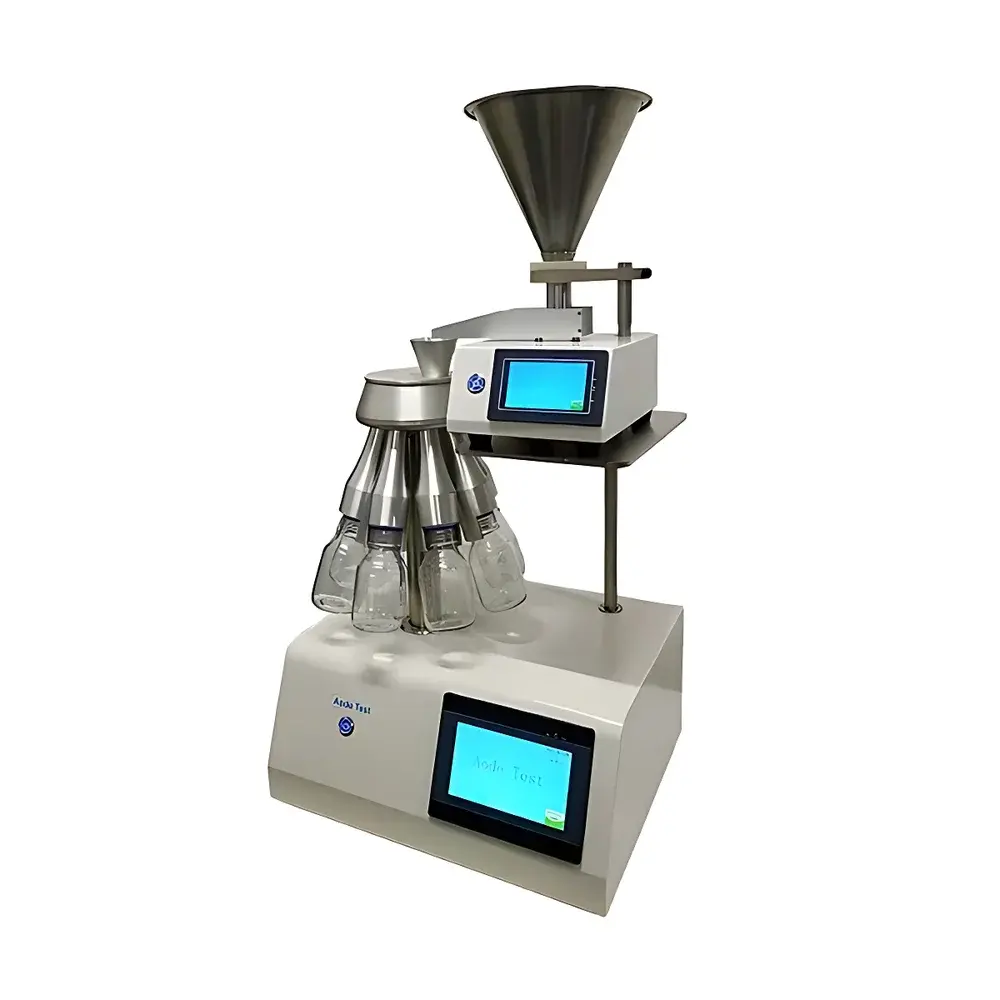
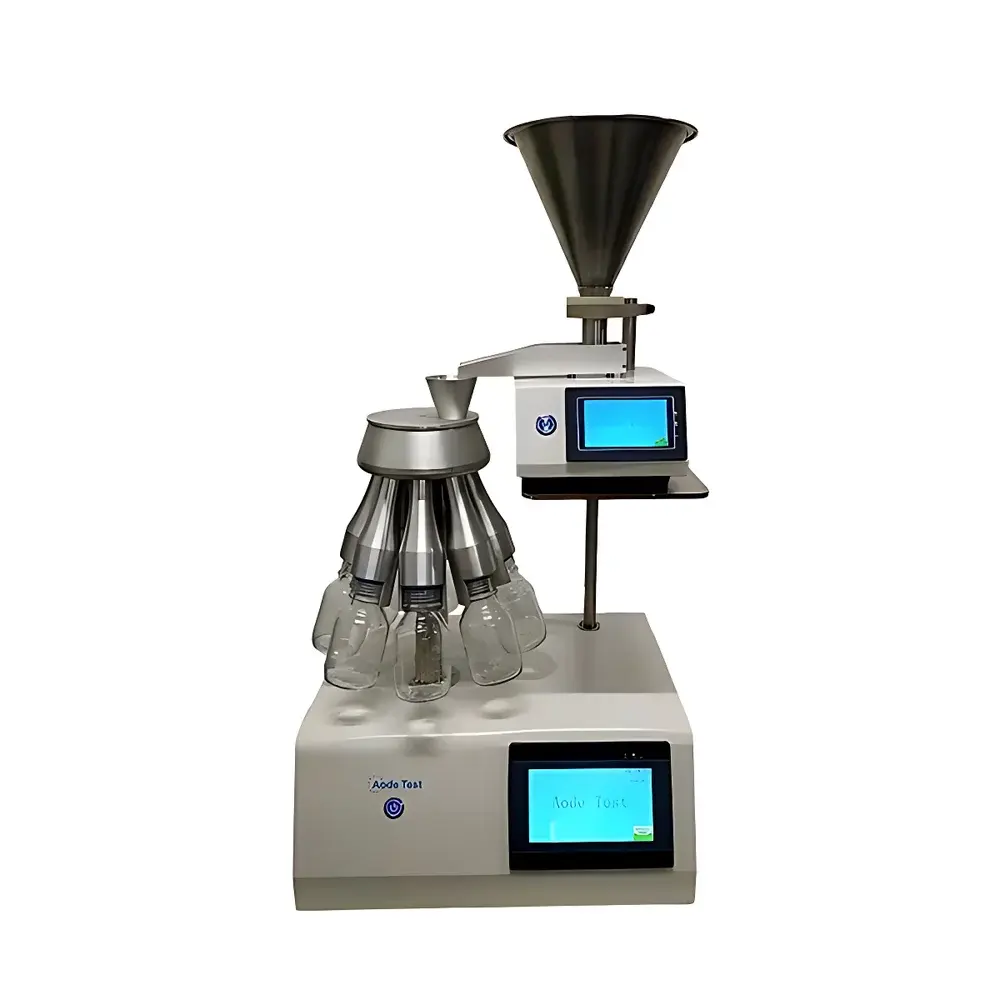
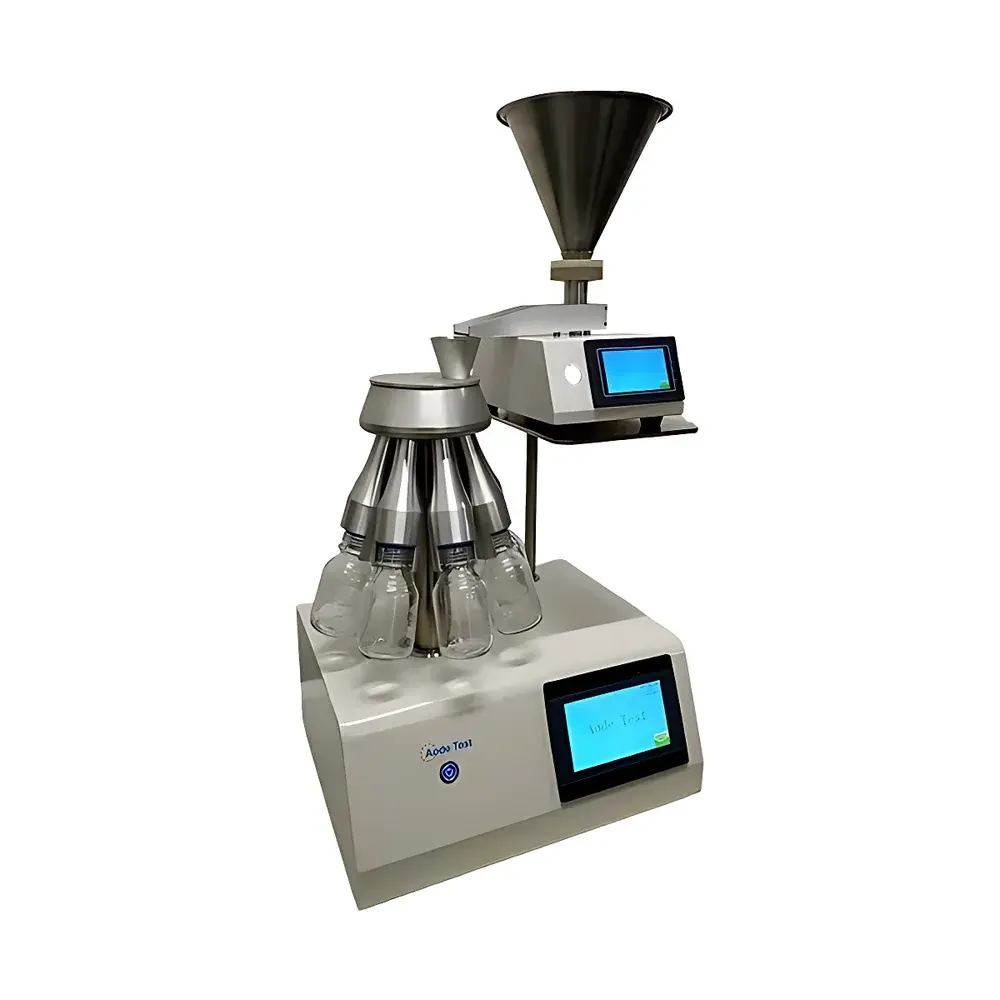
Aode AODE-100 Rotary Sample Divider
| Brand | Aode |
|---|---|
| Origin | Liaoning, China |
| Manufacturer Type | Direct Manufacturer |
| Model | AODE-100 (211129) |
| Sample Division Frequency | 900–1100 cycles/min |
| Control Interface | 7-inch Touchscreen HMI |
| Drive System | Precision Microcontroller + Integrated Circuit |
| Sample Delivery | Gravity-fed + Centrifugal Distribution |
| Receptacle Configuration | Multi-port Rotating Collection Funnel |
| Compliance | Designed for ISO 13320, ASTM D6938, and GB/T 6679-2003 sample homogenization protocols |
Overview
The Aode AODE-100 Rotary Sample Divider is an automated, gravity-assisted centrifugal sample division system engineered for high-reproducibility subsampling of dry granular, powdered, or free-flowing particulate materials. Unlike static riffle or cone-splitter dividers, the AODE-100 employs a dynamically rotating multi-orifice collection funnel that rotates at a precisely controlled speed (900–1100 cycles per minute), enabling continuous, three-dimensional spatial distribution of material across multiple receiving vessels. This rotational geometry—combined with synchronized gravitational feed and radial centrifugal acceleration—ensures uniform mass partitioning by minimizing segregation effects such as particle size stratification, density-driven channeling, or flow-induced bias. The instrument operates on first-principle mechanical sampling theory defined in ISO 13320 (particle size analysis — general principles) and aligns with ASTM D6938 (standard practice for sampling aggregates), supporting statistically valid sub-sampling for downstream analytical workflows including laser diffraction particle sizing, XRF composition analysis, and bulk density determination.
Key Features
- Programmable division frequency: Adjustable from 900 to 1100 cycles/minute via intuitive 7-inch touchscreen HMI, allowing optimization for material flowability and target subsample mass.
- Centrifugal-gravitational dual-force delivery: Material flows under gravity into a central feed hopper, then is radially distributed via controlled rotation—reducing bridging, rat-holing, and wall adhesion common in cohesive powders.
- Modular multi-port collection funnel: Precision-machined stainless steel funnel with evenly spaced apertures ensures geometrically symmetric sample splitting; compatible with standard 15–50 mL vials or custom receptacles.
- Integrated microcontroller architecture: Real-time motor speed regulation, cycle counting, and fault detection (e.g., jam detection, overload current monitoring) ensure operational continuity and traceability.
- Robust industrial enclosure: Powder-coated steel chassis with sealed electronics compartment meets IP54 environmental rating for laboratory and light industrial environments.
- No consumables or calibration fluids required: Mechanical design eliminates dependency on lubricants, sensors, or disposable components—supporting GLP-compliant maintenance logs and long-term stability verification.
Sample Compatibility & Compliance
The AODE-100 accommodates dry, non-sticky, free-flowing materials with particle sizes ranging from 10 µm to 5 mm—including mineral ores, cement clinker, pharmaceutical granules, polymer pellets, agricultural seeds, and ceramic powders. It is not intended for wet, fibrous, hygroscopic, or highly electrostatic materials. The device satisfies functional requirements outlined in ISO 13320 Annex B (sampling for particle size analysis), ASTM D6938 Section 5 (mechanical sampling equipment criteria), and Chinese national standard GB/T 6679-2003 (general rules for sampling solid chemical products). While not certified to IEC 61000-6-2/6-4, its EMC performance has been verified per laboratory-level electromagnetic compatibility screening for typical analytical lab installations.
Software & Data Management
Operation is managed entirely through the embedded 7-inch resistive touchscreen interface, which stores up to 100 user-defined method profiles—including rotation speed, total cycle count, dwell time between cycles, and auto-shutdown delay. All session logs (start time, duration, cycles completed, operator ID tag) are timestamped and exportable via USB 2.0 to CSV format. No proprietary software installation is required; data files are human-readable and compatible with LIMS integration via manual upload. Audit trail functionality complies with basic GLP documentation requirements (21 CFR Part 11 Subpart B—electronic records), though full electronic signature capability requires external validation of the host lab’s IT infrastructure.
Applications
- Preparation of representative subsamples prior to laser diffraction (e.g., Malvern Mastersizer) or dynamic image analysis (e.g., Retsch CAMSIZER).
- Homogenization of bulk powder lots for QC release testing in cement, fertilizer, and metallurgical industries.
- Splitting of batch samples for parallel testing across multiple instruments (e.g., simultaneous TGA, XRD, and SEM preparation).
- Reduction of large field-collected soil or ore composites to laboratory submission size while preserving particle size distribution integrity.
- Supporting ISO/IEC 17025 accredited labs in fulfilling clause 7.3.2 (sample handling) and 7.4.1 (sub-sampling uncertainty estimation) requirements.
FAQ
What is the minimum recommended sample mass for reliable division?
For optimal statistical representativeness, ≥500 g is recommended for materials with D90 < 1 mm; lower masses (≥200 g) may be used with documented uncertainty assessment per ISO 8573-1 Annex C.
Can the AODE-100 handle abrasive materials like silica sand or alumina?
Yes—stainless steel funnel and feed components are hardened to HV 400; routine inspection of aperture edges is advised after every 500 operating hours when processing Mohs 6+ materials.
Is third-party calibration or certification available?
Aode provides factory verification reports (traceable to CNAS-accredited metrology labs); users may engage independent ISO/IEC 17025 labs for periodic performance verification against ISO 13320 sampling bias thresholds.
Does the unit support 220 V / 50 Hz only, or is dual-voltage configuration possible?
Standard configuration is 220 V ±10%, 50 Hz; optional 110 V / 60 Hz power supply modules are available upon order specification.
How is cleaning and maintenance performed between sample types?
The funnel, feed chute, and collection ports are tool-free detachable; ultrasonic cleaning in isopropanol is recommended for residue-sensitive applications—validated cleaning procedures are included in the operator manual.



