
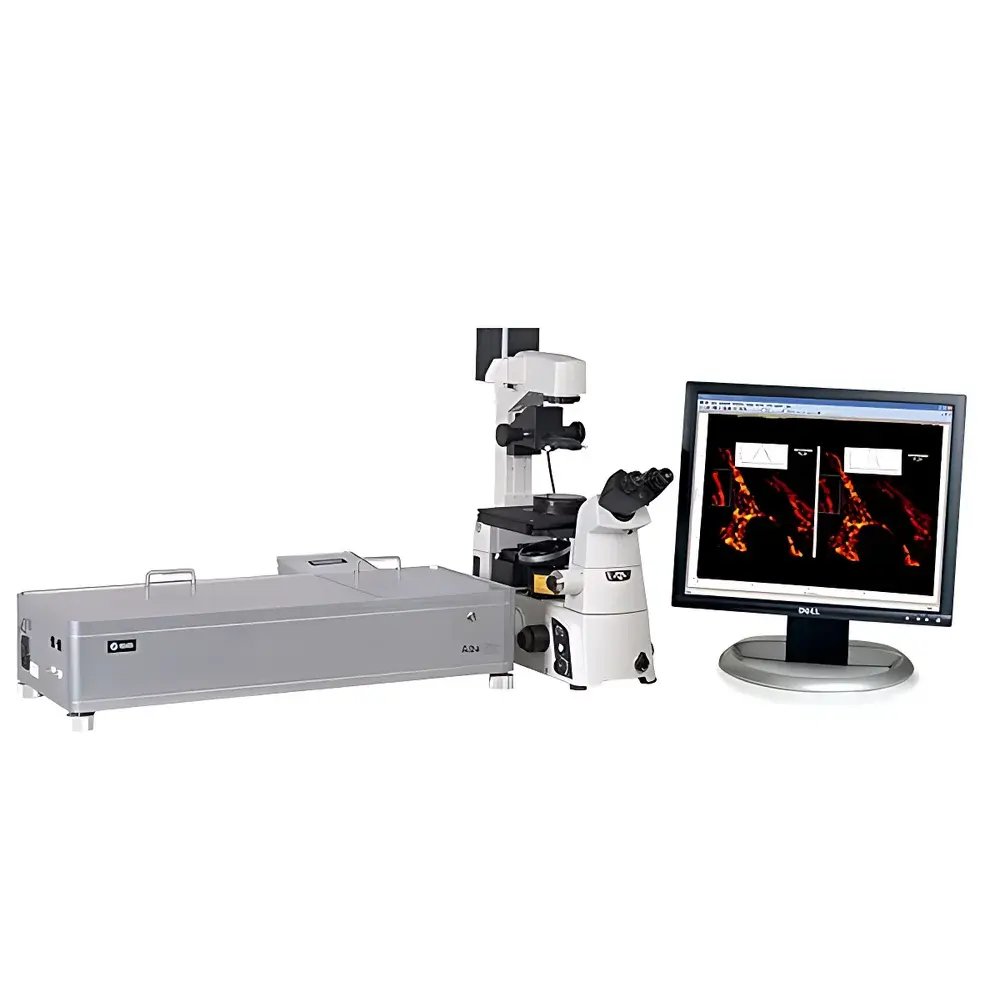
ISS Alba-STED Super-Resolution Laser Scanning Confocal Microscope
| Brand | ISS |
|---|---|
| Origin | USA |
| Manufacturer Type | Authorized Distributor |
| Origin Category | Imported |
| Model | Alba-STED |
| Price | USD 680,000 (FOB New York) |
Overview
The ISS Alba-STED Super-Resolution Laser Scanning Confocal Microscope is an engineered platform for quantitative single-molecule cell biology, combining stimulated emission depletion (STED) nanoscopy with time-resolved fluorescence detection. Unlike conventional confocal systems limited by the Abbe diffraction barrier (~250 nm lateral resolution), the Alba-STED implements pulsed STED (pSTED) — a true far-field super-resolution technique — to achieve spatial resolution down to ≤50 nm in biological specimens. Its core optical architecture integrates synchronized picosecond-pulsed excitation and depletion lasers, enabling precise temporal gating of fluorescence emission. Coupled with FastFLIM (Fast Frequency-Domain Fluorescence Lifetime Imaging), the system captures photon arrival times at high throughput, supporting phasor-based lifetime separation, background suppression, and quantitative multi-parameter analysis without spectral crosstalk. Designed for rigorous live-cell and fixed-tissue applications, the Alba-STED meets the metrological requirements of structural cell biology, molecular biophysics, and dynamic protein interaction studies under physiologically relevant conditions.
Key Features
- pSTED implementation with dual synchronized pulsed laser sources (excitation + STED depletion), enabling sub-diffraction imaging with controllable depletion efficiency and minimal phototoxicity
- FastFLIM acquisition engine delivering full lifetime decay histograms at pixel dwell times as low as 0.2 µs, supporting >100 fps frame rates at 512×512 resolution
- Phasor plot–driven image processing pipeline for label-unmixing, background correction, and resolution enhancement without iterative fitting or prior assumptions
- Dual-label discrimination capability using lifetime contrast: simultaneous imaging of spectrally overlapping fluorophores (e.g., Atto 647N and Atto 655) excited by the same 640 nm laser line
- High dynamic range detection: up to 60 million photon counts per second across the entire field of view, preserving signal fidelity in both low-abundance single-molecule and high-density organelle labeling experiments
- Modular scanning head compatible with upright and inverted microscope frames; optimized for integration with environmental chambers (37°C, 5% CO₂, humidity control)
Sample Compatibility & Compliance
The Alba-STED supports standard glass-bottom dishes (MatTek, Ibidi), coverslips (No. 1.5H), and specialized substrates including ultrathin polymer films and silicon nitride membranes for correlative light-electron microscopy (CLEM). It is validated for use with common biological fluorophores (SiR, Alexa Fluor dyes, ATTO dyes, mEos variants) and genetically encoded tags (mCherry, mMaple). All optical alignment, calibration, and acquisition protocols comply with ISO/IEC 17025:2017 guidelines for testing laboratories. System validation reports include NIST-traceable PSF measurements using 60 nm fluorescent beads, and are provided with each installation. The platform supports GLP-compliant workflows via audit-trail-enabled acquisition logs and timestamped metadata embedding (EXIF + custom XML schema), aligning with FDA 21 CFR Part 11 requirements for electronic records in regulated research environments.
Software & Data Management
Acquisition and analysis are performed using ISS’s proprietary SymPhoTime 64 software suite, which provides native support for pSTED-FastFLIM workflows. The software includes real-time phasor transformation, FLIM-FCS hybrid analysis modules, and automated drift correction using fiducial bead tracking. Raw data is stored in HDF5 format with embedded metadata (laser power, dwell time, pinhole position, temperature, CO₂ level), ensuring full reproducibility and FAIR (Findable, Accessible, Interoperable, Reusable) data principles. Export options include TIFF stacks with embedded lifetime maps, CSV-based decay parameters, and MATLAB-compatible .mat files. Integration with Python (via PySymPhoTime API) and ImageJ/Fiji plugins enables custom algorithm development and batch processing pipelines compliant with institutional HPC infrastructure.
Applications
- Single-molecule localization and stoichiometry quantification in nuclear pore complexes and chromatin-associated cohesin rings
- Nanoscale mapping of actin cytoskeleton remodeling in glial cells during synaptic plasticity assays
- Simultaneous tracking of receptor dimerization dynamics and endocytic trafficking using dual-color lifetime-resolved STED
- Quantitative assessment of mitochondrial membrane potential heterogeneity via voltage-sensitive dye lifetime shifts
- Correlative STED–CLEM workflows for ultrastructural validation of protein clustering observed in live cells
- Development and validation of novel STED-optimized fluorogenic probes and self-labeling tags (e.g., HaloTag, SNAP-tag derivatives)
FAQ
What is the typical lateral resolution achievable with the Alba-STED in fixed biological samples?
Typical full-width-at-half-maximum (FWHM) resolution is 40–55 nm in immunolabeled cellular structures, verified using 60 nm fluorescent bead standards and validated against ground-truth EM data.
Does the system support live-cell imaging under physiological conditions?
Yes — the pSTED pulse architecture minimizes average laser power while maintaining peak intensity, enabling >10-minute time-lapse imaging of mitochondria or microtubules in primary neurons at 37°C and 5% CO₂.
Can existing confocal users upgrade to STED functionality?
The Alba-STED is a turnkey integrated system; however, ISS offers retrofit packages for compatible Leica TCS SP8 and Nikon A1R HD25 platforms, subject to optical path compatibility and laser safety certification.
Is FastFLIM data acquisition compatible with third-party analysis tools?
All raw FLIM datasets are exported in vendor-neutral HDF5 format with standardized metadata fields, enabling direct import into open-source tools such as FLIMfit, TRAST, and PHANTOM.
How is instrument calibration maintained over time?
The system includes automated daily alignment checks using internal reference photodiodes and NIST-traceable spectral filters; annual recalibration services are available through ISS-certified field engineers.





