
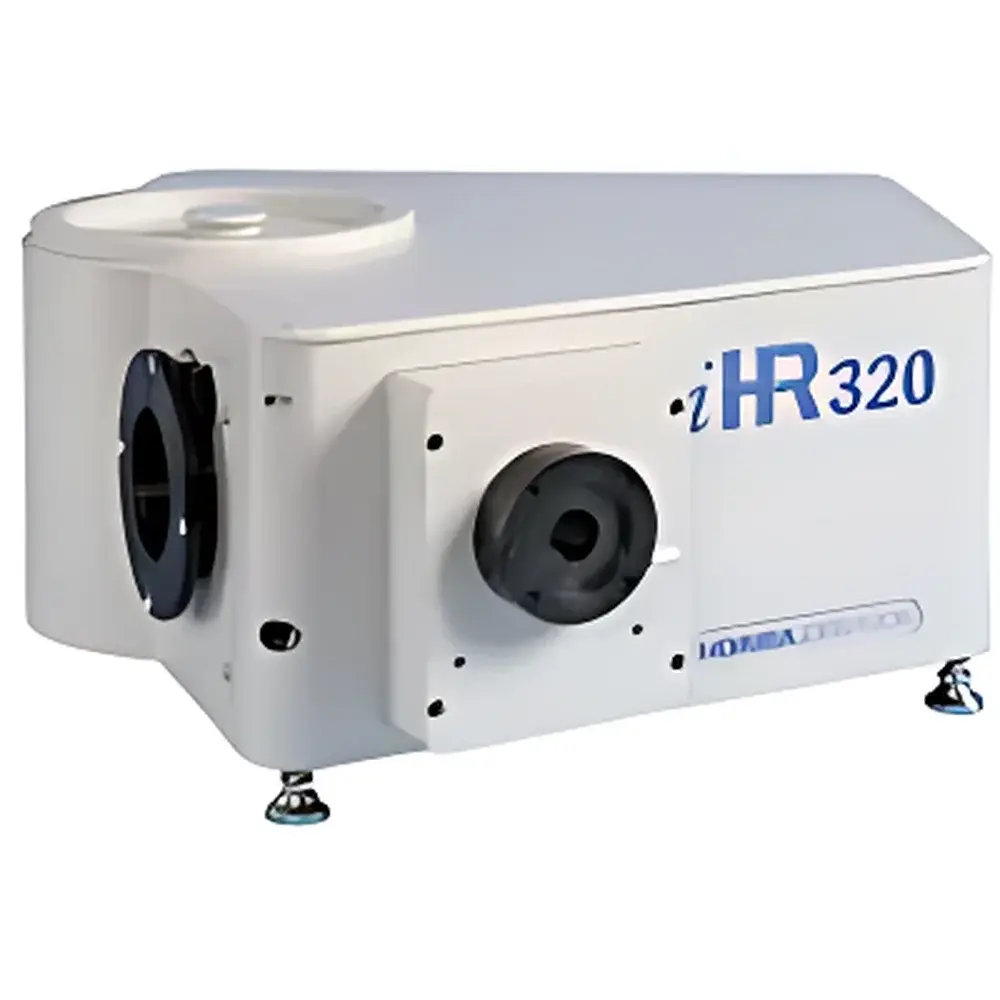
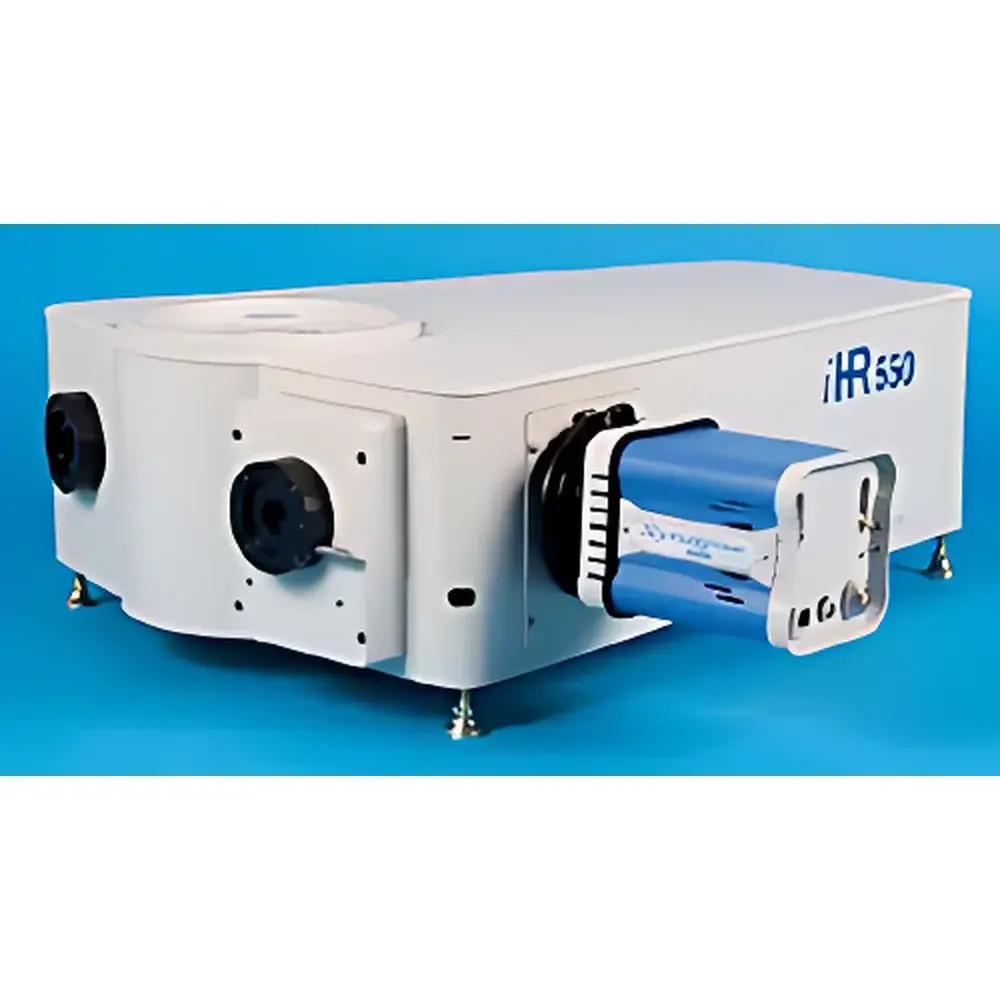
HORIBA iHR320 and iHR550 Imaging Spectrometers
| Brand | HORIBA |
|---|---|
| Origin | USA |
| Model | iHR320 / iHR550 |
| Focal Length | 320 mm (iHR320), 550 mm (iHR550) |
| f-number | f/4.1 (iHR320), f/6.4 (iHR550) |
| Spectral Resolution | 0.06 nm (iHR320), 0.025 nm (iHR550) |
| Linear Dispersion | 2.31 nm/mm (iHR320), 1.34 nm/mm (iHR550) |
| Grating Size | 68 mm × 68 mm (iHR320), 76 mm × 76 mm (iHR550) |
| Stray Light | 1.5×10⁻⁴ (iHR320), 1.0×10⁻⁵ (iHR550) |
Overview
The HORIBA iHR320 and iHR550 are high-performance, research-grade imaging spectrometers engineered for precision spectroscopic applications requiring both spatial and spectral fidelity. Based on a patented Czerny–Turner optical architecture with in-plane grating scanning and optimized off-axis reflective optics, these instruments deliver diffraction-limited imaging across the full focal plane—enabling true 2D spectral mapping without vignetting or field curvature. The iHR series is specifically designed to support low-light, high-resolution experiments including Raman microspectroscopy, photoluminescence mapping, time-resolved emission spectroscopy, and synchrotron beamline diagnostics. Its optical path eliminates secondary diffraction orders through rigorously modeled asymmetric beam geometry, while the oversized focusing mirror ensures uniform photon collection efficiency from center to edge of the detector array—critical for quantitative hyperspectral analysis and calibration traceability.
Key Features
- Aberration-Corrected Imaging Optics: Incorporates toroidal mirrors to correct astigmatism; asymmetric optical layout and in-axis grating scanning minimize coma and higher-order aberrations across the entire spectral range (180–2100 nm).
- Zero-Vignetting Flat-Field Performance: Focusing mirror diameter exceeds that of the collimating mirror, enabling full illumination of large-format CCD/CMOS detectors (up to 27 mm diagonal) with no falloff at the edges—essential for radiometric accuracy and pixel-to-pixel intensity calibration.
- In-Axis Grating Scanning Mechanism: Maintains incident light precisely at the grating’s central active area during wavelength scanning, maximizing diffraction efficiency (>85% typical for ruled and holographic gratings) and minimizing spectral drift over extended acquisitions.
- Stray Light Suppression: Computer-optimized optical alignment reduces stray light to ≤1.5×10⁻⁴ (iHR320) and ≤1.0×10⁻⁵ (iHR550), meeting ASTM E275 and ISO 9022-3 requirements for high-dynamic-range spectroscopy.
- Mechanical & Thermal Stability: Monolithic aluminum alloy baseplate, stress-relieved optical mounts, and dual-stage motorized drives validated for repeatability better than ±0.005 nm over 24-hour continuous operation under ambient lab conditions (20–25°C, <50% RH).
- Modular Interface Architecture: Standard SMA905, FC/PC, and vacuum-compatible flange options; supports direct coupling to cryogenic detectors, ICCDs, EMCCDs, and scientific CMOS sensors with TE or LN₂ cooling.
Sample Compatibility & Compliance
The iHR320/iHR550 spectrometers are compatible with solid, liquid, and gaseous samples when integrated into appropriate excitation and collection configurations—including confocal microscopy stages, fiber-coupled probe heads, vacuum chambers, and environmental cells. Optical throughput optimization supports UV-Vis-NIR measurements compliant with USP , ASTM E308, and ISO/IEC 17025 calibration frameworks. All mechanical and software components meet CE, RoHS, and FCC Part 15 Class A electromagnetic compatibility standards. Optional hardware and firmware configurations support 21 CFR Part 11-compliant audit trails and electronic signature workflows when deployed in regulated GMP/GLP laboratories.
Software & Data Management
HORIBA’s LabSpec 6 software provides full instrument control, real-time spectral acquisition, and advanced data processing—including spectral deconvolution, multivariate curve resolution (MCR), and spatial-spectral correlation mapping. The SDK supports Python, MATLAB, and LabVIEW integration via TCP/IP and DLL interfaces. Raw data is saved in HDF5 format with embedded metadata (wavelength calibration, grating ID, slit width, integration time, detector temperature), ensuring FAIR (Findable, Accessible, Interoperable, Reusable) data principles. Automated calibration routines include pixel-to-wavelength mapping using Hg/Ar/Ne lamps and intensity flat-field correction using tungsten-halogen sources—traceable to NIST SRM 2035 and SRM 2036.
Applications
- Raman and photoluminescence microspectroscopy of 2D materials (graphene, TMDCs), perovskites, and quantum dots
- Time-resolved fluorescence lifetime imaging (FLIM) with gated ICCD detection
- Hyperspectral imaging of biological tissues and pharmaceutical tablets
- Plasmonic resonance characterization in nanostructured metasurfaces
- Synchrotron-based XUV and soft X-ray beamline monochromation (with optional MgF₂ or Si-coated optics)
- Environmental monitoring of atmospheric trace gases using differential optical absorption spectroscopy (DOAS)
FAQ
What grating options are available for the iHR320 and iHR550?
Standard offerings include 150–3600 grooves/mm ruled and holographic gratings, with blaze wavelengths from 150 nm (UV) to 12 µm (MIR); custom blazed gratings and VPH transmission gratings are available upon request.
Can the iHR series be used under vacuum or purged environments?
Yes—both models support UHV-compatible versions with all-metal seals, CF-63 or CF-100 flanges, and bake-out rated to 150°C; standard units operate in dry nitrogen-purged mode for deep-UV applications below 200 nm.
Is LabSpec 6 validated for use in regulated pharmaceutical labs?
LabSpec 6 v6.5+ includes IQ/OQ documentation packages and optional 21 CFR Part 11 modules with role-based access control, electronic signatures, and immutable audit logs—validated per ASTM E2500 and Annex 11 guidelines.
How is wavelength calibration maintained over long-term operation?
The system supports automated recalibration using internal reference lamps; thermal drift compensation algorithms adjust for ambient temperature fluctuations between −10°C and +40°C, maintaining accuracy within ±0.01 nm over 12 months without manual intervention.
What detector interfaces are supported?
Native support for HORIBA Synapse and Symphony CCDs, Andor iXon EMCCDs, Princeton Instruments PI-MAX ICCDs, and Hamamatsu ORCA-Fusion BT sCMOS cameras—via USB 3.0, Camera Link, or PCIe Gen3 interfaces.





