
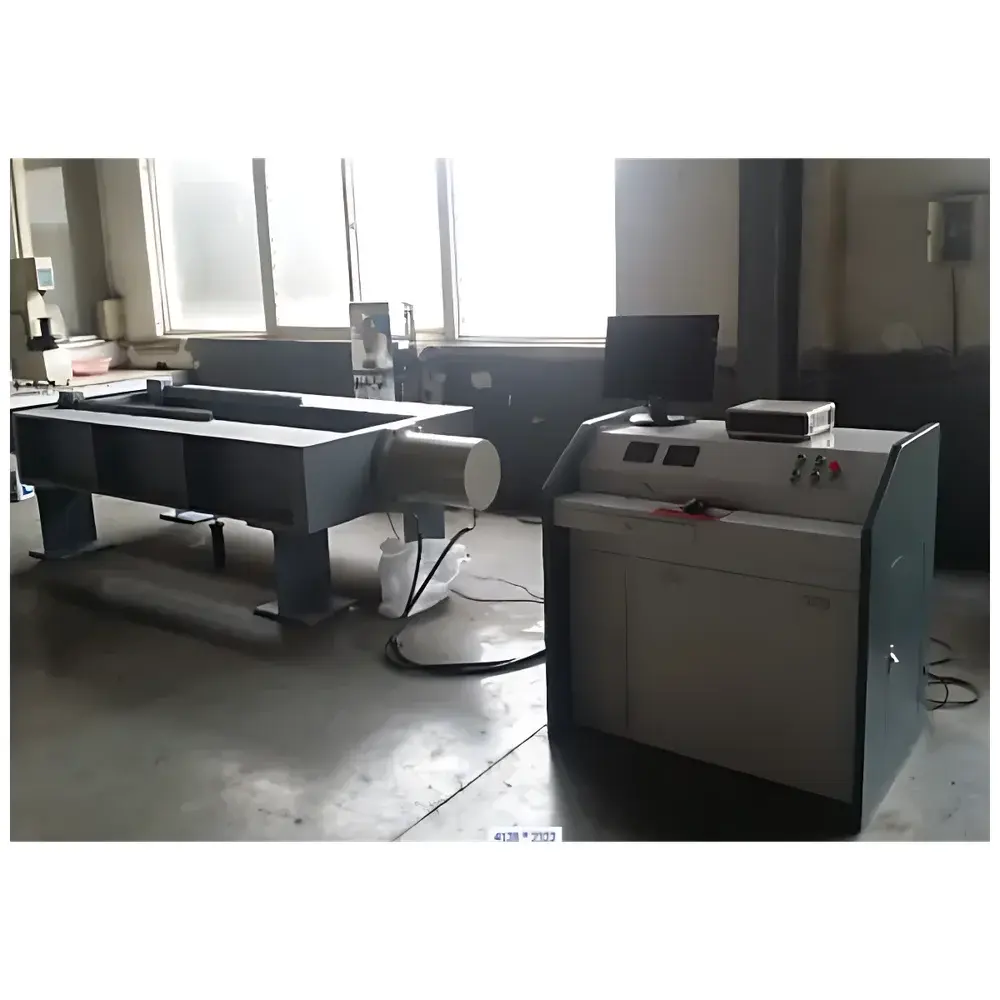
YANRUN 300kN Computer-Controlled Electro-Hydraulic Servo Horizontal Tensile Testing Machine
| Brand | YANRUN |
|---|---|
| Origin | Shanghai, China |
| Manufacturer Type | Direct Manufacturer |
| Model | 300kN |
| Max Test Force | 300 kN |
| Force Measurement Range | 4–100% FS |
| Force Accuracy | ≤ ±1% |
| Stroke | 1,000 mm |
| Maximum Test Length (Gauge Length Extension) | 10 m |
| Piston Speed (No-Load) | ≥100 mm/min |
| Controlled Loading Speed | 0.5–80 mm/min |
| Control System | Electro-hydraulic servo with real-time PC-based closed-loop control |
| Display Interface | Industrial PC with LCD monitor and dedicated tensile testing software |
Overview
The YANRUN 300kN Computer-Controlled Electro-Hydraulic Servo Horizontal Tensile Testing Machine is an industrial-grade static mechanical testing system engineered for high-force, long-stroke uniaxial tension evaluation of structural components, cables, anchorages, prestressed tendons, railway rails, composite rods, and large-scale geotechnical or civil engineering specimens. Unlike vertical tensile frames, its horizontal configuration enables stable loading of extended specimens—up to 10 meters in effective test length—while minimizing gravitational sag, bending moments, and alignment-induced eccentricity. The system operates on the principle of electro-hydraulic servo actuation: a high-response proportional servo valve regulates hydraulic flow to a double-acting 300 kN capacity cylinder, enabling precise force and displacement control via real-time feedback from a calibrated 300 kN load cell and linear displacement transducers. Designed for ISO 7500-1 Class 1 and ASTM E4-compliant static force verification, it delivers traceable, repeatable performance across its full operational range (4–100% FS) with ≤ ±1% force measurement uncertainty.
Key Features
- Horizontal load frame architecture with rigid welded base, reinforced guide rails, and precision-aligned pull rods to ensure axial loading fidelity and minimize parasitic bending during high-force tests.
- 300 kN dual-acting servo-hydraulic actuator featuring a 1,000 mm stroke and piston velocity up to 100 mm/min under no-load conditions; programmable loading rates from 0.5 to 80 mm/min with closed-loop displacement or force control.
- High-stability 300 kN S-type or canister-type load cell, independently calibrated per ISO 376, integrated with temperature-compensated signal conditioning and 24-bit ADC resolution.
- Dedicated industrial control cabinet housing servo amplifier, safety interlock logic (emergency stop, over-travel, pressure limit), and I/O modules compliant with IEC 61000-6-2/6-4 EMC standards.
- Hydraulic power unit with low-noise variable-displacement pump, multi-stage filtration (β₃≥1000), pressure relief and check valves, and seamless steel tubing + high-pressure rubber hoses rated to 35 MPa.
- Real-time control and data acquisition via embedded industrial PC running Windows OS and proprietary tensile testing software supporting multi-channel synchronous sampling (force, displacement, extensometer if added) at ≥1 kHz.
Sample Compatibility & Compliance
This horizontal tensile tester accommodates specimens requiring extended gauge lengths—including wire ropes (6×37, 6×19), pre-stressing strands (1×7, 1×19), anchor assemblies, bridge hangers, mining cables, and modular composite beams—without reconfiguration. Fixtures include adjustable wedge-type grips, custom pin-ended fixtures (with standardized销轴 interfaces), and auxiliary support cradles for distributed load management. The system meets mechanical safety requirements per ISO 12100 and functional safety per EN 62061 (SIL 2). Force calibration traceability aligns with ISO/IEC 17025-accredited laboratories. Data integrity complies with FDA 21 CFR Part 11 when audit trail, electronic signature, and user role-based access controls are enabled in software configuration.
Software & Data Management
The bundled testing software provides ISO 6892-1:2019-compliant tensile curve generation (engineering stress–strain, true stress–strain), automatic yield point detection (0.2% offset, upper/lower yield), modulus calculation (tangent, secant, chord), and fracture analysis (elongation at break, reduction of area). Raw data is stored in encrypted binary format with metadata (operator ID, timestamp, environmental conditions, calibration IDs). Export options include CSV, XML, PDF reports (with company logo, test standard header, and digital signature), and direct integration with LIMS via OPC UA or TCP/IP socket interface. All test sequences, parameter sets, and report templates are version-controlled and backed up automatically.
Applications
- Mechanical qualification of high-strength steel cables and post-tensioning systems in bridge and building construction.
- Proof testing and fatigue pre-conditioning of lifting slings, marine mooring lines, and offshore anchoring chains.
- R&D validation of advanced composites (CFRP rods, GFRP rebars) under sustained tensile load per ACI 440.3R.
- Quality assurance of rail fastening systems and switch components per EN 13481-2.
- Calibration reference for secondary force standards in metrology labs operating under ISO/IEC 17025 scope.
- Geotechnical pull-out testing of soil nails and ground anchors under controlled displacement ramping.
FAQ
What is the maximum specimen length supported without modification?
The machine supports up to 10 meters of effective test length between front and rear crossheads, accommodating full-scale structural elements without sectioning.
Can the system be configured for cyclic or creep testing?
Yes—when equipped with optional high-resolution extensometers and upgraded software license, it supports displacement-controlled sinusoidal loading (±0.5–5 Hz, limited by hydraulic response) and time-dependent creep/stress relaxation protocols per ISO 899-1.
Is third-party calibration documentation provided upon delivery?
Each unit ships with a factory calibration certificate traceable to NIM (China National Institute of Metrology), including as-found/as-left data for load cell and displacement sensors.
What safety certifications does the control cabinet hold?
The electrical enclosure conforms to GB/T 5226.1 (equivalent to IEC 60204-1), with CE marking for machinery directive 2006/42/EC and RoHS compliance.
Does the software support multi-user environments with permission tiers?
Yes—administrator, operator, and reviewer roles are configurable, with password protection, session logging, and immutable audit trails for all critical actions (test start/stop, parameter edits, report approvals).



