
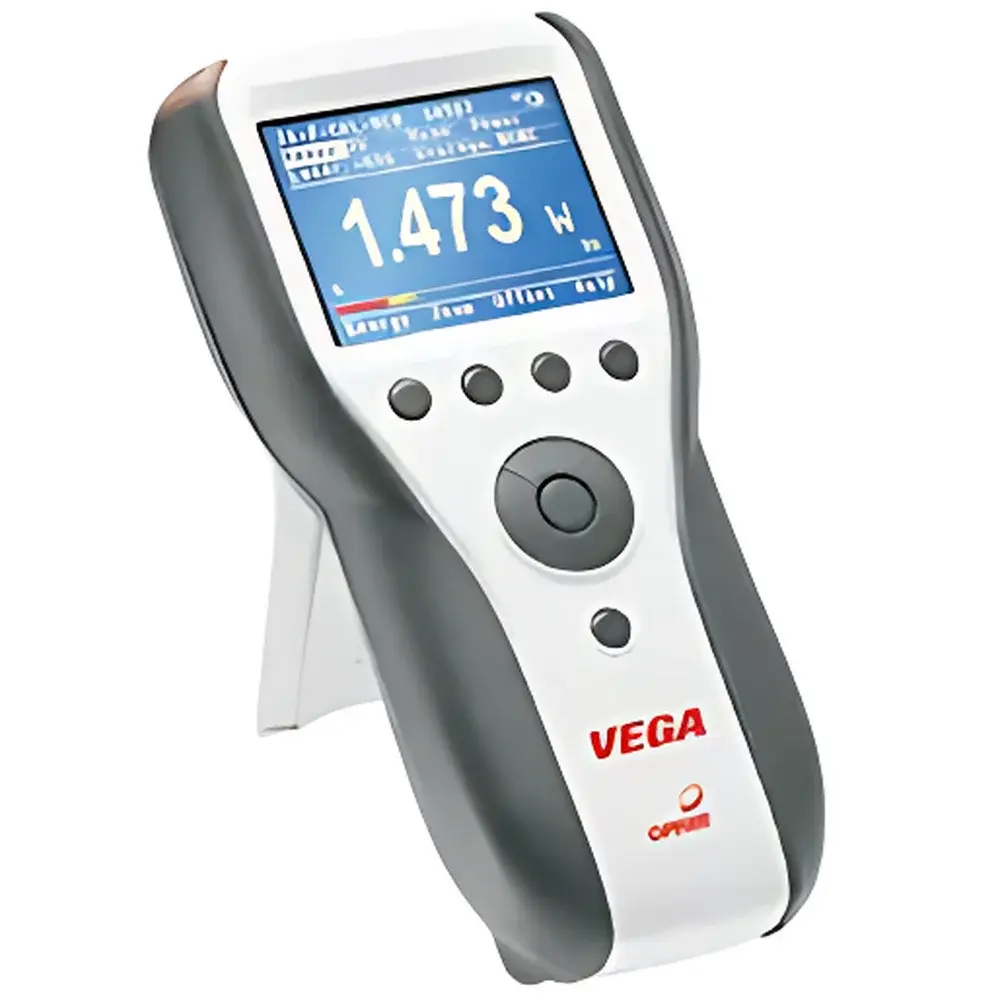
Ophir VEGA Laser Power and Energy Meter
| Brand | Ophir |
|---|---|
| Origin | Israel |
| Model | VEGA |
| Probe Compatibility | Thermopile, Pyroelectric, Photodiode, BeamTrack, RP Sensors |
| Display | 320×240 TFT Color LCD |
| Data Storage Capacity | 250,000 readings |
| Sampling Rate (with Pyroelectric Probes) | Up to 4,000 Hz |
| Interface | USB 2.0, RS232, Optional GPIB |
| Software Integration | StarLab, StarCom, LabVIEW, COM Object, ActiveX |
| Compliance | CE, RoHS, ISO/IEC 17025 traceable calibration support |
Overview
The Ophir VEGA Laser Power and Energy Meter is a high-precision, handheld instrumentation platform engineered for accurate, real-time measurement of continuous-wave (CW) laser power and pulsed laser energy across ultraviolet, visible, and near-infrared spectral ranges. Based on calibrated thermopile, pyroelectric, and photodiode sensor technologies—each traceable to NIST or PTB standards—the VEGA meter functions as a universal readout unit that interfaces seamlessly with Ophir’s full family of ISO 11554-compliant optical sensors. Its architecture implements analog-to-digital conversion with 16-bit resolution, temperature-compensated signal conditioning, and automatic range selection to ensure measurement stability under varying ambient conditions. Designed for use in R&D laboratories, laser manufacturing QA/QC environments, medical device validation, and defense-related optical testing, the VEGA meets the metrological rigor required by ISO/IEC 17025-accredited facilities and supports audit-ready data integrity workflows.
Key Features
- Universal probe compatibility: Fully supports Ophir’s thermopile (for CW power up to 10 kW), pyroelectric (for pulse energy from µJ to J, repetition rates up to 25 kHz), photodiode (for low-power CW beams down to nW), BeamTrack (for beam position, size, and centroid analysis), and RP series (for high-energy nanosecond pulses) sensors.
- High-resolution color display: 320×240-pixel TFT LCD with adjustable brightness and backlighting—optimized for both cleanroom and low-light operational settings.
- High-speed data acquisition: Up to 4,000 Hz sampling when paired with pyroelectric probes; real-time waveform capture and statistical analysis (mean, standard deviation, min/max) directly on-device.
- Robust local data management: Internal non-volatile memory stores up to 250,000 timestamped measurements with user-defined logging intervals; supports CSV export via USB mass storage mode.
- Dual-mode visualization: Simultaneous numeric readout and analog-style needle display for intuitive trend recognition during alignment or transient monitoring.
- Industrial-grade connectivity: Integrated USB 2.0 (CDC & HID classes), RS232 (TTL/DB9), and optional IEEE-488 (GPIB) interfaces enable integration into automated test benches and compliance-driven software ecosystems.
Sample Compatibility & Compliance
The VEGA meter operates exclusively with Ophir-certified, individually calibrated sensors—each supplied with a unique calibration certificate referencing ISO/IEC 17025-accredited reference standards. Sensor selection is governed by laser parameters including wavelength (190 nm – 20 µm), average power (nW to 10 kW), pulse energy (µJ to 100 J), pulse width (fs to CW), and beam diameter (50 µm to >25 mm). All supported probes comply with IEC 60825-1 for laser safety classification and undergo damage threshold verification per ISO 21254. The VEGA platform itself conforms to EN 61326-1 (EMC) and EN 61010-1 (safety), carries CE and RoHS markings, and supports FDA 21 CFR Part 11–compliant electronic record workflows when used with validated StarLab v3.x or custom LabVIEW applications featuring audit trail, electronic signatures, and role-based access control.
Software & Data Management
Ophir StarLab v3.30+ serves as the primary PC-based application for advanced configuration, real-time visualization, statistical reporting, and GLP/GMP-aligned data archiving. The VEGA exports raw and processed data in IEEE-488 SCPI command syntax and supports direct instrument control via LabVIEW drivers (NI-VISA), COM Object libraries, and ActiveX controls—enabling seamless integration into MATLAB, Python (PyVISA), and custom MES/QMS platforms. All communications include checksummed packet framing and configurable timeout/retry logic to ensure deterministic behavior in production automation environments. Firmware updates are delivered via signed .hex files with SHA-256 verification, and device configuration profiles (including unit preferences, averaging modes, and alarm thresholds) are stored in encrypted onboard memory.
Applications
- Laser source characterization during development and production of fiber, CO₂, diode-pumped solid-state (DPSS), and ultrafast lasers.
- Medical laser system validation per ANSI Z136.3 and IEC 60601-2-22 for dermatology, ophthalmology, and surgical ablation devices.
- Optical component damage threshold testing—including coatings, windows, and nonlinear crystals—using calibrated single-shot or burst-mode energy delivery.
- Beam delivery system commissioning in semiconductor lithography, additive manufacturing, and precision micromachining lines.
- Academic and national lab research requiring traceable radiometric measurements in quantum optics, plasma diagnostics, and laser-induced breakdown spectroscopy (LIBS).
FAQ
What calibration standards does the VEGA meter reference?
The VEGA itself is not calibrated independently; it relies on factory-calibrated Ophir sensors whose responsivity is traceable to national metrology institutes (NIST, PTB, NPL) per ISO/IEC 17025. Calibration certificates include uncertainty budgets and wavelength-dependent correction factors.
Can the VEGA operate without a PC connection?
Yes—it functions autonomously with full local display, data logging, statistics, and alarm triggering. PC connectivity is optional and used only for extended analysis, remote control, or regulatory documentation.
Is firmware update capability available in the field?
Yes—updates are performed via USB using Ophir-provided tools; no hardware modification or service center visit is required.
Does the VEGA support multi-channel measurement?
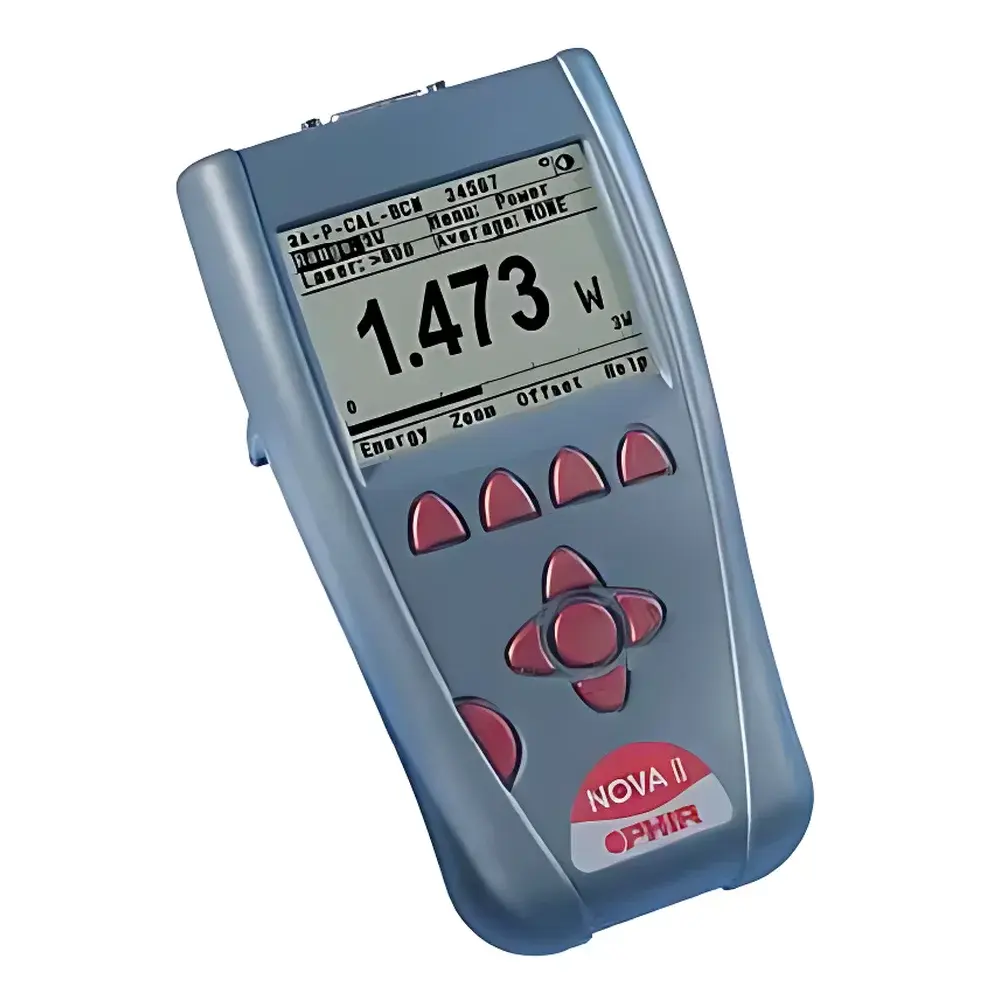
No—the VEGA is a single-channel meter. For dual-channel operation, users select the Juno or Nova II platforms, which share the same probe ecosystem but offer synchronized dual-input acquisition.
How is measurement uncertainty determined for a given sensor/meter combination?
Total uncertainty is calculated per GUM (JCGM 100:2008) as the root-sum-square of sensor calibration uncertainty, linearity error, temperature drift coefficient, digital resolution, and meter electronics noise—values published in each sensor’s datasheet and StarLab’s built-in uncertainty calculator.




