
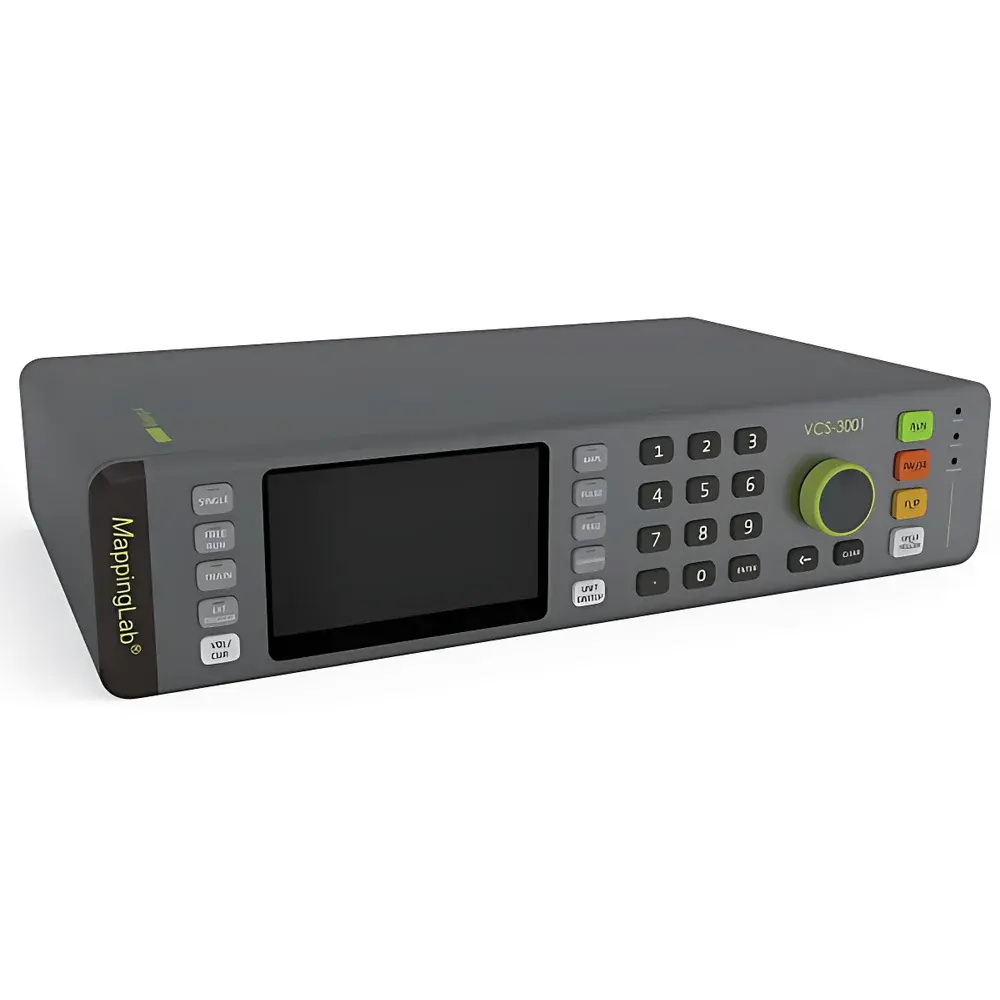
MappingLab VCS-3002 Dual-Mode Isolated Electrical Stimulator for Electrophysiology
| Brand | MappingLab |
|---|---|
| Model | VCS-3002 |
| Output Modes | Constant Voltage & Constant Current |
| Voltage Range | ±90 V |
| Current Range | ±32 mA |
| Voltage Accuracy | ±0.1 V |
| Current Accuracy | ±20 µA |
| Max Output Frequency | 30 kHz |
| Pulse Duration Stability | Up to 200 h continuous operation |
| Isolation | Built-in galvanic isolation (no external isolator required) |
| I/O Interface | TTL-triggered stimulation, analog/digital I/O connectors |
| Protection | Integrated overcurrent and overvoltage protection |
Overview
The MappingLab VCS-3002 Dual-Mode Isolated Electrical Stimulator is a precision-engineered instrument designed for controlled, reproducible electrical stimulation in electrophysiological research. It operates on the fundamental principle of delivering calibrated voltage or current pulses—either independently or interchangeably—to biological preparations such as neurons, muscle fibers, brain slices, or in vitro cell cultures. Unlike conventional stimulators requiring external isolation modules, the VCS-3002 integrates high-voltage galvanic isolation directly into its architecture, ensuring compliance with safety standards for low-noise, artifact-free recordings in patch-clamp, extracellular field potential, or whole-cell stimulation paradigms. Its dual-mode capability enables rigorous experimental design where stimulus modality itself is a controlled variable—e.g., comparing neuronal firing thresholds under constant-current versus constant-voltage drive, or validating electrode impedance effects during chronic stimulation protocols.
Key Features
- Dual-output architecture supporting both constant-voltage (±90 V) and constant-current (±32 mA) stimulation modes, switchable via front-panel interface or software command
- Built-in galvanic isolation rated for biomedical use—eliminates need for external isolation amplifiers and reduces ground-loop artifacts in multi-electrode setups
- High temporal fidelity: capable of generating biphasic, monophasic, or arbitrary pulse trains up to 30 kHz, with sub-millisecond timing resolution
- Precision output calibration: voltage accuracy ±0.1 V; current accuracy ±20 µA—traceable to internal reference circuits and validated per IEC 61000-4-5 surge immunity guidelines
- Robust hardware protection: automatic shutdown upon detection of open-circuit, short-circuit, or thermal overload conditions
- Flexible control layer: TTL input triggers synchronized stimulation onset; analog voltage input enables real-time amplitude modulation; digital I/O supports integration with DAQ systems or behavioral rigs
Sample Compatibility & Compliance
The VCS-3002 is validated for use with standard electrophysiology preparations including acute brain slices, dissociated primary neuronal cultures, skeletal and cardiac myocytes, and peripheral nerve explants. Its isolated output stage meets IEC 60601-1 requirements for applied part safety in laboratory-grade medical devices. While not intended for human clinical use, its performance aligns with GLP-compliant preclinical study workflows—particularly in neuropharmacology, neuromodulation device characterization, and in vitro neurotoxicity screening. The unit complies with electromagnetic compatibility (EMC) standards EN 61326-1 (Class B) and operates within ambient temperature ranges specified for ISO/IEC 17025-accredited laboratories.
Software & Data Management
Stimulation parameters—including pulse amplitude, duration, frequency, polarity, and inter-pulse interval—are configurable via a dedicated Windows-based GUI that logs timestamped parameter sets alongside system status events. The software supports export of configuration files in XML format for protocol replication across instruments and laboratories. For automated experiments, the VCS-3002 provides a documented COM interface and LabVIEW-compatible DLL drivers, enabling full integration into custom acquisition pipelines (e.g., with Spike2, pClamp, or Python-based OpenEphys environments). All parameter changes are recorded with audit-trail metadata, satisfying documentation requirements for FDA 21 CFR Part 11–aligned data integrity frameworks when used in regulated preclinical studies.
Applications
- Threshold determination and input-output curve generation in single-neuron or network-level stimulation
- Validation of microelectrode array (MEA) stimulation efficacy and charge-balanced waveform safety
- In vitro assessment of neuroprosthetic electrode materials under physiological saline conditions
- Paired-pulse facilitation/depression protocols requiring precise inter-stimulus intervals and amplitude stability over extended durations
- Chronic stimulation studies where 200-hour continuous operational reliability ensures uninterrupted long-term experiments
- Calibration of optical voltage or calcium indicators using defined electrical perturbations
FAQ
Is the VCS-3002 suitable for in vivo rodent experiments?
Yes—when used with appropriate stereotaxic electrodes and proper grounding, the isolated output minimizes stimulation artifact during simultaneous recording. Users must verify electrode impedance matching per channel specification.
Can multiple VCS-3002 units be synchronized?
Yes—via shared TTL master clock signal or external trigger distribution; phase alignment accuracy is <1 µs between units under identical firmware versions.
Does the device support biphasic symmetric/asymmetric waveforms?
Yes—both cathodic-anodic and anodic-cathodic configurations are programmable, with independent amplitude and duration control per phase.
What maintenance is required for long-term calibration stability?
No routine recalibration is needed; internal references are temperature-compensated and drift <0.05% per year under standard lab conditions (20–25°C, 40–60% RH).
Is firmware update supported remotely?
Yes—updates are distributed via encrypted USB key or secure HTTPS download, with SHA-256 signature verification and rollback capability.
Related Products




