
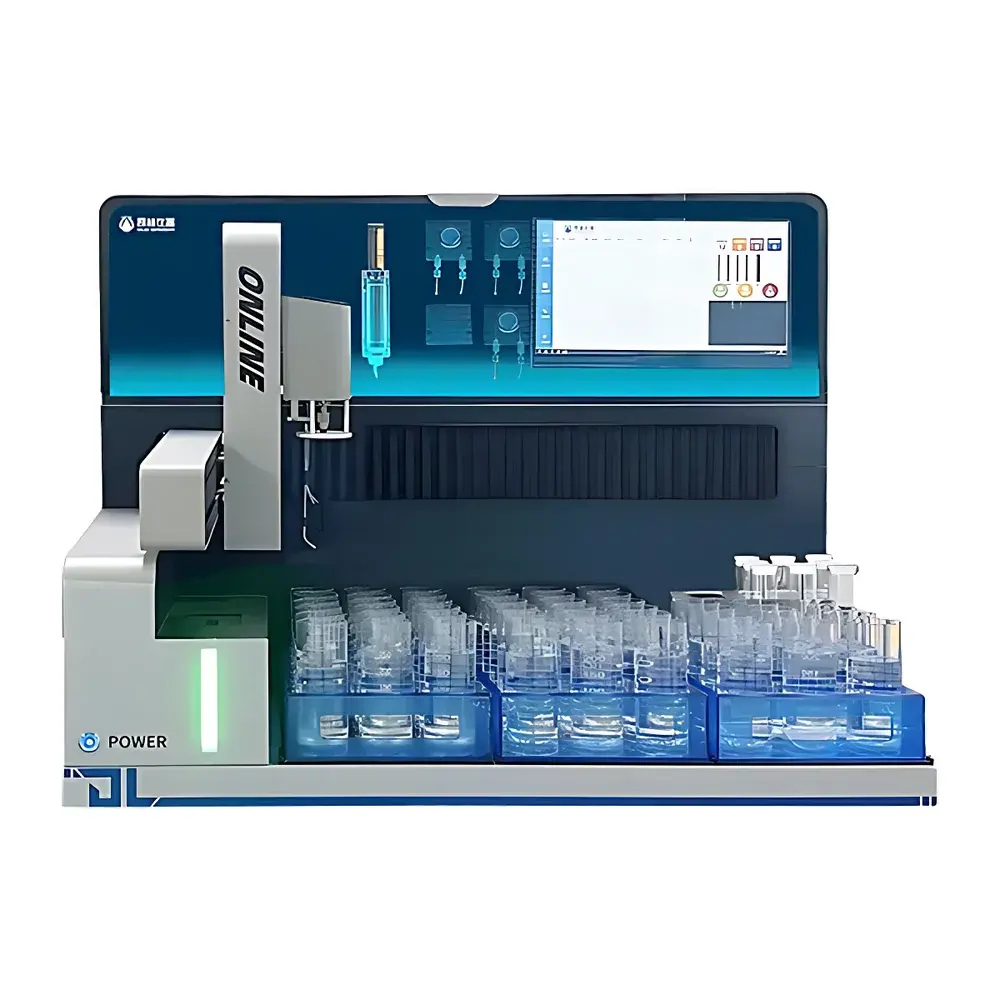
Online Instrument OL2900N Automated Nitrite (as N) Water Quality Analyzer
| Brand | Online Instrument |
|---|---|
| Model | OL2900N |
| Origin | Shanghai, China |
| Application Standard | GB/T 5750.5–2023 (Diazotization-Coupling Spectrophotometry for Nitrite as N) |
| Automation Level | Fully Automated Sample Processing, Reagent Dispensing, Calibration Curve Generation, Dilution, Measurement, and System Cleaning |
| Compliance | Designed for drinking water and raw water testing per Chinese national standard methodology |
| Remote Operation | Web-based and mobile-compatible interface with real-time status monitoring and voice/text-assisted technical support |
| Sample Throughput | Continuous unattended operation with priority-sample insertion capability |
| Waste Management | Closed-loop waste collection with integrated reagent-level monitoring and low-reagent alert |
Overview
The Online Instrument OL2900N is a fully automated, benchtop nitrite (as N) analyzer engineered for high-throughput, regulatory-compliant water quality testing in municipal drinking water utilities, environmental monitoring laboratories, and source water assessment facilities. It implements the diazotization-coupling spectrophotometric method specified in GB/T 5750.5–2023—a standardized adaptation of the classical Griess reaction—where nitrite ions in aqueous samples react with sulfanilamide under acidic conditions to form a diazonium salt, which then couples with N-(1-naphthyl)ethylenediamine dihydrochloride to yield a stable pink azo dye. Absorbance is measured at 540 nm using a precision photometric detection module with temperature-stabilized optics and dual-beam referencing to minimize drift. The instrument’s core architecture integrates fluidic control, photometric sensing, thermal management, and embedded analytical logic into a single sealed unit, eliminating manual intervention across all critical steps: sample aspiration, reagent metering, mixing, reaction incubation, optical measurement, data reduction, and post-run system decontamination.
Key Features
- Fully automated analytical workflow—from sample loading to report-ready concentration output—compliant with GB/T 5750.5–2023 requirements for nitrite quantification in drinking water and raw water.
- Intelligent multi-range calibration: automatic preparation of calibration standards from stock solutions, real-time generation and validation of working curves, and seamless switching between pre-stored low- and high-concentration curve sets.
- Auto-dilution functionality: detects out-of-range absorbance signals and initiates programmable serial dilution using onboard diluent reservoirs, ensuring quantitative accuracy across extended concentration ranges without operator input.
- Priority-sample handling protocol: supports dynamic queue management; marked urgent samples are inserted into the analysis sequence immediately after completion of the currently running assay, minimizing turnaround time for time-critical compliance checks.
- Integrated reagent monitoring system: tracks consumption volume for each reagent channel, triggers visual and audible alerts upon threshold depletion, and logs usage history for inventory planning and audit readiness.
- End-to-end closed-system design: all liquid pathways—including sample lines, reagent manifolds, mixing chambers, and waste conduits—are pneumatically sealed and flushed post-analysis to prevent cross-contamination and carryover.
Sample Compatibility & Compliance
The OL2900N is validated for use with clarified, filtered, or centrifuged samples meeting turbidity specifications outlined in GB/T 5750.5–2023 (≤1 NTU). It accommodates 10–50 mL sample volumes in standard polypropylene vials and accepts common laboratory-grade reagents without modification. While developed to meet China’s national drinking water standard methodology, its analytical principle aligns with internationally recognized protocols including ISO 6775:1984 (Water quality — Determination of nitrite — Spectrometric method) and APHA Standard Method 4500-NO₂⁻ B. The system supports GLP-aligned data integrity through timestamped audit trails, user-access logging, and electronic signature-capable result export. All firmware and software modules comply with IEC 62304 for medical device software safety classification, adapted for environmental instrumentation risk management.
Software & Data Management
The OL2900N operates via an embedded Linux-based control platform with a responsive HTML5 web interface accessible from any modern browser or mobile device (iOS/Android). Users can initiate runs, monitor real-time status (e.g., valve positions, photometer baseline, reagent levels), view live absorbance kinetics, and retrieve historical datasets with full metadata (sample ID, operator, date/time, curve parameters, dilution factors). Data exports conform to CSV and PDF formats compatible with LIMS integration. The system enforces role-based access control (RBAC), maintains immutable run logs compliant with 21 CFR Part 11 principles (electronic records and signatures), and provides optional cloud backup with TLS 1.3 encryption. Voice-assisted troubleshooting—powered by on-device natural language processing—is available for contextual help without external connectivity.
Applications
- Routine compliance monitoring of nitrite (as N) in municipal drinking water distribution systems and treatment plants.
- Source water surveillance for agricultural runoff, industrial discharge, or wastewater effluent impacts.
- Quality assurance testing in bottled water production and food processing facilities where water serves as ingredient or rinse medium.
- Field-deployable lab support for environmental agencies conducting seasonal groundwater or surface water surveys.
- Research applications requiring reproducible, low-interference nitrite quantification in complex matrices such as chlorinated or iron-rich waters.
FAQ
What is the detection range for nitrite (as N) on the OL2900N?
The instrument achieves a typical linear dynamic range of 0.001–1.0 mg/L nitrite-N, extendable up to 10 mg/L via automated dilution. Actual performance depends on sample matrix, filter clarity, and reagent batch calibration.
Does the OL2900N require daily maintenance or manual calibration?
No daily recalibration is required. The system performs self-diagnostic checks at startup and validates photometric stability before each batch. Routine maintenance includes monthly tubing inspection and quarterly photometer verification using NIST-traceable standards.
Can the OL2900N be integrated into an existing LIMS or SCADA environment?
Yes—via configurable RESTful API endpoints and HL7-compliant message formatting. Pre-built drivers are available for Thermo Fisher SampleManager, LabVantage, and Siemens Desigo CC platforms.
Is remote firmware update supported?
Firmware updates are delivered via secure SFTP or USB import, with rollback capability and SHA-256 signature verification to ensure integrity and traceability.
How does the system handle interfering substances like chloride or nitrate?
The method incorporates built-in interference correction algorithms based on GB/T 5750.5–2023 guidance, including optional pre-treatment steps (e.g., cadmium column reduction for nitrate masking) when configured with auxiliary modules.







