
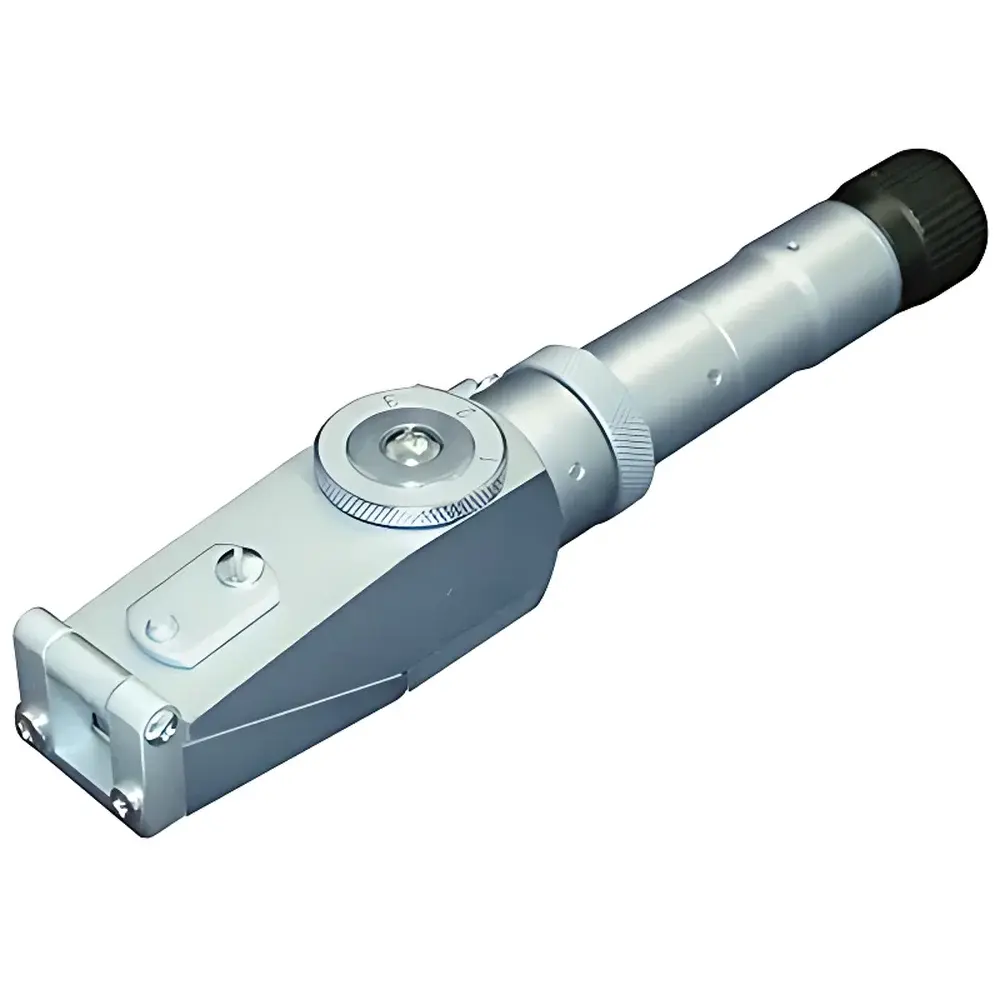
ATAGO HSR-500 Handheld Refractometer
| Brand | ATAGO |
|---|---|
| Origin | Japan |
| Model | HSR-500 |
| Measurement Range | Brix 0.0–90.0% |
| Accuracy | ±0.2% Brix |
| Temperature Control | Yes |
| Display Type | Analog (scale-view optical eyepiece) |
| Sample Volume | < 0.3 mL |
| Dimensions | 4 × 4 × 20 cm |
| Weight | 600 g |
| Compliance | ISO 2173, AOAC 932.12, ASTM D1078 |
Overview
The ATAGO HSR-500 Handheld Refractometer is a precision optical instrument engineered for rapid, field-deployable measurement of refractive index–derived concentration parameters—including Brix (sugar content), total dissolved solids (TDS), and specific gravity—across liquid samples in food & beverage, agriculture, chemical, and pharmaceutical applications. Based on the principle of critical angle refraction, the device employs a high-stability Abbe-type prism system coupled with temperature-compensated optics to deliver consistent readings independent of ambient thermal fluctuations. Unlike digital refractometers requiring battery power or calibration software, the HSR-500 operates entirely optomechanically: incident light passes through the sample-prism interface, and the resulting shadow line position on an internal scale is interpreted visually through a calibrated eyepiece. Its wide Brix range (0.0–90.0%) supports diverse matrices—from fruit juices and syrups to honey, molasses, and industrial brines—without dilution or range-switching.
Key Features
- Optical temperature compensation (ATC) mechanism integrated into the prism assembly, maintaining accuracy across 10–40 °C without external thermostating
- Robust all-metal housing (aluminum alloy body) with IP54-rated ingress protection against dust and splashing water
- High-contrast engraved scale with dual Brix and refractive index (nD) graduations for cross-referenced interpretation
- No batteries, no electronics—fully mechanical operation ensures long-term reliability and zero drift over time
- Minimal sample requirement: ≤0.3 mL per measurement, reducing waste and enabling analysis of precious or viscous samples
- Ergonomic handheld form factor (600 g, 20 cm length) optimized for extended use in production lines, orchards, or lab benchtops
Sample Compatibility & Compliance
The HSR-500 is validated for aqueous solutions where solutes exhibit linear refractive index–concentration relationships—primarily sucrose-based systems—but also applicable to glucose, fructose, sodium chloride, ethylene glycol, and propylene glycol solutions when referenced to appropriate calibration curves. It complies with internationally recognized standard methods including ISO 2173 (fruit and vegetable products), AOAC Official Method 932.12 (sugar in cane juice), and ASTM D1078 (refractive index of liquids). While not designed for turbid, highly colored, or emulsified samples—where light scattering compromises critical angle detection—the instrument meets GLP documentation requirements when used within defined SOPs and maintained per ATAGO’s recommended cleaning and verification protocol (e.g., daily zero-check with distilled water at 20 °C).
Software & Data Management
As a purely analog optical instrument, the HSR-500 does not incorporate embedded firmware, Bluetooth connectivity, or data logging capabilities. All measurements are recorded manually by the operator via visual scale reading and transcription into paper logs or LIMS-compatible spreadsheets. This architecture eliminates cybersecurity vulnerabilities, firmware update dependencies, and electronic calibration drift—making it suitable for regulated environments where audit trails rely on procedural controls rather than digital validation. For laboratories operating under FDA 21 CFR Part 11 or EU Annex 11, the HSR-500 may be included in instrument qualification protocols (IQ/OQ/PQ) as a Class I passive measuring device; its verification is documented through periodic reference standard checks using NIST-traceable sucrose solutions.
Applications
- Quality control of fruit juices, jams, and soft drinks during processing and final packaging
- In-field ripeness assessment of grapes, mangoes, and citrus fruits prior to harvest
- Concentration monitoring of syrup, honey, and maple sap in artisanal and industrial production
- Antifreeze solution verification in automotive and HVAC maintenance
- Routine checking of battery electrolyte specific gravity (via nD correlation)
- Educational demonstration of optical refraction principles in chemistry and food science curricula
FAQ
Does the HSR-500 require calibration before each use?
No—calibration is performed only when environmental conditions change significantly or after physical impact; a daily zero check with distilled water at 20 °C is recommended.
Can it measure non-sucrose solutions like saltwater or ethanol?
Yes, but requires application-specific calibration tables or conversion factors; factory Brix scale is optimized for sucrose equivalence.
Is the eyepiece adjustable for users with corrective vision?
Yes—the diopter-adjustable ocular allows focus tuning for operators wearing glasses or contact lenses.
What cleaning agents are safe for the prism surface?
Use only lens-grade tissue with reagent-grade isopropyl alcohol or distilled water; avoid acetone, chlorinated solvents, or abrasive cloths.
How is temperature compensation achieved without electronics?
Via a bimetallic ATC strip bonded to the prism, which physically shifts the optical path to offset thermal expansion effects on refractive index.





