
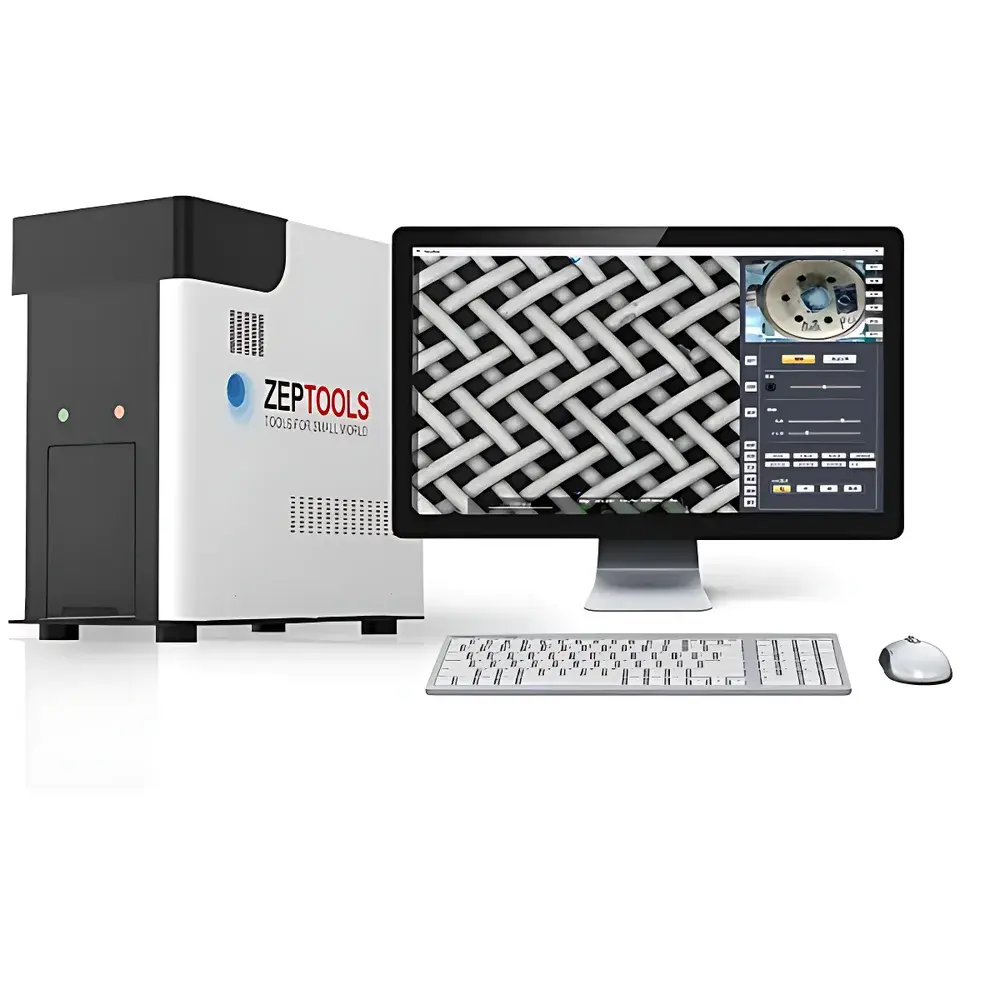
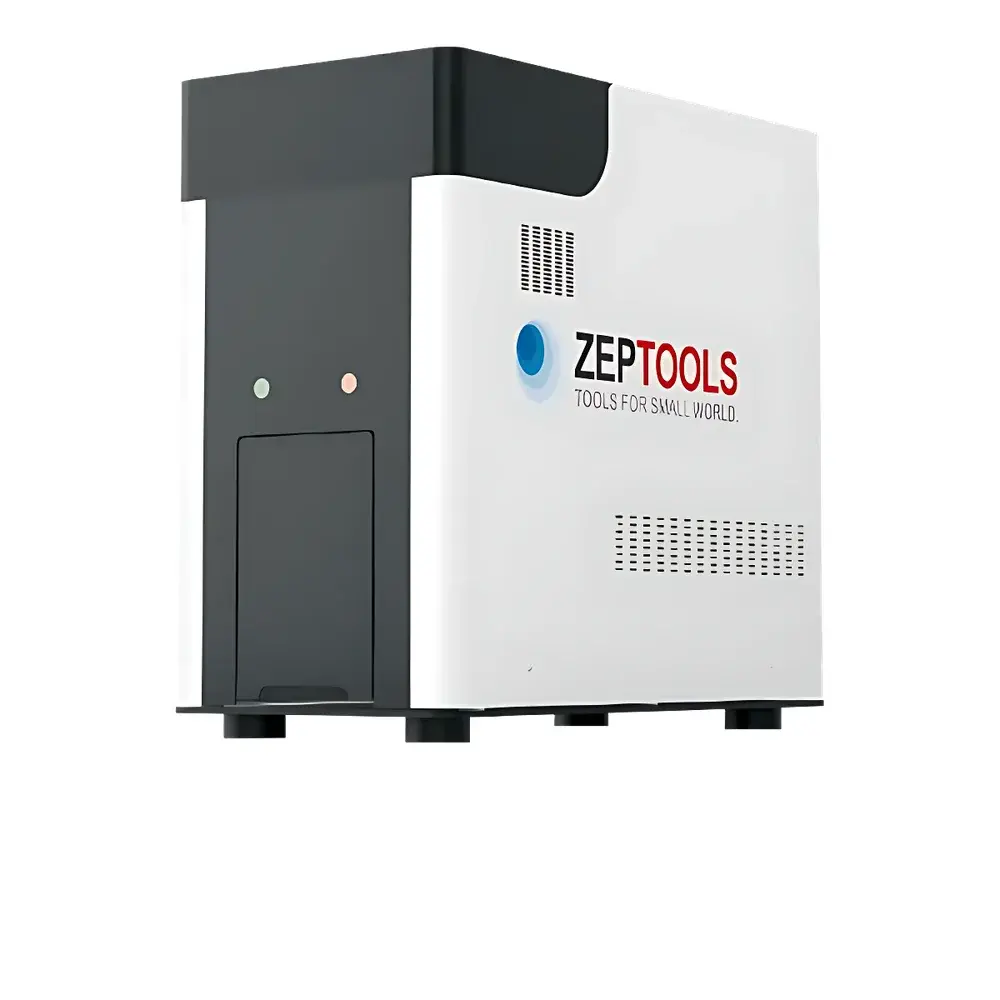
ZEPTOOLS ZEM15C Desktop Scanning Electron Microscope
| Brand | ZEPTOOLS |
|---|---|
| Origin | Anhui, China |
| Manufacturer Type | Direct Manufacturer |
| Instrument Type | Desktop SEM |
| Electron Source | Pre-aligned Tungsten Filament |
| Acceleration Voltages | 5 kV / 10 kV / 15 kV |
| Secondary Electron (SE) Resolution | <10 nm |
| Backscattered Electron (BSE) Resolution | <10 nm |
| Maximum Magnification | 150,000× |
| Stage Type | Motorized 2-Axis Sample Stage (X/Y: 25 mm × 25 mm) |
| Vacuum Pumping Time to High Vacuum | ≤2 min |
| Max Sample Dimensions | Ø50 mm × H35 mm |
| Integrated Optics | Monolithic Condenser Lens System |
| Operating Environment | Standard Lab/Office Floor with Vibration Damping Base |
Overview
The ZEPTOOLS ZEM15C Desktop Scanning Electron Microscope is a compact, high-performance SEM engineered for routine imaging and microstructural analysis in resource-constrained or space-limited environments. Unlike conventional floor-standing SEMs requiring dedicated rooms, high-voltage infrastructure, and extensive shielding, the ZEM15C employs a pre-aligned tungsten filament electron source combined with an integrated high-voltage generator and vacuum control system—enabling stable beam operation from standard 100–240 V AC power. Its imaging principle relies on raster-scanned electron beam interaction with solid specimens, generating secondary electrons (SE) for topographic contrast and backscattered electrons (BSE) for atomic number contrast. With a verified SE and BSE resolution of <10 nm at 15 kV and magnifications up to 150,000×, the ZEM15C delivers analytical capability comparable to mid-tier benchtop SEMs while maintaining operational simplicity and rapid vacuum cycling (≤2 minutes to high vacuum, ~1×10⁻³ Pa).
Key Features
- Pre-aligned tungsten filament electron gun: Eliminates manual filament centering and alignment procedures—reducing operator training time and improving daily reproducibility.
- Integrated monolithic condenser lens system: Provides consistent beam convergence and optimal probe current stability across acceleration voltages (5 kV, 10 kV, 15 kV).
- Motorized 2-axis sample stage (X/Y: 25 mm × 25 mm): Enables precise positional navigation and automated area mapping without manual repositioning.
- Dual-detector configuration: Simultaneous acquisition via segmented BSE detector (4-quadrant) and Everhart-Thornley-type SE detector supports multi-contrast imaging and compositional correlation.
- Compact footprint (<0.5 m² floor space) and vibration-damped base design: Allows deployment in general-purpose laboratories, QC rooms, cleanrooms (Class 10,000), or even office environments without structural reinforcement.
- High-vacuum chamber with turbomolecular pumping: Achieves operating pressure ≤1×10⁻³ Pa in under 120 seconds—minimizing idle time between samples.
Sample Compatibility & Compliance
The ZEM15C accommodates conductive and non-conductive specimens up to Ø50 mm in diameter and 35 mm in height. Non-conductive samples—including polymers, biological tissues, ceramics, and geological sections—can be imaged directly or following low-thickness carbon or Au/Pd sputter coating (≤5 nm). The instrument meets IEC 61000-6-3 (EMC emission) and IEC 61000-6-2 (immunity) standards. Its vacuum interlock architecture and real-time pressure monitoring comply with ISO 14644-1 (cleanroom classification) interface requirements. While not certified for GMP/GLP-regulated production environments, its audit-ready log file generation (timestamped acquisition metadata, user ID, HV settings, detector gain) supports traceability per ISO/IEC 17025:2017 clause 7.8.2 for testing laboratories.
Software & Data Management
Control and image acquisition are managed via ZEPTOOLS’ proprietary SEM Suite v3.2—a Windows-based application supporting live streaming, real-time focus/stigmation correction, and batch acquisition protocols. All acquired images embed EXIF-style metadata (acceleration voltage, working distance, dwell time, detector type, magnification, stage coordinates). Export formats include TIFF (16-bit), PNG, and CSV (for intensity profile extraction). Raw image data and system logs are stored in encrypted local directories with optional network share synchronization. Audit trail functionality records all parameter modifications, user logins, and acquisition events—supporting internal QA reviews and FDA 21 CFR Part 11-compliant workflows when deployed with validated IT infrastructure.
Applications
The ZEM15C serves as a primary characterization tool in academic teaching labs, materials R&D centers, and industrial quality assurance departments. Typical use cases include: morphology assessment of battery cathode materials (e.g., LiFePO₄ particles at 30 k×), dispersion analysis of nanocarbons (e.g., CNT networks at 20 k×), grain boundary evaluation in sintered oxides (e.g., SiO₂ at 100 k×), and failure analysis of metallized polymer films. Its low-kV imaging capability (5 kV) enables charge-free imaging of beam-sensitive organics and thin-film coatings. In life sciences, it supports dried, fixed, and coated biological specimens—including pollen, diatoms, and freeze-fractured tissue sections—without cryo-stage dependency.
FAQ
What vacuum level does the ZEM15C achieve, and how is it maintained?
The system reaches ≤1×10⁻³ Pa using a hybrid vacuum architecture: a scroll pump for roughing and a turbomolecular pump for high vacuum. A capacitance manometer provides continuous pressure feedback, and automatic valve sequencing ensures stable operation during sample exchange.
Is conductive coating required for non-metallic samples?
Coating is recommended for insulating specimens thicker than 1 µm to prevent charging artifacts; however, the ZEM15C’s low-kV mode (5 kV) and optimized BSE detection often allow uncoated imaging of thin polymer films and biological sections.
Can the ZEM15C be integrated into automated workflows?
Yes—the instrument supports RS-232 and Ethernet (TCP/IP) communication protocols. SDK documentation and Python-compatible API modules enable integration with LIMS, robotic sample handlers, and custom metrology scripts.
What maintenance intervals are recommended for the tungsten filament?
Under typical usage (≤4 h/day, 5 kV–15 kV), filament lifetime exceeds 150 hours. Replacement is performed via front-access cartridge design and requires no vacuum break or realignment—average downtime: <15 minutes.
Does the system support elemental analysis?
The ZEM15C platform is EDS-ready: it includes a standardized 8-pin electrical interface and mechanical mounting points compatible with third-party silicon drift detectors (SDD), though EDS hardware is not included by default.



