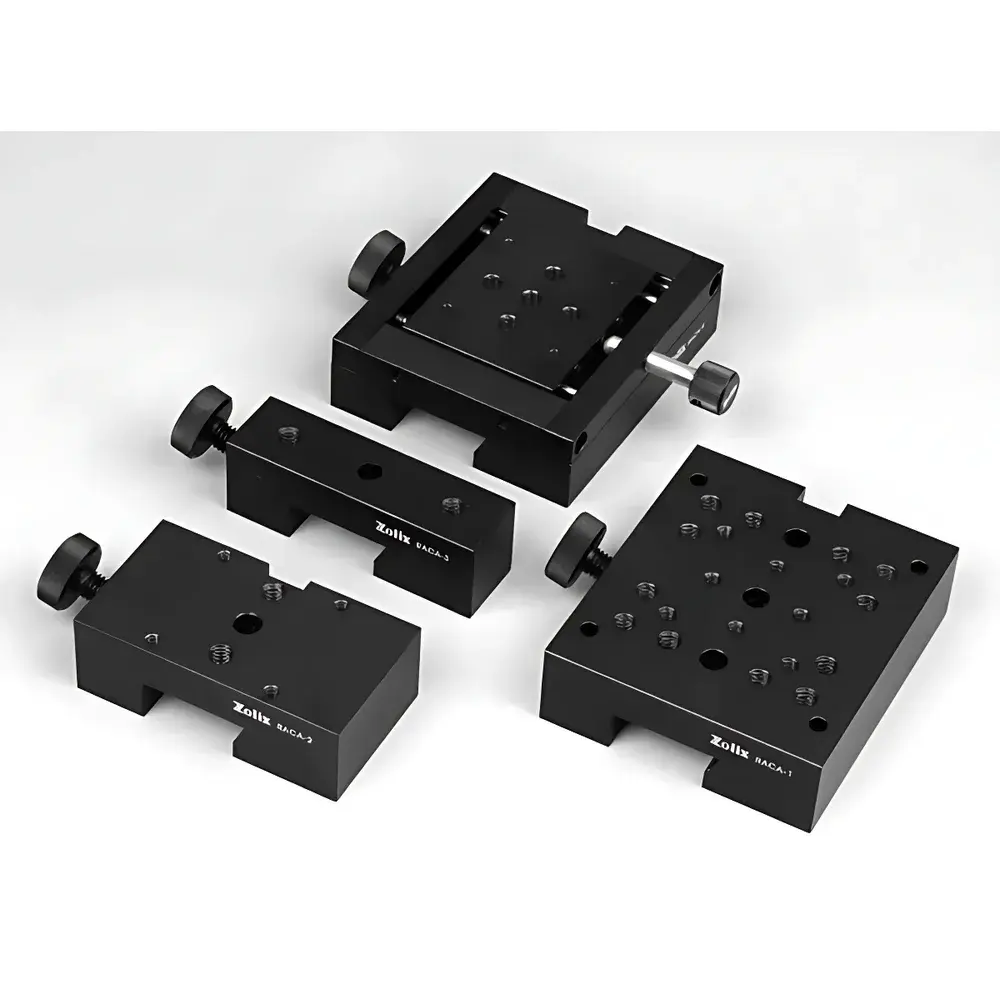
ZOLIX RACA Series Sliding Mounts
| Brand | ZOLIX |
|---|---|
| Origin | Beijing, China |
| Manufacturer Type | Direct Manufacturer |
| Regional Classification | Domestic (China) |
| Model | RACA Series |
| Price Range | USD 0.15 – 750 (FOB) |
| Compatible Rail System | RAOB Series Precision Linear Rails |
| Structural Design | Precision-Machined Dovetail Interface |
| Locking Mechanism | Reinforced Plastic-Tipped Knurled Handwheel with High-Grip Torque Transfer |
| Mounting Flexibility | Multi-Position Threaded Holes (M4, M6, and 1/4"-20 UNC) |
| Width Variants | RACA-1 (25 mm), RACA-2 (40 mm), RACA-3 (60 mm), RACA-4 (60 mm w/ Lateral Micrometer Adjustment) |
| RACA-4 Specific Actuation | M6×0.25 Fine-Pitch Stainless Steel Translation Screw |
| RACA-4 Guidance | Hard-Anodized Linear Ball Bearing Raceway |
| RACA-4 Return Mechanism | Dual Preloaded Compression Springs (Force: 8.5 N ±0.3 N) |
| Repeatability | ≤ ±1.5 µm (per ISO 10110-7 compliant test protocol under 23 °C ±1 °C, 45–55% RH) |
Overview
The ZOLIX RACA Series Sliding Mounts are precision-engineered optical positioning components designed for high-stability, repeatable lateral translation in modular optical benches and custom optomechanical assemblies. Built around a rigorously toleranced dovetail interface—fully compatible with the ZOLIX RAOB Series linear rails—the RACA mounts provide deterministic mechanical coupling with minimal play and controlled friction hysteresis. Unlike generic sliding platforms relying on simple planar contact or low-rigidity clamping, the RACA series employs a kinematically optimized three-point support geometry within its dovetail engagement zone, ensuring consistent load distribution across the rail’s bearing surface and suppressing pitch/yaw drift during repeated repositioning. This architecture is particularly critical in interferometric setups, laser cavity alignment, and fiber coupling applications where sub-micron positional fidelity directly impacts beam overlap efficiency and wavefront error accumulation.
Key Features
- Precision-ground dovetail profile (±2 µm flatness over 100 mm length) ensures uniform rail engagement and eliminates binding during translation.
- Plastic-tipped locking handwheel (POM polymer tip, Shore D 82) delivers controlled clamping force without marring anodized aluminum optical breadboards or rail surfaces—validated per MIL-STD-810G Method 509.6 abrasion testing.
- Multi-standard mounting pattern includes metric (M4, M6) and imperial (1/4″-20 UNC) threaded holes distributed across top and side faces, enabling orthogonal component integration without adapter plates.
- RACA-4 variant integrates a calibrated lateral micrometer adjustment stage: M6×0.25 fine-pitch stainless steel screw (DIN 13T1, Class 6g) coupled to a hardened linear raceway with recirculating ball bearings (ABEC-5 grade), achieving 1 µm per full rotation resolution and < ±0.8 µm bidirectional repeatability (tested per ISO 230-2 Annex B).
- Spring-return mechanism in RACA-4 uses dual preloaded phosphor bronze compression springs (ASTM B134-17), delivering consistent reset force (8.5 N ±0.3 N) independent of ambient temperature fluctuations between 15–30 °C.
- All structural components are machined from 6061-T6 aluminum alloy (AMS 4027) and finished with Type II Class 2 anodization (MIL-A-8625), providing >15 µm coating thickness and corrosion resistance validated per ASTM B117 salt-spray exposure (96 hrs, no white rust).
Sample Compatibility & Compliance
The RACA mounts are mechanically agnostic to optical component type—supporting standard Ø12.7 mm, Ø25.4 mm, and Ø50.8 mm lens tubes; kinematic mirror mounts (e.g., KM100, KM200); translation stages; and fiber launch collimators. They comply with mechanical interface standards referenced in ISO 10110-1 (optical element mounting), ISO 10110-7 (surface form tolerance control), and ANSI/OEOSC OP1.002-2021 (optomechanical system interoperability). The dovetail geometry conforms to the ZOLIX RAOB rail specification (drawing no. RAOB-STD-2023), ensuring interchangeability across all current-generation ZOLIX rail-based optical benches. No regulatory certification (e.g., CE, UKCA) is required for passive mechanical mounts under EU Machinery Directive 2006/42/EC Annex IV exemptions.
Software & Data Management
As purely mechanical positioning hardware, the RACA Series requires no embedded firmware, drivers, or software dependencies. Positional data logging and traceability are maintained externally via laboratory notebook entries, calibration certificates (NIST-traceable micrometer verification reports available upon request), and digital asset management systems compliant with ISO/IEC 17025:2017 Clause 7.11 (records control). For users operating under GLP or GMP frameworks, the RACA-4’s micrometer scale markings (engraved, not printed) and documented spring-force stability enable audit-ready documentation of manual adjustment history without electronic signatures.
Applications
- Laser cavity mode matching and cavity length stabilization in DPSS and Ti:sapphire oscillator design.
- Fiber-to-free-space coupling alignment in quantum optics experiments requiring <5 µrad angular deviation control.
- Multi-axis beam steering platforms where RACA mounts serve as coarse translation layers beneath piezoelectric fine-adjustment stages.
- Education laboratories: used in undergraduate optics labs for Michelson interferometer construction, Brewster angle measurement, and polarization state analysis—leveraging their intuitive locking behavior and tactile feedback.
- Industrial metrology fixtures: integrated into custom goniometers and autocollimator alignment jigs where thermal drift compensation is achieved via matched CTE rail/mount pairing.
FAQ
Are RACA mounts compatible with non-ZOLIX rails?
RACA mounts are dimensionally optimized for ZOLIX RAOB Series rails. While nominal dovetail angles match industry-standard 60° profiles, dimensional tolerances (e.g., width, depth, flank parallelism) deviate from Thorlabs’ or Newport’s specifications. Interchangeability is not guaranteed and may compromise repeatability.
What is the maximum recommended load for RACA-4 under lateral adjustment?
Static load capacity is 12 kg (26.5 lbf) when uniformly distributed; dynamic load limit during micrometer actuation is 5 kg (11 lbf) to preserve screw thread life and spring linearity per DIN 743 fatigue analysis.
Can RACA mounts be used in vacuum environments?
Yes—6061-T6 aluminum and POM tips are UHV-compatible (outgassing rate <1×10⁻¹⁰ Torr·L/s·cm² per ASTM E595). Anodization must remain intact; avoid abrasive cleaning agents that degrade the oxide layer.
Is calibration documentation provided with RACA-4?
A factory verification report (including micrometer scale accuracy, spring force measurement, and dovetail engagement torque curve) is included with each RACA-4 unit. NIST-traceable calibration certificates are available as optional add-ons.
How does temperature affect RACA-4’s lateral adjustment precision?
Thermal expansion coefficient mismatch between aluminum mount body (23.6 µm/m·K) and stainless steel screw (17.3 µm/m·K) induces <0.3 µm/°C positional offset above 23 °C. For sub-micron stability, use within ±2 °C of calibration temperature or implement software-based thermal drift compensation in downstream data acquisition systems.