
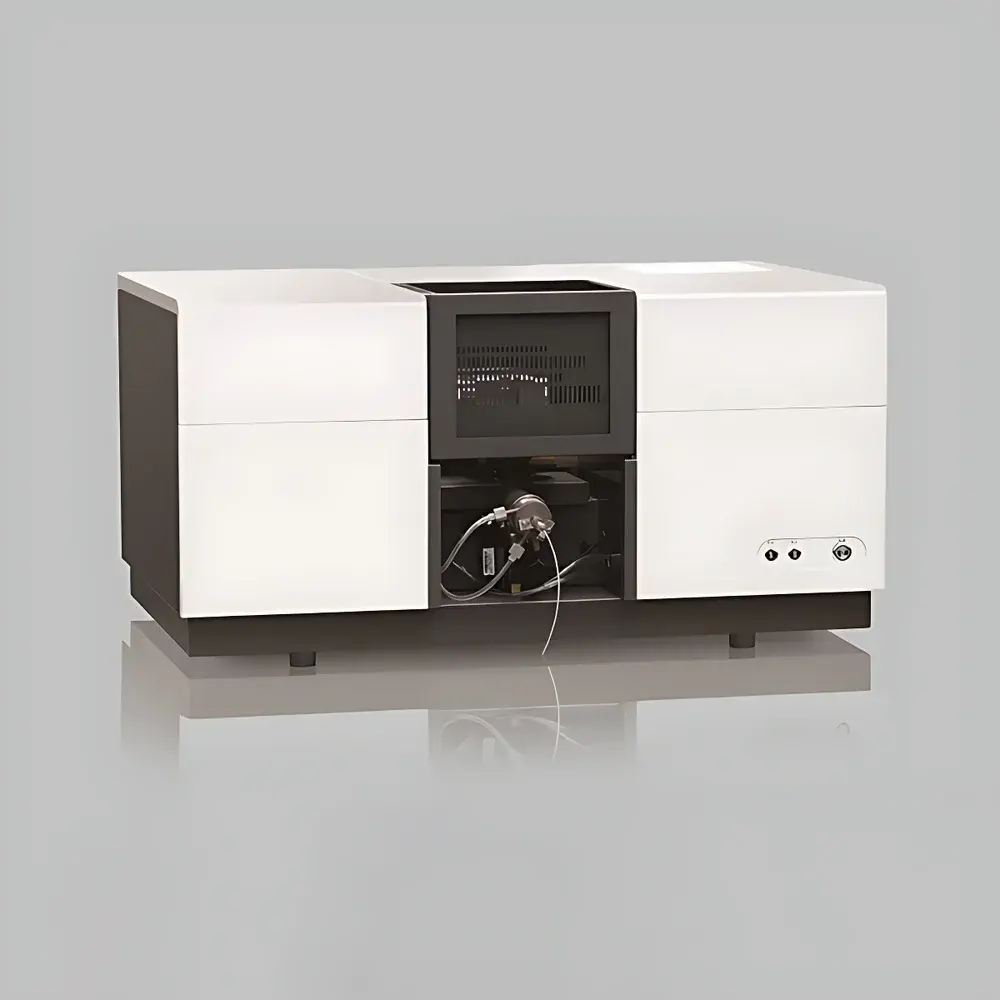
ZOLIX AA-2000 Series Flame and Graphite Furnace Atomic Absorption Spectrometer
| Brand | ZOLIX |
|---|---|
| Origin | Beijing, China |
| Manufacturer Type | Direct Manufacturer |
| Instrument Type | Flame and Graphite Furnace AAS |
| Optical System | Single-beam Czerny-Turner monochromator with 1800 lines/mm holographic grating |
| Wavelength Range | 190–900 nm |
| Spectral Bandwidth | 0.1 / 0.2 / 0.4 / 1.0 / 2.0 nm (5-step auto-switching) |
| Wavelength Accuracy | ±0.1 nm |
| Wavelength Repeatability | ≤0.05 nm |
| Baseline Stability | ≤0.003 A/30 min (dynamic), ≤0.002 A/30 min (static) |
| Resolution | <0.1 nm |
| Flame Cu Detection Limit | ≤0.003 µg/mL |
| Flame Cu Characteristic Concentration | ≤0.02 µg/mL/1% |
| Graphite Furnace Cd Characteristic Mass | 0.3×10⁻¹² g |
| Graphite Furnace Detection Limit | 0.2×10⁻¹² g |
| Graphite Furnace Temperature Range | Room temperature to 3000 °C |
| Max. Graphite Furnace Ramp Rate | ≥3000 °C/s (optical control), ≥2000 °C/s (power control) |
| Background Correction | D₂-lamp and self-absorption (AAS) modes, correction capacity >60× at 1.0 A background absorbance |
| Sample Introduction | Manual or automated (flame/graphite furnace/hydride generation) |
| Dimensions (W×D×H) | 880 × 540 × 450 mm |
| Weight | 125 kg |
| Power Supply | AC 220 V, 50 Hz |
| Main unit | 500 W |
| Graphite furnace module | 5 kW |
Overview
The ZOLIX AA-2000 Series Flame and Graphite Furnace Atomic Absorption Spectrometer is a dual-mode analytical platform engineered for high-precision elemental quantification across trace and ultra-trace concentration ranges. Based on the fundamental principle of atomic absorption spectroscopy—where ground-state free atoms in the gaseous phase absorb characteristic radiation emitted by hollow cathode lamps—the instrument delivers quantitative analysis via Beer-Lambert law-based calibration. Its integrated optical architecture employs a single-beam Czerny-Turner monochromator equipped with an 1800 lines/mm holographic grating, optimized for high photon throughput and spectral resolution (<0.1 nm), enabling reliable detection of edge-wavelength elements such as As (193.7 nm) and Cs (852.1 nm). The system supports three primary atomization techniques: air-acetylene flame, electrothermal graphite furnace, and hydride generation (via optional HG-01 module), making it suitable for routine QC, environmental monitoring, clinical toxicology, geological surveying, food safety testing, and materials science research.
Key Features
- Integrated dual-atomizer design: Flame burner and graphite furnace housed within a single chassis, minimizing footprint and eliminating optical realignment during mode switching.
- Automated 6-lamp turret with computer-controlled positioning, enabling sequential multi-element analysis without manual lamp replacement or wavelength recalibration.
- Two independent background correction systems: Deuterium lamp (D₂) and self-absorption (AAS) methods, both validated for correction of up to 1.0 A background absorbance with >60× correction factor.
- Optimized graphite furnace system featuring longitudinal optical temperature control, 20-step programmable heating, and isothermal atomization zone (8 mm length, ~170 µL volume) achieved via dual-constriction graphite tube geometry.
- Maximum sample injection volume of 70 µL into the graphite furnace—enhancing sensitivity for low-concentration analytes and supporting replicate injections without re-pipetting.
- Full-spectrum safety interlocks: Acetylene leak detection, water seal level monitoring, gas pressure supervision (fuel/oxidant/shield), graphite furnace overtemperature cutoff, and hollow cathode lamp overcurrent protection.
- Modular expandability: Compatible with HG-01 hydride generator (for As, Se, Hg, Pb, Bi, Sb, Sn, Te), AS-500 graphite furnace autosampler, AS-600 combined flame/graphite furnace autosampler, and EW-900CH recirculating chiller.
Sample Compatibility & Compliance
The AA-2000 accommodates aqueous, organic, and digested solid samples across diverse matrices—including soils, biological tissues, petroleum derivatives, pharmaceutical excipients, and food extracts. Its flame configuration supports analysis of ~70 elements; the graphite furnace extends detection capability to sub-picogram levels for refractory and volatile species (e.g., Cd, Mo, Ni, V). The system complies with ASTM E1909 (standard test method for determination of lead in blood by GFAAS), ISO 11885 (water quality—determination of selected elements by AAS), and USP guidelines for elemental impurities in pharmaceuticals. Optional GMP-compliant software modules provide full 21 CFR Part 11 audit trails, electronic signatures, and QA/QC parameter logging—including SD/RSD calculation, correlation coefficient validation, baseline drift compensation, and QC sample flagging.
Software & Data Management
Control and data acquisition are managed through a Windows-based workstation software suite supporting multilingual UI (English, Korean, Chinese). Core functions include automatic wavelength scanning, slit width selection, lamp current optimization, and atomizer switching—all executed within 40 seconds per method setup. The software implements robust QA/QC protocols: standard deviation (SD), relative standard deviation (RSD), linear/nonlinear curve fitting (including standard addition), and automated reanalysis upon outlier detection. Data export supports CSV, TXT, and PDF formats; historical records are encrypted and time-stamped for GLP/GMP traceability. Real-time status monitoring displays flame gas pressures, graphite furnace coolant flow rate, water bath temperature, and element lamp usage hours—enabling predictive maintenance and operational transparency.
Applications
The AA-2000 serves laboratories requiring regulatory-grade elemental analysis across multiple sectors. In environmental labs, it quantifies heavy metals (Pb, Cd, As) in wastewater per EPA Method 7000B and soil per ISO 11466. Clinical and toxicology facilities use it for blood Pb screening (CLIA-certified workflows) and urinary Cd monitoring. Food safety programs deploy it for Ni and Cr in stainless-steel cookware leachates (EC No. 1935/2004), while metallurgical QA labs verify alloy composition against ASTM E3061. Research applications include nanoparticle dissolution kinetics (graphite furnace temporal profiling), speciation studies via hydride generation, and high-temperature element stability assessment (Mo, V, Co up to 3000 °C).
FAQ
Does the AA-2000 support both flame and graphite furnace analysis in a single instrument?
Yes—the AA-2000 integrates both atomizers into one compact chassis with fully automated, software-driven switching; no manual optical realignment is required.
What background correction methods are available, and what is their maximum correction capacity?
The system offers dual-mode correction: deuterium lamp and self-absorption (AAS). Both methods are validated for background absorbance up to 1.0 A, with demonstrated correction factors exceeding 60×.
Can the instrument meet GLP/GMP requirements for pharmaceutical testing?
When configured with the optional GMP software package, the AA-2000 provides full 21 CFR Part 11 compliance—including user access controls, electronic signatures, immutable audit trails, and automated QA/QC flagging.
What is the maximum graphite furnace temperature, and how is temperature uniformity ensured?
The furnace achieves up to 3000 °C with optical pyrometric control. Isothermal conditions over the 8-mm atomization zone are maintained via a proprietary dual-constriction graphite tube design, verified by thermal mapping and RSD ≤1.5% for Cd and Mo standards.
Is external cooling required for the graphite furnace module?
Yes—a recirculating chiller (e.g., EW-900CH) is recommended for sustained high-power operation. The system monitors coolant flow and temperature in real time and halts heating if parameters fall outside safe thresholds.





