
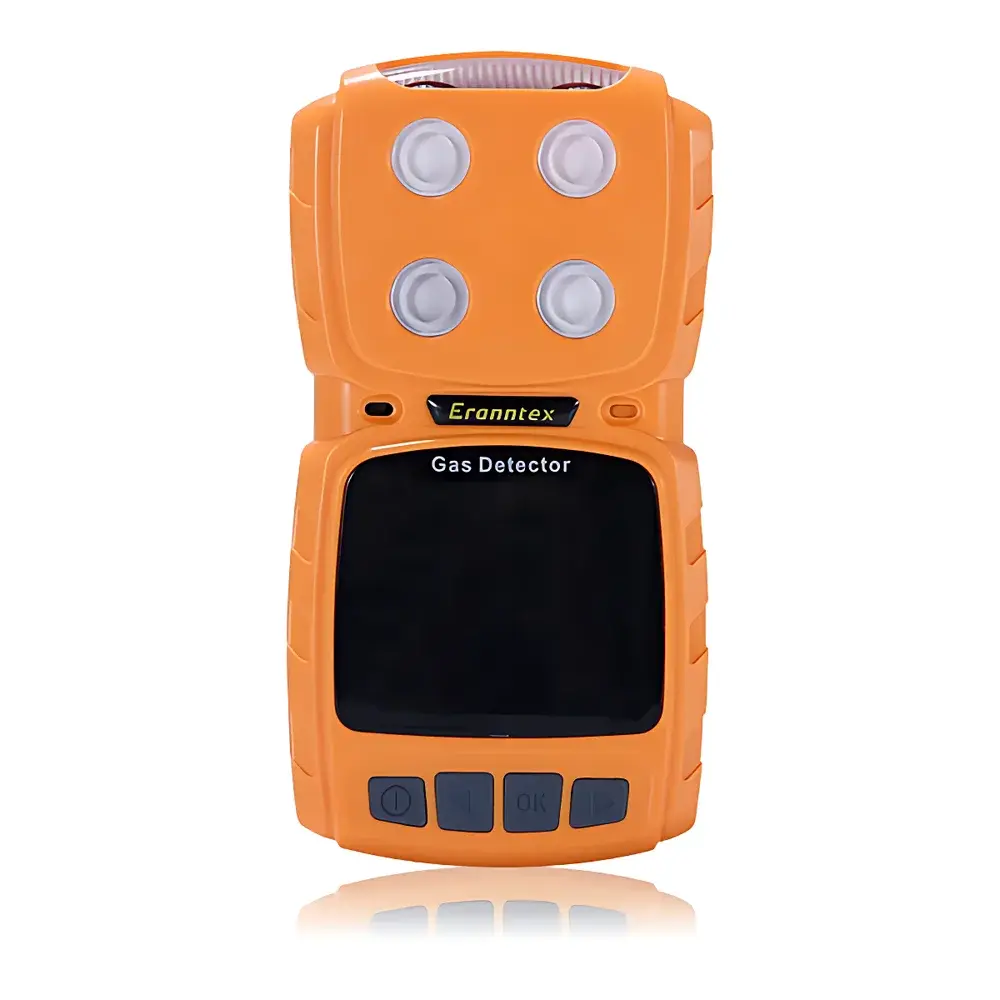
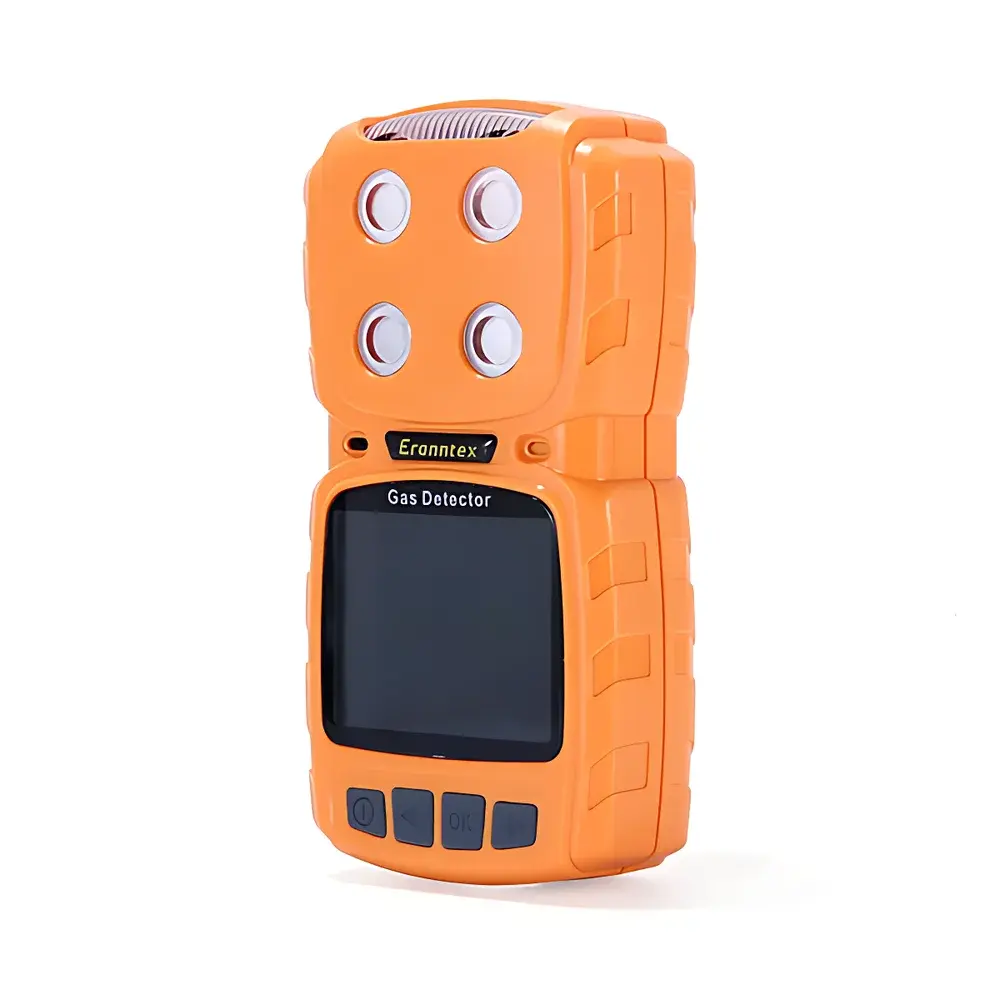
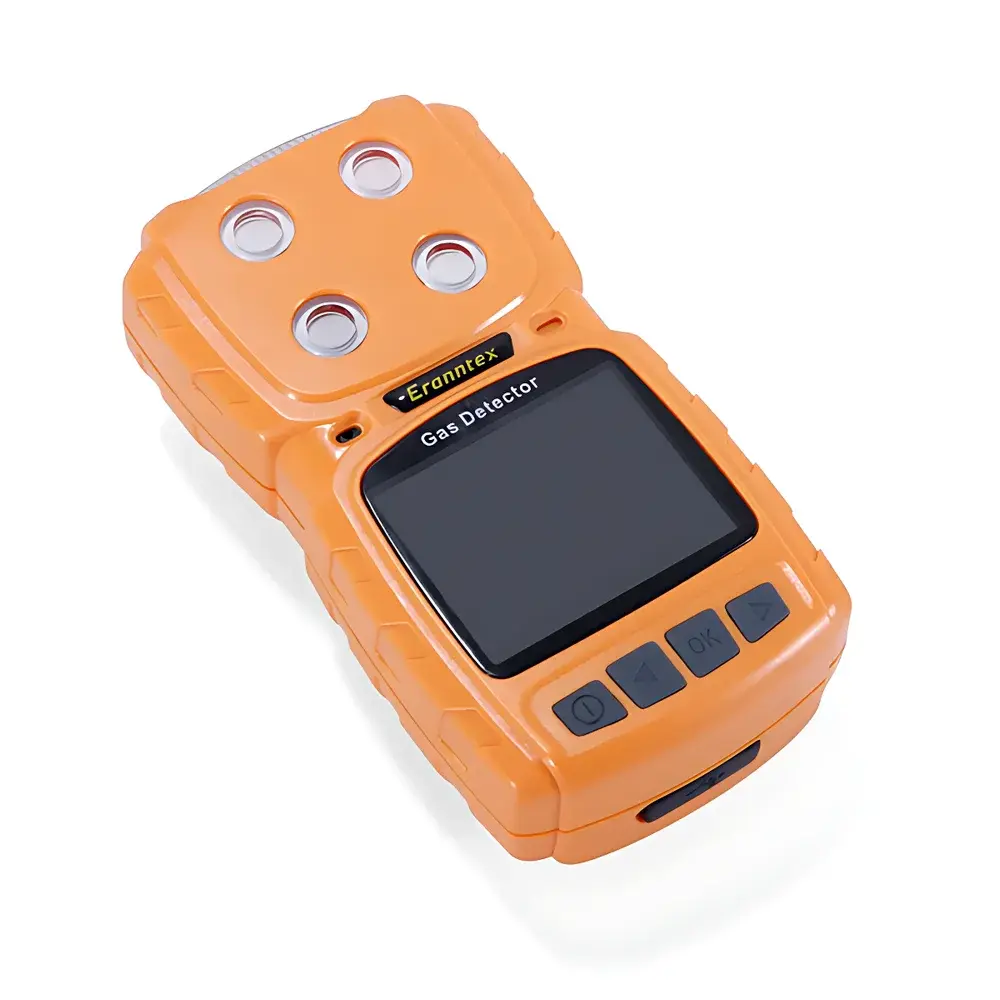
Eranntex MS104K-AsH₃ Portable Arsine (AsH₃) Gas Detector
| Brand | Eranntex |
|---|---|
| Model | MS104K-AsH₃ |
| Detection Principle | Electrochemical / Catalytic Combustion / Infrared (configurable) |
| Detection Range | 0–10 ppm or 0–100 ppm AsH₃ (customizable) |
| Resolution | 0.01 ppm (AsH₃), 0.1% LEL, 0.01% Vol |
| Accuracy | ≤±3% FS |
| Response Time (T90) | ≤30 s |
| Recovery Time | ≤30 s |
| Display | 2.31″ 320×240 color TFT screen |
| Data Storage | 100,000 entries (timestamped, configurable storage modes) |
| Battery | 3.7 V DC, 2100 mAh Li-polymer |
| Operating Temp. | −40 °C to +70 °C |
| Humidity Range | 0–95% RH (non-condensing) |
| IP Rating | IP65 |
| Explosion Protection | Exia II CT4 Ga |
| Dimensions | 130 × 68 × 34 mm |
| Weight | 200 g |
| Certifications | CPA Type Approval (China), GB Standard Compliance |
Overview
The Eranntex MS104K-AsH₃ Portable Arsine (AsH₃) Gas Detector is an intrinsically safe, field-deployable instrument engineered for reliable, real-time detection of arsine gas in occupational and industrial environments where exposure risk is critical. Arsine—a highly toxic, colorless, and flammable gas with a garlic-like odor at high concentrations—poses severe acute health hazards even at sub-ppm levels; its permissible exposure limit (PEL) is 0.0003 ppm (3 ppb) per OSHA and ACGIH guidelines. The MS104K-AsH₃ employs a multi-principle sensor architecture—primarily electrochemical for low-range AsH₃ quantification (0–10 ppm), with optional catalytic combustion or infrared sensors for broader range or cross-interference mitigation—ensuring high specificity and stability under variable ambient conditions. Designed for diffusion-based sampling, the device operates without external pumps by default but supports optional integrated or handheld sampling probes for confined-space or remote-point measurement. Its compact form factor (130 × 68 × 34 mm, 200 g), robust housing, and extended battery life (up to 18 hours continuous operation) make it suitable for routine safety inspections, emergency response, leak surveys, and compliance verification across hazardous process areas.
Key Features
- Intrinsically safe design certified to Exia II CT4 Ga standard, compliant with IEC 60079-0/11 for use in Zone 0/1 explosive atmospheres
- IP65-rated enclosure providing dust-tight protection and resistance to water splashes—validated per IEC 60529
- 2.31″ high-resolution color TFT display (320 × 240 pixels) with intuitive icon-driven UI supporting dual-language interface (English/Chinese)
- Configurable multi-gas capability: simultaneous detection of up to four gases—including AsH₃ plus optional O₂, H₂S, CO, CH₄, SO₂, NO₂, Cl₂, NH₃, or VOCs—via modular sensor bays
- Three display modes: quad-channel concentration view, large-font single-channel cycling, and real-time trend curve (user-selectable auto/manual cycling)
- Comprehensive alarm system: audible (≥85 dB), visual (dual-color LED), vibration, and low-battery/fault alerts; programmable thresholds (low/high/interval alarms)
- Advanced data integrity features: zero-point auto-tracking, multi-point calibration with error-lockout on misconfiguration, and anti-drift compensation algorithms
- Built-in environmental monitoring: optional temperature (−40 °C to +70 °C, ±0.5 °C) and relative humidity (0–100% RH, ±3% RH) sensing for compensation and contextual logging
Sample Compatibility & Compliance
The MS104K-AsH₃ is optimized for ambient air sampling in both open and confined environments—including tanks, pipelines, fermentation vessels, sewage systems, utility tunnels, and chemical storage facilities. Its diffusion-based inlet ensures representative sampling without flow bias, while optional external sampling pumps (0.4–0.9 m stainless-steel or telescopic probe) extend reach into hard-to-access zones. Sensor selection aligns with application-specific requirements: electrochemical cells deliver optimal sensitivity and selectivity for trace AsH₃ (sub-ppm detection), whereas catalytic bead or NDIR modules may be specified for higher-range or multi-component hydrocarbon-rich matrices. The instrument meets Chinese national metrological standards (CPA Type Approval) and conforms to GB 12358–2006 (General Requirements for Portable Gas Detectors) and GB 3836.1–2010 (Explosion-Protected Electrical Equipment). While not pre-certified to ATEX or IECEx, its Exia II CT4 Ga rating provides direct equivalency for global hazardous area deployment under harmonized EU and international frameworks.
Software & Data Management
Data handling follows GLP-aligned principles: all measurements are time-stamped, sensor-identified, and stored with environmental metadata (temperature, humidity if enabled). The 100,000-entry non-volatile memory supports three retention policies—continuous logging, alarm-triggered capture only, or scheduled interval recording—with user-defined intervals from 1 second to 24 hours. On-device review includes chronological browsing, channel-filtered search, and selective deletion. Export occurs via micro-USB interface using vendor-supplied PC software compatible with Windows 10/11, enabling CSV export, statistical summary (min/max/avg/stdev), trend charting, and PDF report generation. Audit trail functionality records calibration events, alarm activations, and configuration changes—supporting 21 CFR Part 11 readiness when deployed in regulated pharmaceutical or biomanufacturing settings. Firmware updates and parameter configuration are performed securely through the same interface.
Applications
- Petrochemical refineries and LNG terminals: monitoring AsH₃ ingress during catalyst regeneration, hydrotreating unit maintenance, or sour gas handling
- Semiconductor fabrication facilities: verifying arsine cylinder integrity, abatement system efficiency, and cleanroom purge validation
- Pharmaceutical synthesis labs: detecting residual AsH₃ in arsenic-containing API manufacturing lines per ICH Q5C and USP <1058>
- Hazardous waste treatment sites: assessing landfill gas composition and leachate off-gas toxicity prior to flare or scrubber routing
- Municipal infrastructure: confined-space entry verification in sewer networks, pumping stations, and digesters where microbial arsenic reduction may occur
- Emergency response units: rapid screening during transportation incidents involving arsenic-based pesticides or metallurgical reagents
FAQ
What is the recommended calibration frequency for the AsH₃ sensor?
Electrochemical AsH₃ sensors should undergo bump testing before each shift and full calibration every 30 days—or immediately after exposure to >100% of full-scale concentration, extreme humidity (>90% RH), or known poisoning agents (e.g., silicones, H₂S).
Can the MS104K-AsH₃ be used in oxygen-deficient environments?
Yes—the device itself functions normally down to 0% O₂. However, catalytic combustion sensors require ≥10% O₂ for accurate hydrocarbon measurement; for AsH₃ detection in inert or hypoxic atmospheres, electrochemical or IR configurations are mandatory.
Does the instrument support MODBUS RTU or other industrial protocols?
Standard configuration uses USB virtual COM port for data transfer. RS485 (MODBUS RTU) is available as an optional hardware module, enabling integration with SCADA, DCS, or centralized gas monitoring platforms.
Is third-party calibration certificate available?
Factory calibration certificates traceable to NIM (National Institute of Metrology, China) are included. NIST-traceable certificates with uncertainty budgets can be provided upon request for regulated applications.
How does the zero-point auto-tracking algorithm function?
The firmware continuously monitors baseline drift during stable ambient periods (no gas exposure, consistent temperature/humidity) and applies adaptive correction within ±10% of nominal zero—without requiring manual intervention—while preserving alarm threshold integrity per ISO 12032.
Related Products





