
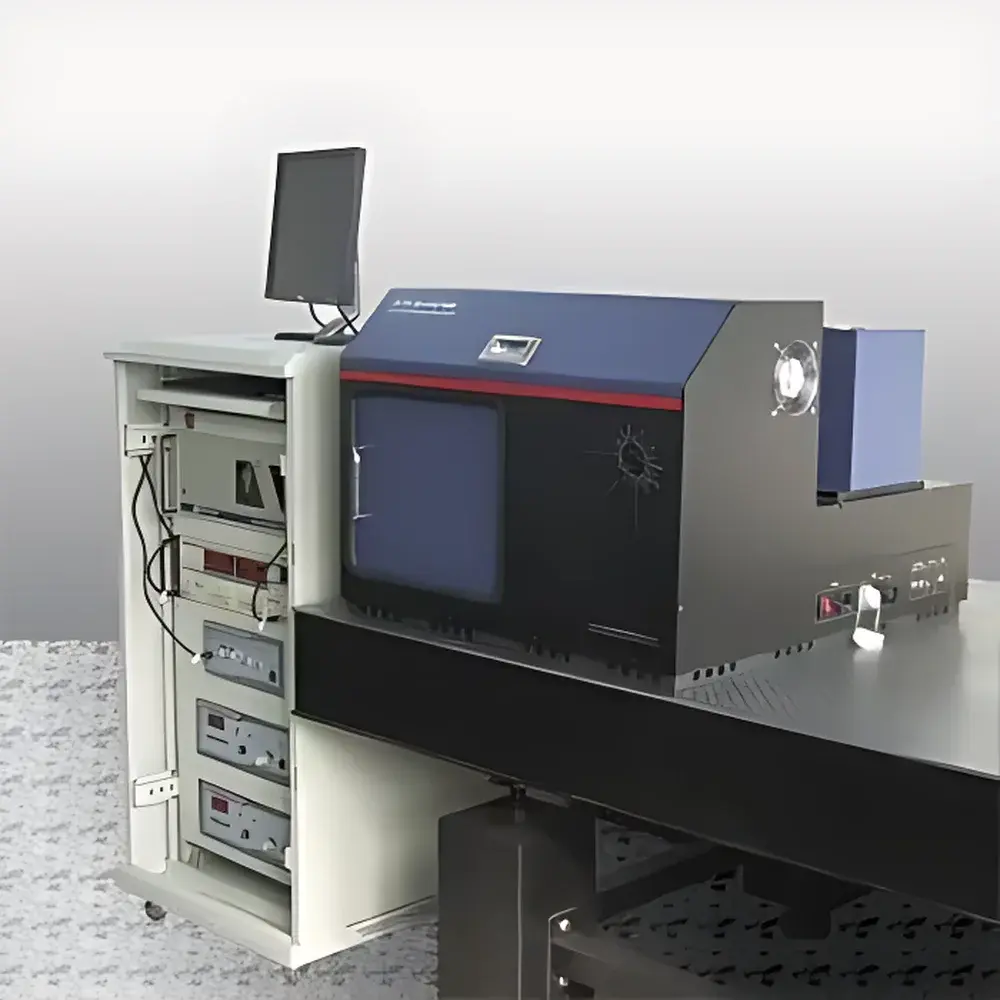
ZOLIX SolarCellScan100 Quantum Efficiency (QE) and Incident Photon-to-Current Efficiency (IPCE) Measurement System
| Brand | ZOLIX |
|---|---|
| Origin | Beijing, China |
| Manufacturer Type | Original Equipment Manufacturer (OEM) |
| Product Category | Domestic |
| Model | SolarCellScan100 |
| Measurement Mode | AC-coupled lock-in detection |
Overview
The ZOLIX SolarCellScan100 Quantum Efficiency (QE) and Incident Photon-to-Current Efficiency (IPCE) Measurement System is a modular, research-grade platform engineered for precise spectral responsivity characterization of photovoltaic devices. It operates on the principle of monochromatic light excitation combined with lock-in amplifier-based current detection—enabling high signal-to-noise ratio (SNR) measurements under both AC-coupled and DC-biased conditions. The system quantifies fundamental optoelectronic parameters including external quantum efficiency (EQE), internal quantum efficiency (IQE), spectral responsivity (A/W), reflectance, transmittance, and short-circuit current density (Jsc). Designed in full compliance with IEC 60904-8:2017 (“Photovoltaic devices — Part 8: Measurement of spectral response of a photovoltaic (PV) device”), it supports traceable calibration against NIST-traceable reference detectors and standard silicon/InGaAs photodiodes. Its modular architecture allows seamless integration of dual broadband sources (Xe and W-halogen), bias illumination units, variable voltage biasing, and motorized sample positioning—making it suitable for R&D laboratories characterizing emerging PV technologies across diverse material systems and device architectures.
Key Features
- AC-coupled lock-in detection mode for ultra-low noise current measurement, essential for low-light or low-responsivity devices such as organic and perovskite solar cells
- Modular dual-source configuration: Xenon lamp (UV–Vis) and tungsten-halogen lamp (Vis–NIR) enable continuous spectral coverage from 300 nm to 1700 nm; optional extension to 2500 nm using calibrated InGaAs detectors
- Integrated bias light capability (150 W Xe or 50 W W-halogen) with independent intensity control—critical for multi-junction, tandem, and thin-film devices requiring stabilized carrier generation during EQE/IQE measurement
- Programmable ±10 V DC bias source (QE-BVS) for dark J–V pre-characterization and bias-dependent QE analysis
- Automated 2D motorized stage (QE-D1) supporting spatially resolved QE mapping (up to 156 mm × 156 mm for SCS100-Silicon; up to 300 mm × 300 mm for SCS100-Film)
- Comprehensive accessory suite including calibrated reference cells (Si, InGaAs), transmission/reflection accessories (QE-B7/B8/C2), and electrochemical cell holders (for DSSC/PEC applications)
Sample Compatibility & Compliance
The SolarCellScan100 accommodates a broad spectrum of photovoltaic technologies: crystalline Si (c-Si), multicrystalline Si (mc-Si), amorphous/microcrystalline Si (a-Si/μc-Si), III–V compounds (GaAs, GaInP, InP), chalcogenides (CdTe, CIS, CIGS), dye-sensitized (DSSC), organic (OPV), polymer, and perovskite solar cells. Device structures supported include single-junction, multi-junction (2T/3T), heterojunction (HIT), thin-film, and high-concentration photovoltaic (HCPV) configurations. Measurement protocols adhere strictly to IEC 60904-8, ASTM E1021, and ISO 18583 standards. All detector calibrations are provided with NIST-traceable certificates (e.g., QE-B2, QE-B3, QE-B4). For regulated environments, the system’s software architecture supports audit trails, user access control, and electronic signature functionality—facilitating alignment with GLP, GMP, and FDA 21 CFR Part 11 requirements when deployed in quality assurance or certification labs.
Software & Data Management
Control and analysis are performed via ZOLIX’s proprietary SolarScanPro software—a Windows-based application built on .NET Framework with real-time instrument synchronization, scriptable measurement sequences, and batch processing capabilities. The software provides automated wavelength scanning, IQE correction routines (using integrated reflectance/transmission data), Jsc integration over AM1.5G spectrum, and export of results in CSV, Excel, and HDF5 formats. Raw lock-in output (X, Y, R, θ), normalized EQE curves, and spatial maps are stored with full metadata (date/time, operator ID, calibration IDs, source settings). Data integrity is ensured through checksum validation and versioned project files. Optional API integration enables third-party automation (LabVIEW, Python) for high-throughput screening or in-line process monitoring.
Applications
- Research and development of next-generation PV materials, including perovskite–silicon tandems and organic–inorganic hybrids
- Process optimization in thin-film deposition lines (e.g., sputtering, evaporation, CVD) via correlation of QE uniformity with film thickness and interface quality
- Failure analysis of degraded modules through comparative EQE mapping before/after stress testing (damp heat, UV exposure, thermal cycling)
- Validation of optical modeling (e.g., transfer matrix method simulations) by fitting measured reflectance/transmittance/EQE spectra
- Calibration and verification of reference cells used in outdoor performance testing and flash tester traceability chains
- Electrochemical photocurrent spectroscopy (IPCE) for photoelectrodes in water-splitting and CO2 reduction studies
FAQ
What spectral range does the base SolarCellScan100 system cover?
The standard configuration spans 300–1100 nm using a silicon photodetector and xenon lamp. With optional tungsten-halogen source and InGaAs detector modules, coverage extends to 1700 nm or 2500 nm.
Can the system measure both EQE and IQE simultaneously?
Yes—when equipped with reflectance (QE-C2) and/or transmittance (QE-B7/B8) accessories, IQE is calculated in real time using the formula: IQE(λ) = EQE(λ) / [1 − R(λ) − T(λ)].
Is the system compatible with non-planar or encapsulated samples?
The open-sample chamber design and adjustable fiber-optic coupling allow testing of textured, curved, or laminated cells; custom fixtures can be fabricated upon request.
Does the software support automated compliance reporting for IEC 60904-8?
Yes—SolarScanPro generates standardized reports including uncertainty budgets, calibration traceability statements, and spectral mismatch correction factors per IEC 60904-8 Annex B.
How is detector linearity verified across the dynamic range?
Linearity is validated using neutral density filter stacks and certified reference cells at multiple irradiance levels; full characterization data is included in each calibration certificate.





