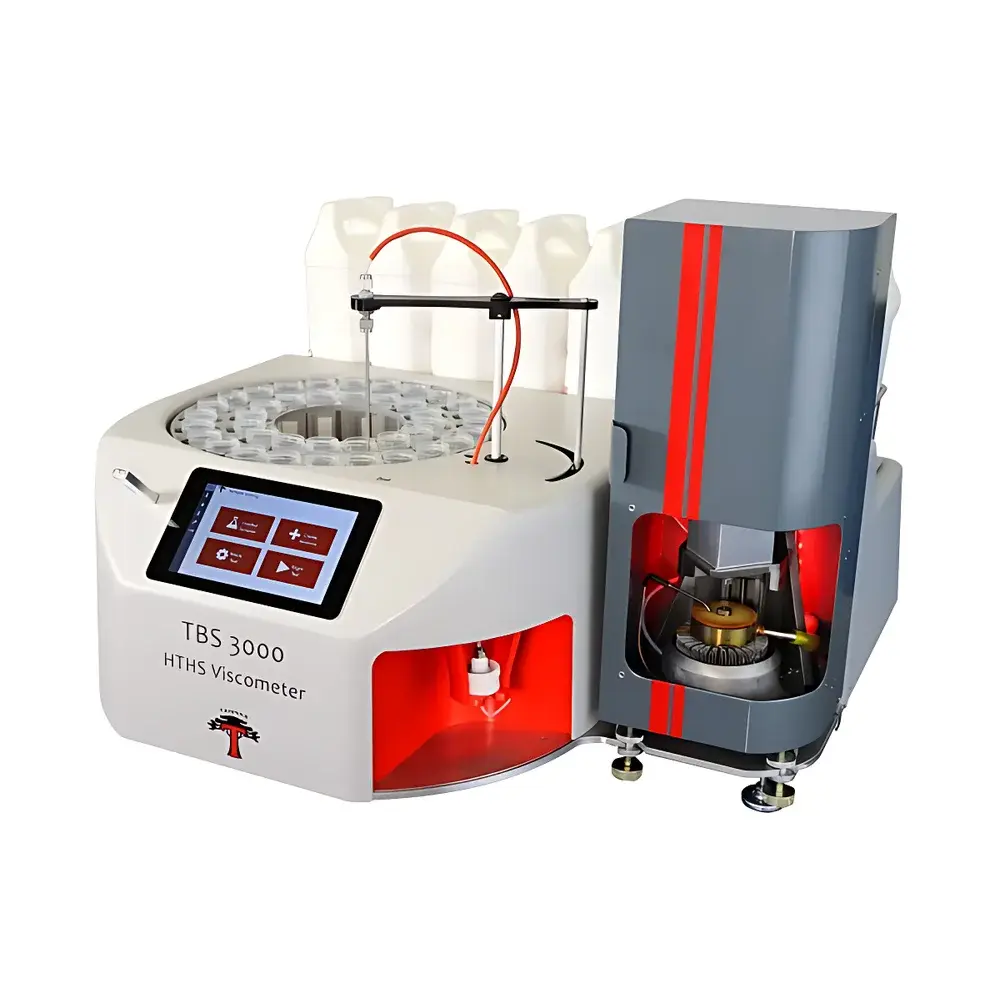
Tannas TBS3000 High-Temperature High-Shear (HTHS) Viscometer
| Brand | Tannas & King |
|---|---|
| Origin | USA |
| Manufacturer Status | Authorized Distributor |
| Origin Category | Imported |
| Model | TBS 3000 |
| Product Type | Laboratory Instrument |
| Test Parameter | HTHS Viscosity |
| Compliance Standards | ASTM D4683, ASTM D6616, SAE J300, GB/T 6538 |
| Dimensions (W × D × H) | 66 × 66 × 48 cm |
| Weight | 38.5 kg |
| Power Supply | 100–240 VAC, ≤6 A, 50/60 Hz |
| Viscosity Range | 1–30 mPa·s (cP) |
| Sample Volume | 40 mL (recommended) |
| Test Duration per Sample | ~5–7 min |
| Auto-sampler Capacity | 1–40 samples per sequence |
| Temperature Control Setpoints | 80 °C, 100 °C, 150 °C (±0.1 °C) |
| Shear Rate Range | 5×10⁵ s⁻¹ to 3×10⁶ s⁻¹ (dependent on fluid viscosity and temperature) |
| Display | Digital touchscreen interface |
| Safety Features | Automatic torque motor and stator heater shutdown upon power interruption |
Overview
The Tannas TBS3000 High-Temperature High-Shear (HTHS) Viscometer is a precision-engineered laboratory instrument designed for the standardized measurement of dynamic viscosity under extreme thermal and mechanical conditions—specifically replicating the shear environments experienced by engine oils in journal bearings and piston ring zones during high-speed operation. Based on the Couette flow principle, the TBS3000 employs a rotating spindle within a thermally stabilized cylindrical cup, generating controlled, laminar shear fields at precisely defined temperatures (80 °C, 100 °C, or 150 °C) and shear rates ranging from 5×10⁵ to 3×10⁶ s⁻¹. Since its introduction in 1979—supported by multiple foundational patents—the TBS platform has served as the reference method for HTHS viscosity in global lubricant specification development and regulatory compliance testing. The TBS3000 represents the fourth-generation evolution of this benchmark system, incorporating upgraded thermal control electronics, enhanced motor drive stability, improved syringe-based sample delivery, and automated calibration routines that reduce operator dependency while maintaining traceability to NIST-traceable standards.
Key Features
- Triple-point programmable temperature control with ±0.1 °C stability at 80 °C, 100 °C, and 150 °C—meeting the stringent thermal requirements of ASTM D4683 and SAE J300.
- High-fidelity rotational actuation system delivering consistent shear rates up to 3×10⁶ s⁻¹, calibrated against primary viscometric references across the 1–30 mPa·s range.
- Integrated digital touchscreen interface supporting real-time display of torque, temperature, rotational speed, and elapsed test time—with intuitive navigation and password-protected method configuration.
- Automated sample handling via precision syringe pump capable of sequential injection of 1–40 samples without manual intervention; each test consumes ~40 mL of sample for full system flush and measurement integrity.
- Fail-safe thermal and mechanical shutdown protocol: upon unexpected power loss, the torque motor and stator heater de-energize immediately, preserving sensor integrity and preventing thermal drift during restart.
- Modular architecture compliant with ISO/IEC 17025 laboratory infrastructure requirements—supports audit-ready documentation of calibration history, maintenance logs, and firmware version tracking.
Sample Compatibility & Compliance
The TBS3000 is validated for use with mineral-, synthetic-, and semi-synthetic engine oils, including low-viscosity fuel-efficient formulations (e.g., SAE 0W-16, 0W-20), heavy-duty diesel lubricants (SAE 15W-40, 20W-50), and advanced API SP/CK-4 and ILSAC GF-6 certified products. All operational parameters align with ASTM D4683 (Standard Test Method for Measuring Viscosity of Engine Oils at High Temperature and High Shear Rate by Tapered Bearing Simulator), ASTM D6616 (for gear oil evaluation), and SAE J300 viscosity classification requirements. The system also supports national standard methods including GB/T 6538 (China’s equivalent to ASTM D4683). Its design incorporates hardware-level safeguards to ensure repeatability across laboratories—critical for inter-laboratory round-robin studies and OEM technical service approvals.
Software & Data Management
Data acquisition and reporting are managed through Tannas’ proprietary ViscoLink™ software suite (v4.2+), installed on external Windows-based workstations. The software provides full GLP-compliant data governance: electronic signatures, user access levels (admin/operator/auditor), audit trails for all method edits and result exports, and automatic timestamping of every measurement event. Raw torque and temperature signals are sampled at ≥100 Hz and stored in .csv and .tdms formats for third-party statistical analysis. Export modules support direct integration into LIMS platforms via ASTM E1394-compliant data exchange protocols. All firmware updates and calibration certificates are digitally signed and verifiable against Tannas’ secure certificate authority—ensuring long-term compliance with FDA 21 CFR Part 11 and EU Annex 11 requirements where applicable.
Applications
- Formulation validation of multi-grade engine oils targeting SAE viscosity grade compliance and fuel economy performance.
- Quality control release testing for batch-to-batch consistency of finished lubricants prior to distribution.
- Research into polymer shear stability, VI improver degradation kinetics, and nano-additive dispersion effects under high-shear stress.
- Supporting OEM engine development programs requiring correlation between bench-scale HTHS data and field durability metrics.
- Accredited testing services for certification bodies performing ISO/IEC 17025-accredited viscosity assessments.
FAQ
What standards does the TBS3000 directly support?
ASTM D4683, ASTM D6616, SAE J300, and GB/T 6538 are fully implemented in method templates and reporting outputs.
Is the TBS3000 suitable for non-oil fluids such as hydraulic or transmission fluids?
While optimized for engine oils, the instrument may be used for other Newtonian or near-Newtonian fluids within its shear rate and viscosity range—subject to validation per ISO 17025 method verification guidelines.
How is calibration traceability maintained?
Each unit ships with a NIST-traceable calibration certificate covering temperature, rotational speed, and torque transduction—renewable annually via Tannas-certified service centers.
Can test data be exported to enterprise LIMS systems?
Yes—ViscoLink™ supports ASTM E1394-compliant ASCII export and configurable ODBC connectivity for direct database ingestion.
What maintenance intervals are recommended?
Preventive maintenance is scheduled every 12 months or after 500 test cycles, including thermal sensor verification, spindle alignment check, and syringe pump recalibration—all documented in the built-in service log.