
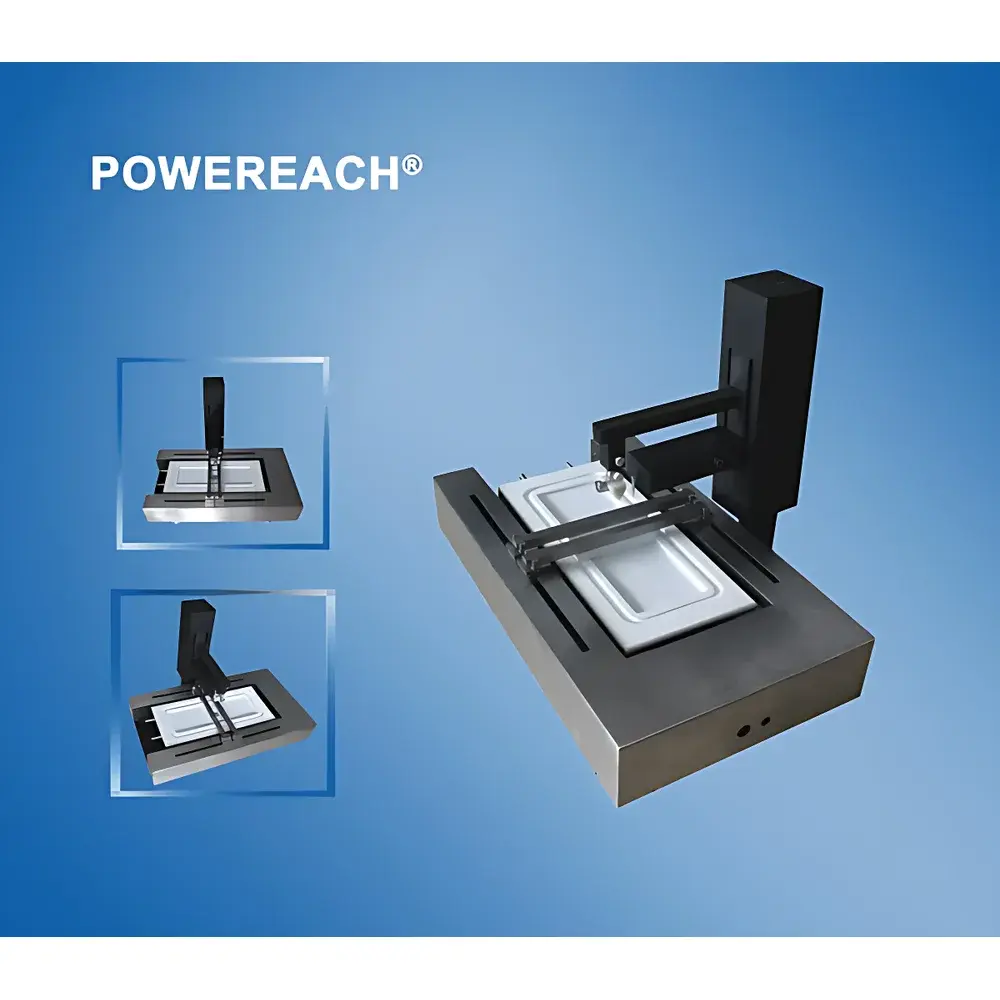
POWEREACH JML04C2 Multifunctional Langmuir-Blodgett Trough Analyzer (Film Balance / Langmuir Trough)
| Brand | POWEREACH (Shanghai Zhongchen) |
|---|---|
| Origin | Shanghai, China |
| Model | JML04C2 |
| Surface Tension Range | 0–150 mN/m |
| Resolution | < 0.05 mN/m |
| Measurement Method | Wilhelmy Plate |
| Trough Material | PTFE |
| Trough Dimensions | 300 mm × 100 mm |
| Compression Ratio | Up to 90% |
| Barrier Speed | 0.05–3 mm/s |
| Vertical Deposition Speed | 0.02–2 mm/s |
| Operating Temperature | Ambient (with optional external thermostatic bath, ≤65 °C) |
| Power Supply | AC 220 V ±10%, 50 Hz, <150 W |
Overview
The POWEREACH JML04C2 Multifunctional Langmuir-Blodgett Trough Analyzer is a precision surface science instrument engineered for quantitative characterization of monolayer films formed by amphiphilic molecules at the air–liquid interface. Based on the classical Langmuir trough architecture and Wilhelmy plate tensiometry, it enables real-time measurement of surface pressure (π), surface tension (γ), molecular area (A), and their interdependent relationships—most notably π–A and γ–A isotherms. These thermodynamic profiles are foundational to understanding molecular packing, phase transitions (gaseous, liquid-expanded, liquid-condensed, solid), collapse pressure, compressibility modulus, and monolayer stability. The system supports both static Langmuir monolayer studies and dynamic Langmuir–Blodgett (LB) film transfer onto solid substrates via vertical dipping, making it indispensable for research in biophysics, soft matter physics, nanomaterials assembly, and functional thin-film development.
Key Features
- Fully automated operation via embedded microcontroller and host PC, minimizing operator-induced variability and ensuring protocol reproducibility across experiments.
- High-precision Wilhelmy plate sensor with sub-0.05 mN/m resolution and calibrated force transduction, enabling detection of subtle interfacial phenomena including lipid domain formation and protein–lipid interactions.
- PTFE-coated Langmuir trough (300 × 100 mm) offering chemical inertness, low background contamination, and minimal evaporation—critical for long-duration isotherm acquisition and volatile solvent compatibility (e.g., chloroform, chloroform/methanol mixtures).
- Dual symmetric barrier system with low-vibration stepper motor drive (0.05–3 mm/s adjustable), achieving uniform compression and high mechanical stability during area-controlled monolayer formation.
- Programmable vertical deposition module supporting upward and downward dipping modes, with speed control from 0.02 to 2 mm/s and real-time tension feedback for constant-pressure or constant-area transfer protocols.
- Integrated surface tension auto-measurement function using the same Wilhelmy plate, eliminating need for separate tensiometer calibration prior to monolayer experiments.
- Modular design accommodates custom trough dimensions, barrier geometries, and subphase temperature control via external recirculating bath (compatible with standard 40 mm diameter × 50 mm depth immersion wells).
Sample Compatibility & Compliance
The JML04C2 is validated for use with a broad spectrum of amphiphilic materials—including phospholipids (DPPC, POPC), fatty acids, surfactants, block copolymers, peptides, membrane proteins, and synthetic dendrimers—in aqueous, buffered, or mixed organic–aqueous subphases. Its PTFE construction ensures compatibility with aggressive solvents commonly used in LB film preparation (e.g., chloroform, dichloromethane, hexane). While not certified to ISO/IEC 17025 as a standalone metrology device, the system supports GLP-compliant workflows when paired with audit-trail-enabled software configurations. Experimental data output conforms to ASTM D971 (Standard Test Method for Surface Tension of Petroleum Products) and ISO 4789 (Surface Active Agents – Determination of Surface Tension by the Ring or Plate Method) principles, and its isotherm-derived parameters align with IUPAC-recommended monolayer analysis conventions.
Software & Data Management
The Windows-based native software provides full graphical user interface (GUI) control over all hardware functions: barrier positioning, dipping cycle sequencing, real-time π–A/γ–A plotting, automatic curve fitting (e.g., linear, polynomial, van der Waals models), and export of raw force/time/area datasets in CSV and Excel formats. All acquired curves include timestamped metadata (date, operator ID, subphase composition, temperature, solvent batch), supporting traceability requirements under FDA 21 CFR Part 11 when deployed in regulated environments. Data can be reprocessed offline using built-in tools for baseline correction, slope analysis, and compressibility modulus (Cs⁻¹ = −A·(dπ/dA)) calculation. Software updates are provided free-of-charge for the lifetime of the instrument, with version history logs maintained for validation documentation.
Applications
- Biophysical investigation of pulmonary surfactant monolayers, including quantification of collapse pressure and respreading behavior relevant to neonatal respiratory distress syndrome (NRDS) and acute respiratory distress syndrome (ARDS).
- Structure–function correlation of membrane-active peptides and antimicrobial agents at model lipid interfaces.
- Development and optimization of LB-assembled nanostructured films for organic electronics, biosensors, and photonic crystals.
- Characterization of polymer–surfactant interactions and co-adsorption kinetics in mixed monolayers.
- Quality control of synthetic surfactants and lipid formulations in pharmaceutical and cosmetic R&D laboratories.
- Teaching laboratory implementation for undergraduate and graduate courses in colloid and interface science, soft matter physics, and biophysics.
FAQ
What subphase temperature control options are available?
The JML04C2 operates at ambient temperature but includes standardized ports for integration with external thermostatic circulators. Users may connect commercially available water baths (e.g., Julabo, Huber) to maintain subphase temperatures between 10 °C and 65 °C with ±0.1 °C stability.
Is the Wilhelmy plate pre-calibrated and replaceable?
Yes—the platinum-iridium Wilhelmy plate is factory-calibrated and supplied with certificate of conformance. Replacement plates are available as consumables; recalibration is performed automatically upon plate installation via software-guided zero-force and reference-weight routines.
Can the system support multi-cycle compression–expansion protocols?
Yes. The software allows definition of up to 10 sequential compression/expansion cycles with independent speed, target area, and dwell time settings per cycle—essential for hysteresis analysis and fatigue testing of monolayers.
What computer interface requirements apply?
A Windows PC (Windows 7 or later) with one USB 2.0 port and one RS-232 serial port (or USB-to-serial adapter) is required. No additional drivers beyond those included in the installation package are needed.
Does the instrument comply with electromagnetic compatibility (EMC) standards for laboratory use?
The JML04C2 meets CE marking requirements per EN 61326-1:2013 (Electrical Equipment for Measurement, Control and Laboratory Use) and operates within Class B emission limits suitable for shared laboratory environments.



