
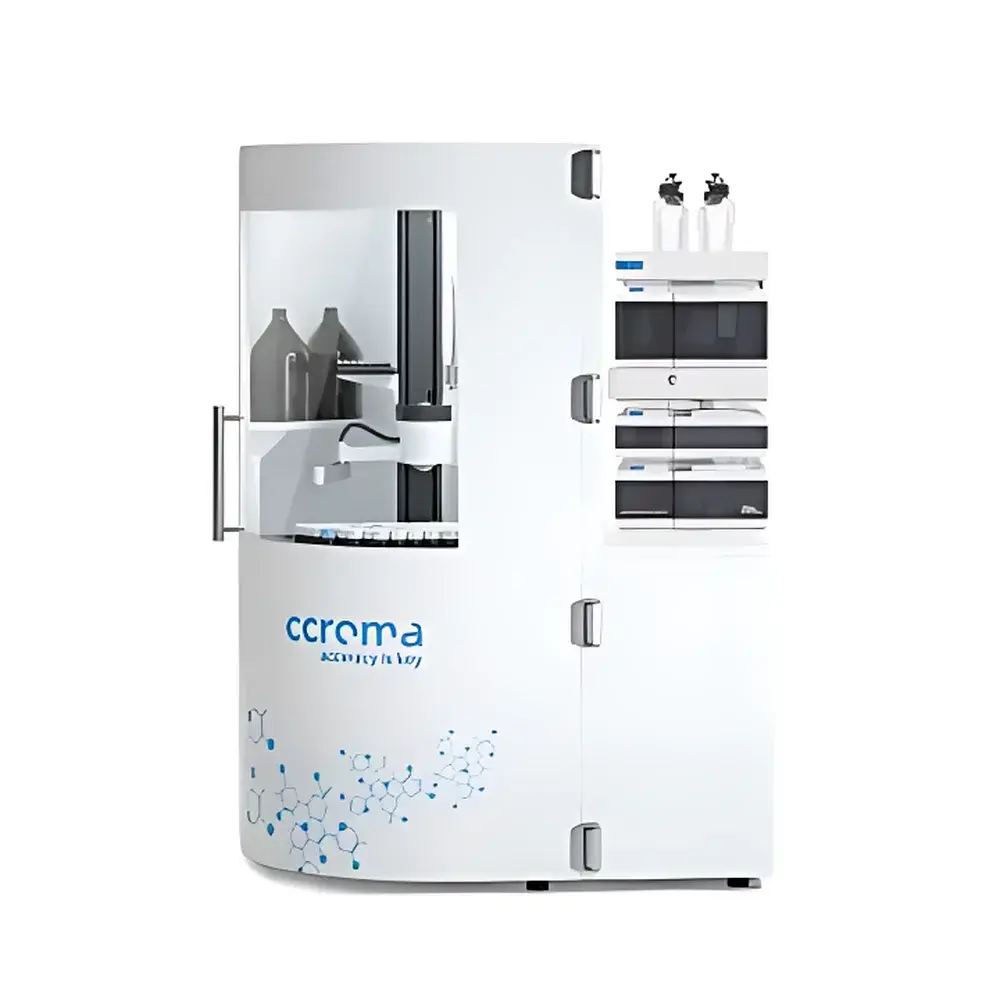
Accroma Accroma Automated Sample Preparation System for HPLC
| Brand | Accroma |
|---|---|
| Origin | Switzerland |
| Model | Accroma |
| Extraction Type | Liquid-Liquid Extraction |
| Temperature Range | −20 °C to 40 °C |
| Dimensions | 144 × 113 × 200 cm |
| Sample Capacity | 124 positions |
| Compliance | Designed for GLP/GMP-aligned workflows, supports 21 CFR Part 11–compliant audit trails |
Overview
The Accroma Accroma Automated Sample Preparation System for HPLC is an integrated, benchtop-scale platform engineered for precise, reproducible, and fully automated sample conditioning prior to liquid chromatographic analysis. Unlike conventional manual or semi-automated approaches, this system implements a closed-loop, protocol-driven architecture grounded in validated liquid-liquid extraction (LLE) principles. It operates under precisely controlled thermal conditions (−20 °C to 40 °C), enabling method robustness across diverse matrices—including solids, semi-solids, and liquids—common in environmental, pharmaceutical, food safety, and clinical research laboratories. The system eliminates operator-dependent variability at critical pre-injection stages, where up to 30% of total analytical error in HPLC workflows originates—primarily from inconsistent phase separation, emulsion formation, solvent volume inaccuracies, and carryover. By digitizing the entire sequence—from sample weighing and solvent addition to phase separation, filtration, and final transfer to autosampler vials—the Accroma system ensures deterministic execution aligned with ISO/IEC 17025 and USP guidelines for analytical instrument qualification.
Key Features
- Fully automated LLE workflow with programmable temperature control (−20 °C to 40 °C) for optimized partitioning efficiency and analyte stability
- 124-position sample capacity with independent, barcode-tracked rack handling for high-throughput batch processing
- Single-use disposable sample tubes eliminate cross-contamination risk and eliminate cleaning validation requirements
- Integrated gravimetric dosing module for accurate solid sample weighing and solvent dispensing (±0.1 mg resolution)
- Robust mechanical phase separation unit with centrifugal force modulation and programmable dwell times
- Modular design compliant with standard laboratory ventilation infrastructure—no dedicated fume hood required
- Real-time system health monitoring with hardware-level fault logging and predictive maintenance alerts
Sample Compatibility & Compliance
The Accroma system accommodates heterogeneous sample types without matrix-specific hardware modification: powdered pharmaceuticals, soil/sediment composites, tissue homogenates, beverages, plasma, and viscous formulations. All fluidic pathways are chemically inert (PTFE, PEEK, borosilicate glass), supporting aggressive solvents including chloroform, ethyl acetate, and hexane. Regulatory readiness is embedded at the firmware level: electronic signatures, user access tiers (admin/operator/auditor), immutable audit trails, and full method versioning satisfy FDA 21 CFR Part 11, EU Annex 11, and ISO 9001 traceability mandates. Each run generates a timestamped, digitally signed report containing instrument parameters, calibration status, environmental logs, and raw sensor outputs—fully exportable in PDF/A or CSV for regulatory submission.
Software & Data Management
The system runs on Accroma ControlSuite™ v4.x—a Windows-based application built on .NET Framework with SQLite backend and optional SQL Server integration. Method development occurs via intuitive drag-and-drop sequencing; validated methods are encrypted and stored as portable .acm files. Software enforces role-based permissions, session timeouts, and automatic backup to network drives or cloud storage (AWS S3, Azure Blob). Data integrity safeguards include checksum verification of method imports, cryptographic hashing of run records, and dual-write logging to both volatile memory and non-volatile flash. For enterprise deployment, RESTful API endpoints enable bidirectional integration with LIMS (e.g., LabWare, Thermo Fisher SampleManager) and ELN platforms, ensuring seamless data lineage from sample receipt to chromatographic result.
Applications
- Residue analysis in agrochemical testing (e.g., pesticide multiresidue screening per EN 15662)
- Impurity profiling of drug substances per ICH Q2(R2) validation requirements
- Myco-toxin quantification in cereals using AOAC 2005.08–aligned workflows
- Pharmaceutical stability-indicating assays requiring strict control of degradation-prone analytes
- Environmental monitoring of PAHs, PCBs, and phthalates in wastewater sludge (EPA Method 3545A equivalent)
- Forensic toxicology sample prep for blood/urine matrices under ISO/IEC 17025 accreditation
FAQ
Does the system support method validation per ICH guidelines?
Yes—built-in performance qualification tools, system suitability checks, and comprehensive documentation templates align with ICH Q2(R2) and Q5(R2) requirements for analytical procedure validation.
Can legacy HPLC methods be migrated to this platform?
Absolutely. The software includes a method translation wizard that maps manual LLE steps (e.g., vortex time, centrifugation speed, solvent volumes) into executable sequences with parameter tolerances and fail-safes.
Is remote monitoring and troubleshooting supported?
Yes—via secure TLS 1.3–encrypted VNC tunneling and optional OEM remote diagnostics port, enabling real-time vendor-assisted support without compromising network security policies.
What validation documentation is provided upon installation?
Full IQ/OQ/PQ protocols, 3Q summary report, certificate of conformance, and raw test data logs—delivered in editable Word/PDF formats compliant with ALCOA+ principles.
How is solvent waste minimized during operation?
Through adaptive solvent volume calculation based on sample mass and target concentration, plus optimized phase separation cycles that reduce repeat extractions—typically achieving >40% solvent reduction versus manual protocols.



