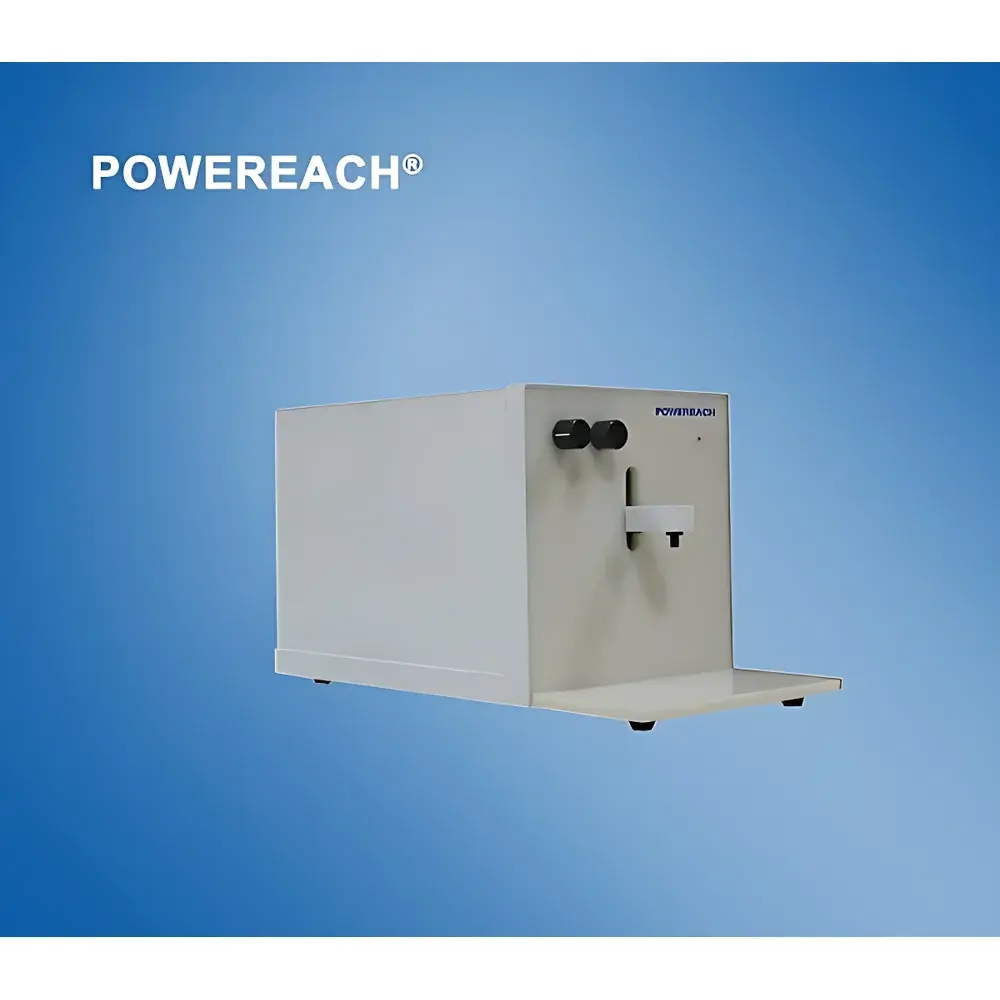
POWEREACH Bio-Tissue Hardness Tester
| Brand | POWEREACH (Shanghai Zhongchen) |
|---|---|
| Origin | Shanghai, China |
| Manufacturer Type | Authorized Distributor |
| Country of Origin | China |
| Model | Bio-Tissue Hardness Tester |
| Pricing | Upon Request |
| System Requirements | Windows 32-bit OS, 1× USB port, 1× RS-232 COM port |
| Included | Instrument host, proprietary control & analysis software, standard probe set, on-site installation, commissioning, operator training, and 12-month warranty (excl. PC) |
| Optional PC Package | ¥4,000/unit (brand-name desktop, factory 3-year on-site warranty) |
Overview
The POWEREACH Bio-Tissue Hardness Tester is a dedicated mechanical characterization instrument engineered for quantitative assessment of quasi-static compressive resistance in soft biological tissues. It operates on the principle of controlled indentation using a calibrated cylindrical or spherical probe driven at constant velocity into excised or in situ tissue specimens under load-controlled or displacement-controlled modes. Force-displacement data are acquired in real time via high-resolution load cell (±0.5% full-scale accuracy) and precision linear encoder (1 µm resolution), enabling derivation of hardness indices—including maximum indentation force (N), peak stress (kPa), elastic modulus approximation (via Hertzian or Oliver–Pharr modeling), and strain-hardening behavior—under physiologically relevant loading rates (0.01–5 mm/min). Designed specifically for translational research environments, the system supports standardized protocols aligned with ASTM F2796 (Standard Practice for Mechanical Testing of Soft Tissues) and ISO 1798 (Rubber—Determination of Tensile Strength and Elongation at Break), with adaptability to GLP-compliant workflows through audit-trail-enabled software logging.
Key Features
- Modular indenter platform accommodating interchangeable probes (1.0 mm, 2.5 mm, and 5.0 mm diameter stainless-steel cylinders; optional spherical tips)
- Motorized Z-axis actuator with closed-loop position feedback and programmable speed range (0.01–10 mm/min, ±0.5% repeatability)
- Integrated 50 N capacity load cell (ISO 376 Class 0.5 accuracy) with thermal drift compensation
- Dual-mode operation: force-controlled (target load hold) and displacement-controlled (target depth ramp)
- Real-time force–displacement curve acquisition at ≥100 Hz sampling rate, stored in open CSV/Excel-compatible format
- Compact benchtop footprint (W320 × D450 × H580 mm) with CE-marked safety enclosure and emergency stop
- Compliance with IEC 61000-6-2 (EMC immunity) and IEC 61000-6-4 (EMC emission) standards
Sample Compatibility & Compliance
The Bio-Tissue Hardness Tester accommodates fresh, fixed, or cryopreserved tissue specimens ranging from 5 mm × 5 mm × 2 mm (minimum) to 30 mm × 30 mm × 15 mm (maximum), including but not limited to liver parenchyma, myocardial slices, skeletal muscle strips, arterial wall sections, and tumor xenografts. Specimen mounting utilizes reusable low-adhesion clamps and adjustable support stages to minimize edge effects and ensure perpendicular probe alignment. All hardware and firmware comply with ISO 13485:2016 (Medical Devices—Quality Management Systems) requirements for design control documentation and traceability. Data output meets FDA 21 CFR Part 11 readiness when used with validated software configuration (electronic signatures, audit trail, and user access controls enabled).
Software & Data Management
The proprietary POWEREACH TissueMech™ software (v3.2+) provides intuitive workflow-driven interface for test method definition, real-time visualization, post-acquisition curve fitting (linear, exponential, power-law models), and comparative statistical reporting (ANOVA, t-test, coefficient of variation). Raw datasets include timestamp, operator ID, environmental temperature/humidity metadata, and calibration certificate references. Export options support .csv, .xlsx, and .mat formats; batch processing enables automated parameter extraction across multi-sample studies. Software validation package available upon request, including IQ/OQ documentation and traceable reference standard test reports per USP and ISO/IEC 17025.
Applications
- Preclinical evaluation of fibrosis progression in rodent liver models (e.g., CCl₄-induced, MCD-diet)
- Biomechanical profiling of cardiac tissue post-myocardial infarction or after stem-cell therapy
- Quality control of decellularized scaffolds for regenerative medicine applications
- Correlation studies between histopathological grading (e.g., METAVIR, Ishak) and quantitative mechanical metrics
- Validation of elastography imaging modalities (e.g., SWE, ARFI) against gold-standard ex vivo indentation
- Material property input for finite element modeling (FEM) of organ-level biomechanics
FAQ
Is the system compatible with third-party data acquisition platforms such as LabVIEW or MATLAB?
Yes—TissueMech™ provides documented DLL-based API and TCP/IP socket interface for bidirectional communication and external script integration.
What calibration standards are supplied, and how often must recalibration be performed?
A NIST-traceable 10 N and 50 N deadweight calibration kit is included. Annual recalibration is recommended; field verification using certified reference springs is supported via software utility.
Can the instrument perform cyclic loading or relaxation tests?
Standard configuration supports single-cycle indentation only. Multi-cycle protocols (e.g., stress-relaxation, creep) require optional dynamic module upgrade (Model DHM-DYN), available separately.
Does the system meet regulatory requirements for use in clinical trial sample analysis?
While intended for research use only (RUO), the hardware/software architecture satisfies technical prerequisites for analytical instrument qualification (AIQ) under ICH GCP and ISO 14155 when implemented within a validated laboratory environment.
Is remote troubleshooting and software update support available internationally?
Yes—POWEREACH offers secure remote desktop assistance (with customer consent) and quarterly software patch releases distributed via encrypted download portal with version-controlled changelogs.