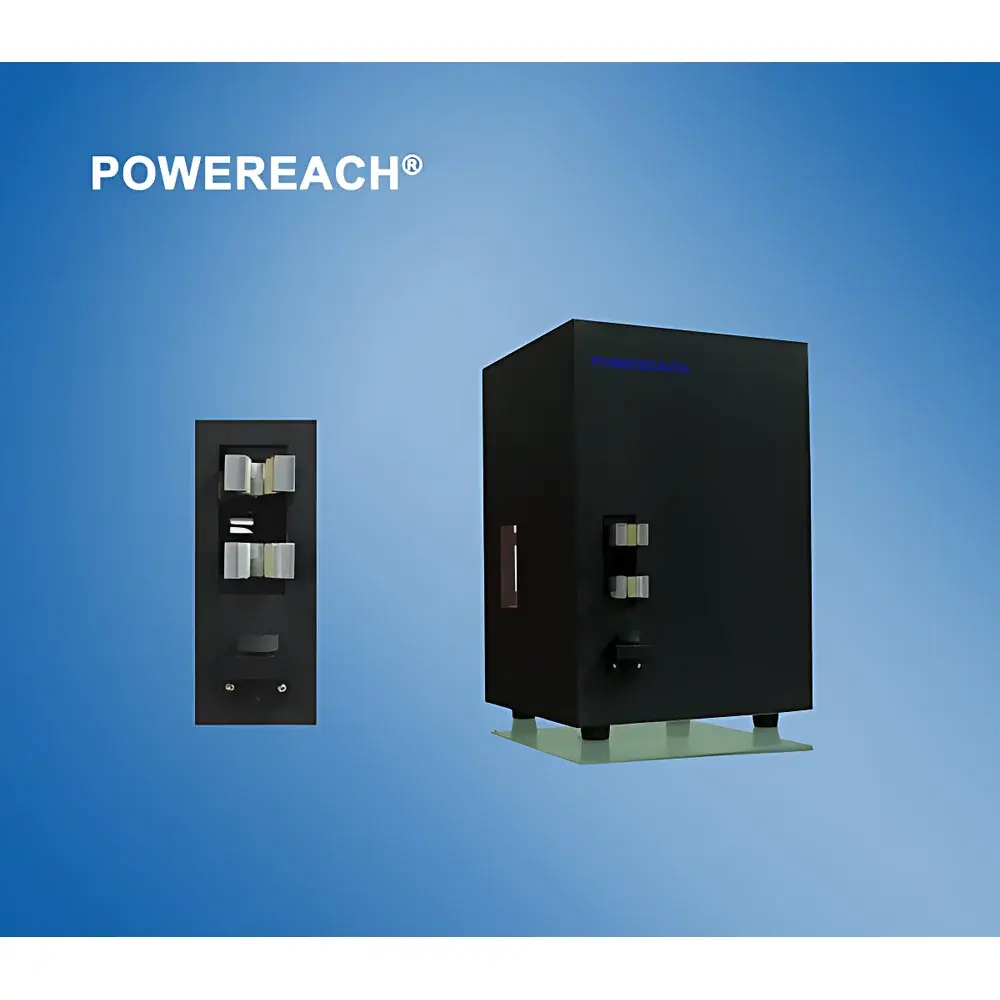
POWEREACH JQ06B Cap Dislodgement Force Tester
| Brand | POWEREACH (Shanghai Zhongchen) |
|---|---|
| Origin | Shanghai, China |
| Manufacturer Type | Authorized Distributor |
| Country of Origin | China |
| Model | JQ06B |
| Pricing | Available Upon Request |
Overview
The POWEREACH JQ06B Cap Dislodgement Force Tester is a precision mechanical testing instrument engineered for standardized evaluation of cap retention force on writing instruments—specifically ballpoint pens, fountain pens, and rollerball pens. It operates on the principle of controlled uniaxial tensile separation: a motorized actuator applies a linearly increasing axial force to detach the pen cap from its barrel while maintaining constant grip geometry and displacement rate. The system complies with core regulatory frameworks governing child safety and product durability, including ISO 11540:2014 (“Writing and marking instruments — Safety requirements”) and ASTM F963-23 Annex 4.22 (“Toy Safety Standard”), both of which mandate quantifiable cap dislodgement thresholds to mitigate choking hazards. Designed for laboratory-grade repeatability, the JQ06B integrates high-resolution load sensing (±0.1% full-scale accuracy), programmable test speed (0.1–500 mm/min), and adjustable gauge length (10–100 mm), enabling strict adherence to method-specific parameters across global compliance protocols.
Key Features
- Automated dual-grip clamping system: Precision-machined, self-centering chucks secure both cap and barrel without slippage or deformation—critical for consistent force transmission and avoidance of premature failure artifacts.
- Adjustable mechanical parameters: Independent control of test speed, initial grip separation distance, and dwell time before tension initiation ensures alignment with diverse national and industry standards (e.g., GB/T 26704–2021, EN 71-1).
- High-fidelity data acquisition: Integrated 24-bit ADC captures real-time force vs. displacement profiles at ≥100 Hz sampling rate; raw data export in CSV format supports traceable post-processing and statistical analysis (mean, SD, CV%, max force, yield point).
- Modular hardware architecture: Mainframe unit includes embedded microcontroller, stepper motor drive, overload protection circuitry, and RS232/USB dual-interface connectivity—designed for long-term stability under repeated cyclic loading.
- Compliance-ready documentation: Factory calibration certificate traceable to NIM (National Institute of Metrology, China); optional ISO/IEC 17025-compliant calibration services available upon request.
Sample Compatibility & Compliance
The JQ06B accommodates cylindrical and tapered caps with outer diameters ranging from 6 mm to 22 mm and lengths up to 45 mm. Compatible sample types include polypropylene (PP), acrylonitrile butadiene styrene (ABS), polycarbonate (PC), and metal-clad composite caps. The instrument satisfies essential requirements for regulatory submission in EU (CE marking per Machinery Directive 2006/42/EC), USA (CPSC 16 CFR Part 1500.18(a)(8)), and China (CCC exemption category for lab equipment). All test methods are structured to support GLP-aligned workflows: audit trails, user access logs, and electronic signature capability (when paired with compliant PC software) meet FDA 21 CFR Part 11 readiness criteria for regulated environments.
Software & Data Management
The included POWEREACH TestMaster v3.2 software provides intuitive GUI-based test configuration, live curve visualization, pass/fail threshold setting, and automated report generation (PDF/Excel). Data files embed metadata including operator ID, timestamp, environmental conditions (optional sensor input), and calibration status. Software architecture supports multi-user role permissions (admin, technician, reviewer), encrypted local storage, and configurable auto-backup to network drives. Raw datasets retain full resolution for third-party statistical validation (e.g., Minitab, JMP) or integration into LIMS platforms via ODBC drivers.
Applications
- Product development labs: Quantifying cap retention performance during iterative design of ergonomic pen assemblies.
- Quality assurance departments: Routine batch verification against internal specifications and customer technical agreements (e.g., OEM supplier PPAP submissions).
- Regulatory testing laboratories: Conducting accredited safety assessments for CE, UKCA, or CCC certification pathways.
- Academic research: Investigating polymer creep behavior, interfacial adhesion mechanics, and frictional engagement dynamics in thermoplastic snap-fit joints.
- Contract testing service providers: Delivering ISO 17025-certified test reports for multinational stationery brands operating in APAC, EMEA, and Americas markets.
FAQ
What computer specifications are required to operate the JQ06B?
A Windows OS (32-bit or 64-bit) with one available USB port and one functional RS232 serial port (or USB-to-serial adapter meeting FTDI chipset specifications) is mandatory. Minimum RAM: 2 GB; HDD space: 500 MB free.
Is the JQ06B suitable for testing non-pen applications?
While optimized for writing instrument caps, the system can be adapted for other small-diameter push-fit or friction-fit components (e.g., medical device caps, cosmetic container closures) subject to custom fixture design and method validation.
Does the system support GMP/GLP audit requirements?
Yes—when deployed with validated software configurations, calibrated sensors, and documented change control procedures, the JQ06B meets foundational data integrity requirements outlined in ALCOA+ principles and supports 21 CFR Part 11 compliance through optional electronic signature modules.
What maintenance intervals are recommended?
Biannual verification of load cell linearity and crosshead alignment is advised; annual recalibration by an accredited metrology lab is recommended for regulated use. Lubrication of lead screw and guide rails every 6 months ensures mechanical longevity.
Can test methods be exported and shared across multiple instruments?
Yes—TestMaster v3.2 supports XML-based method file exchange, enabling identical parameter sets to be loaded across distributed JQ06B units in multi-site manufacturing or contract lab networks.
Related Products