
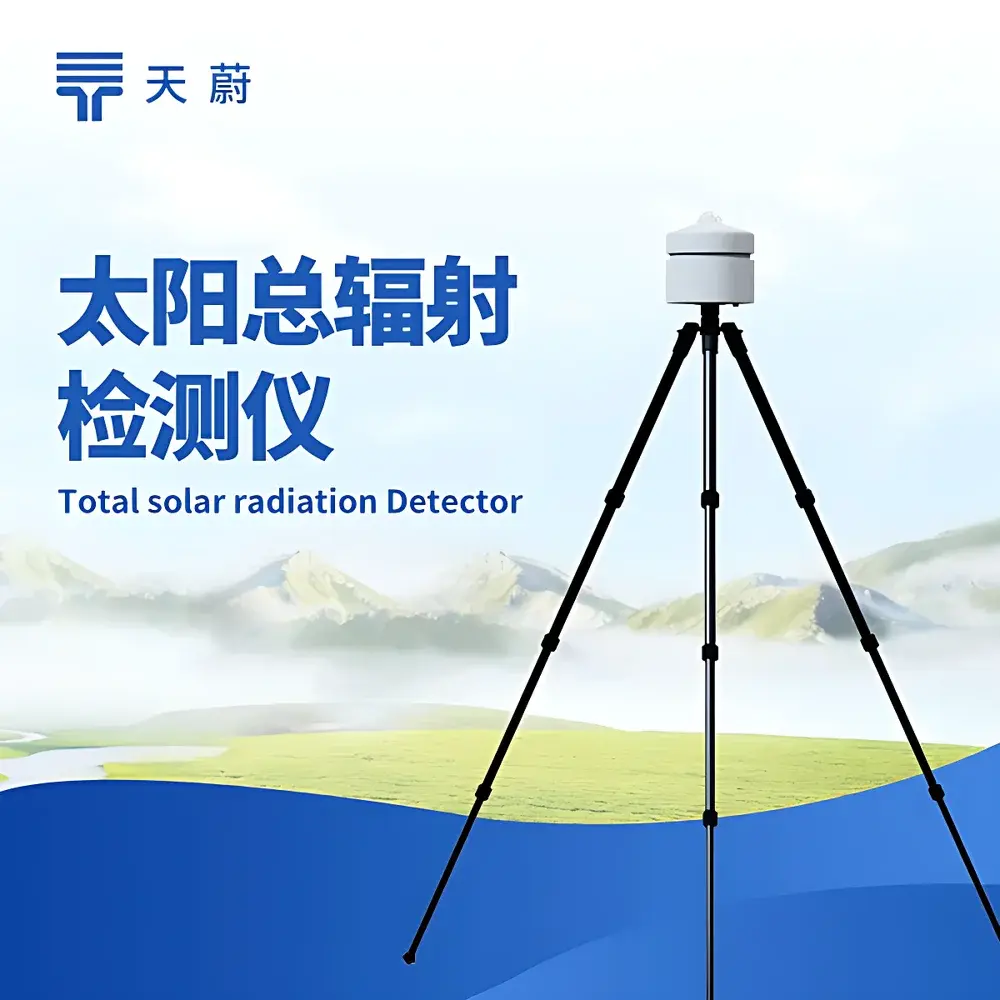
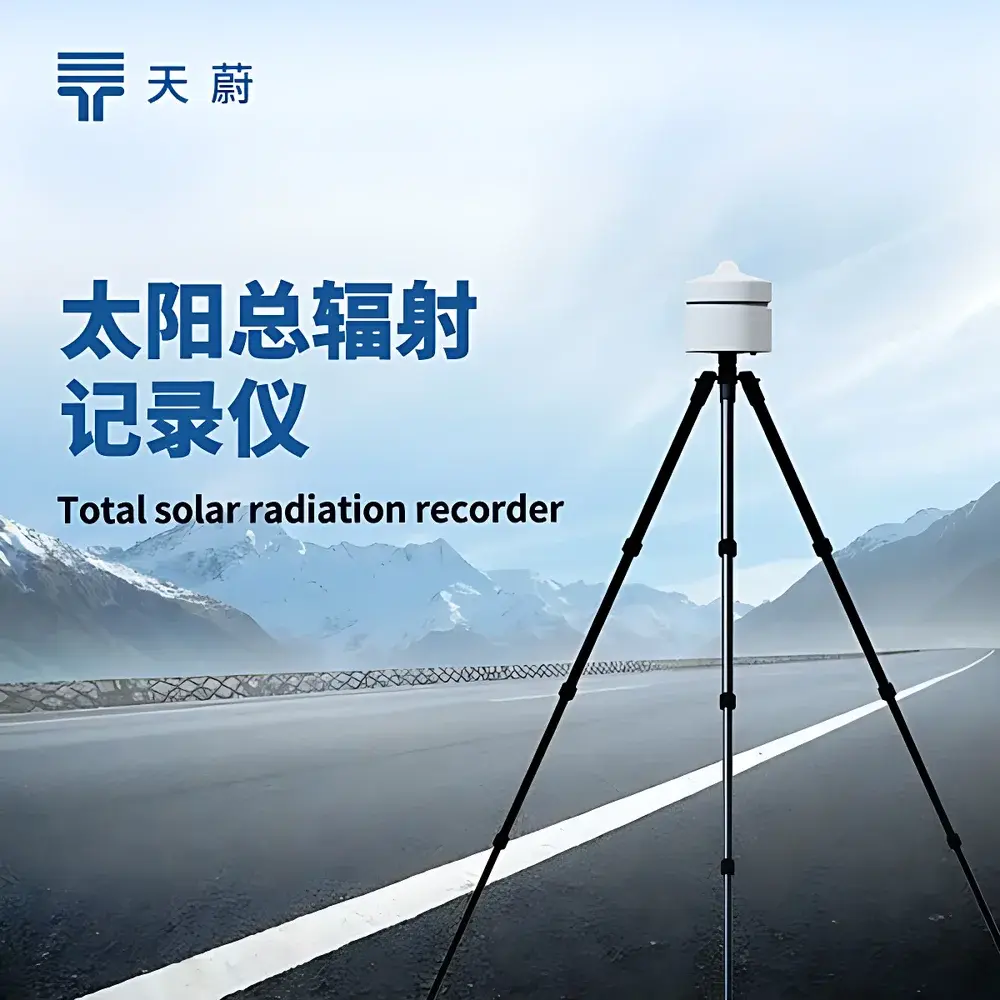
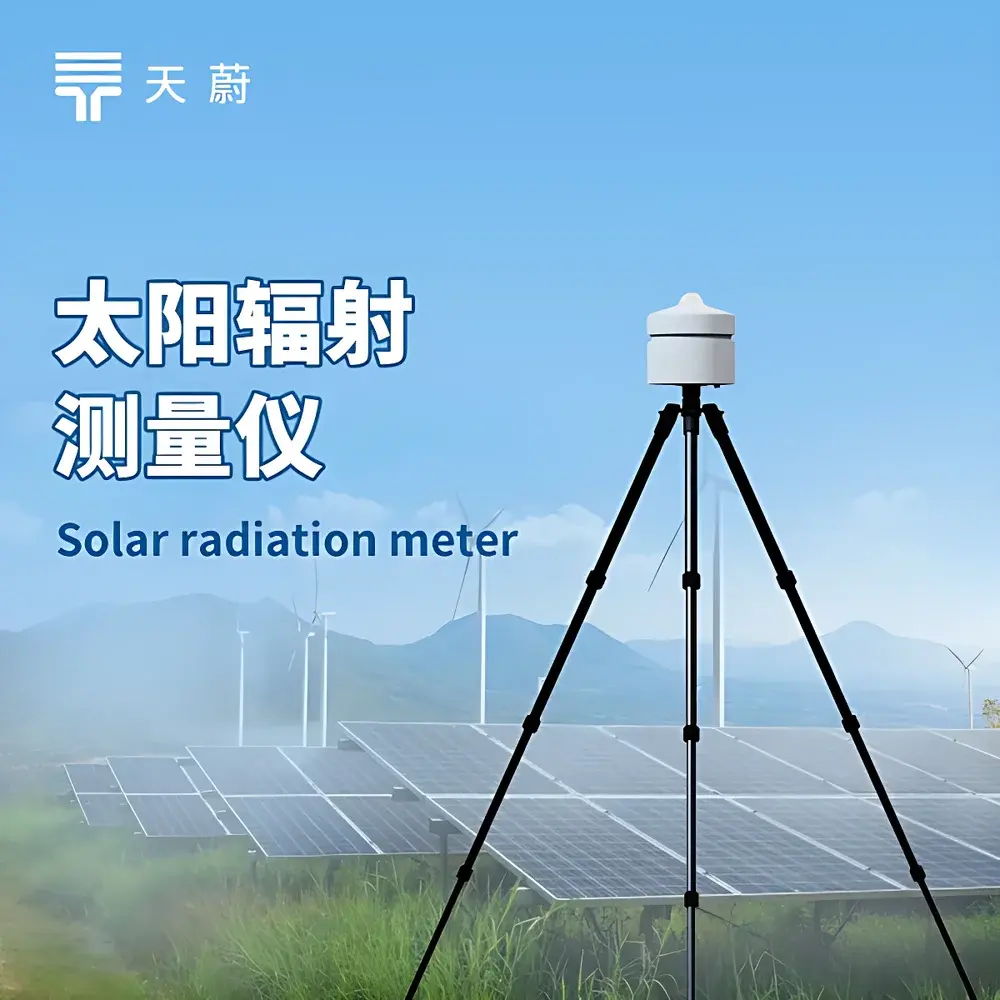
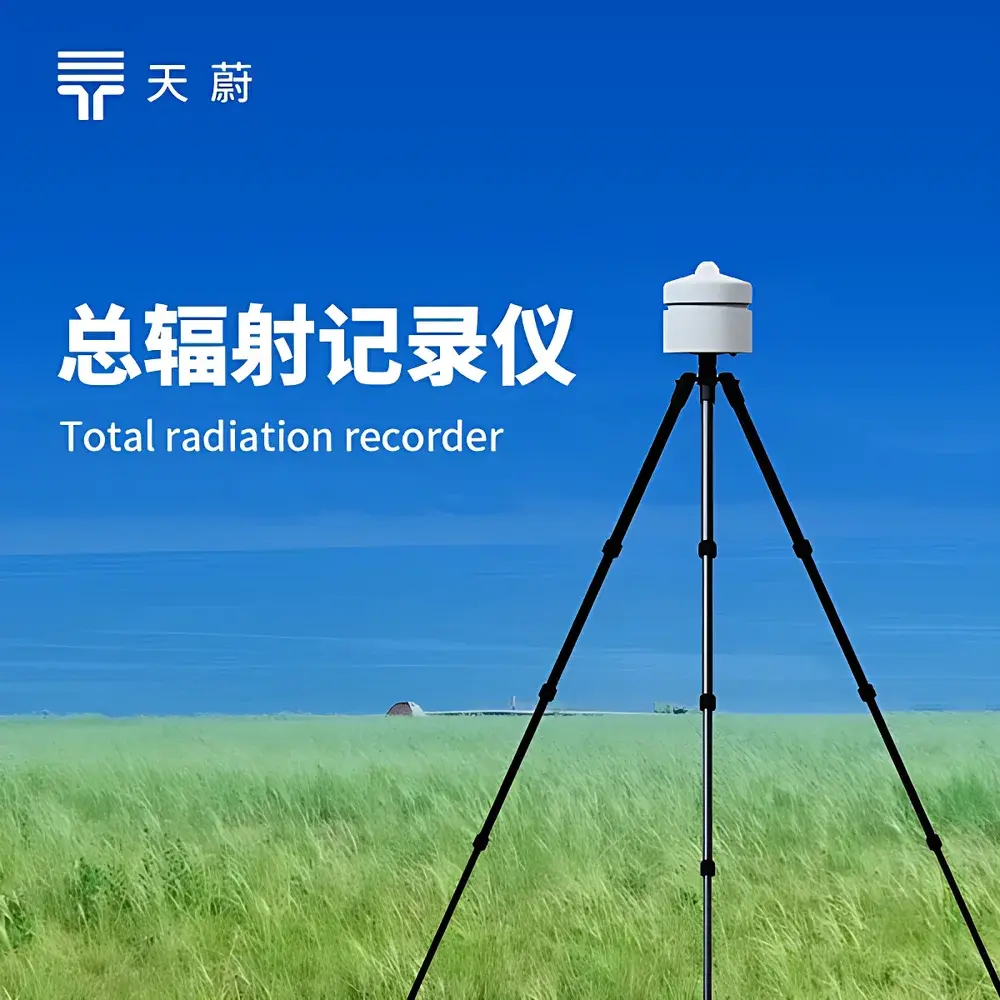
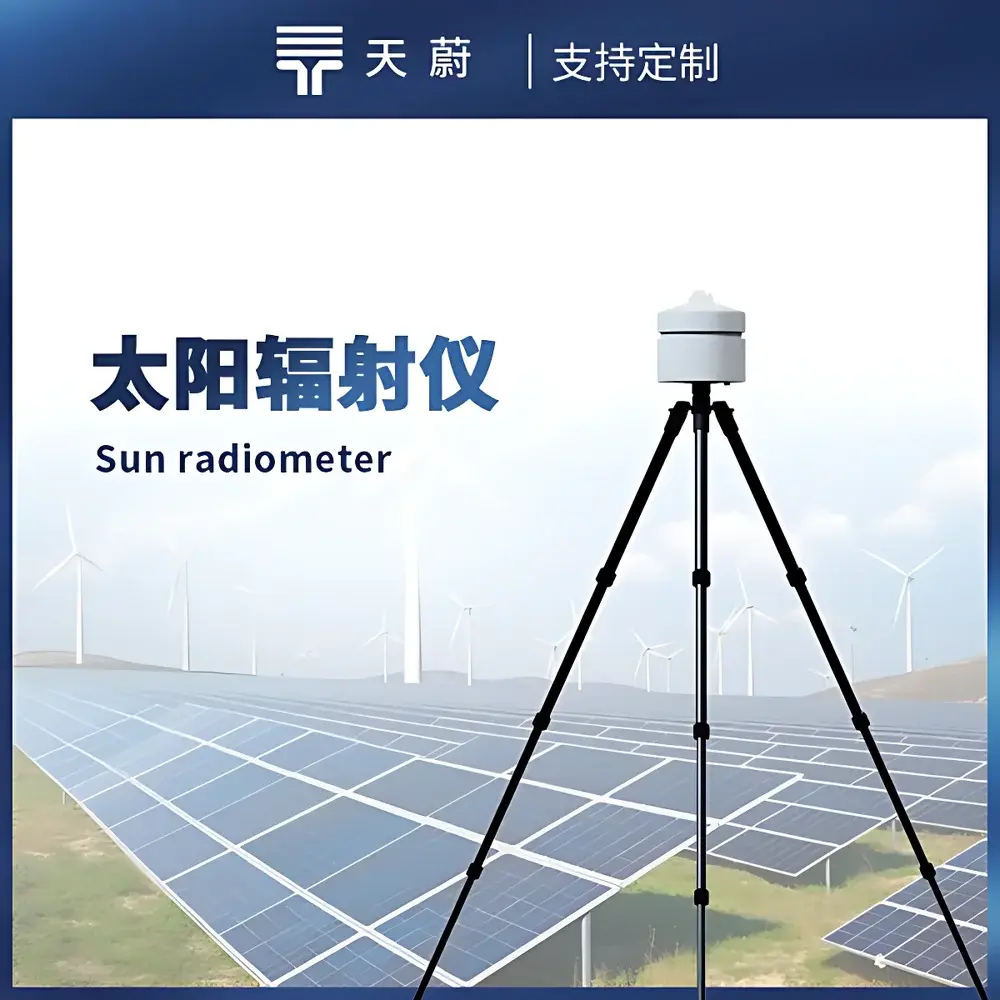
TW-BF1 Total Solar Radiation Recorder by Tianwei Environment
| Brand | Tianwei Environment (TW) |
|---|---|
| Origin | Shandong, China |
| Manufacturer Type | Direct Manufacturer |
| Model | TW-BF1 |
| Instrument Category | Portable/Short-Term Meteorological Station |
| Spectral Range | 280–3000 nm |
| Response Time (95%) | 13 s |
| Zero Offset (Thermal Radiation) | ±10 W/m² |
| Zero Offset (Temperature Variation) | ±3 W/m² |
| Nonlinearity | ±1% |
| Stability (Annual Sensitivity Drift) | ±2% |
| Directional (Cosine) Response Error | ≤±5% at 30° solar elevation |
| Spectral Error | ±3% |
| Temperature Response (−10 to +40 °C) | ±3% |
| Tilt Error | ±1% |
| Sensitivity | 7–14 µV/(W·m⁻²) |
| Internal Resistance | ≤800 Ω |
| Operating Temperature | −40 to +85 °C |
| Operating Humidity | 5–90% RH |
| Power Consumption | 1.75 W |
| Rechargeable Lithium Battery | 12,000 mAh, ≥50 h runtime with battery level indication |
| Data Storage Capacity | ≥500,000 records |
| Deployment Time | ≤2 minutes by single operator |
| Weight | ≤5 kg |
| Communication Interfaces | GPRS, Bluetooth 5.0, RS-485-to-USB converter |
| Compliance | ISO 9060:2018 (Class C, First Class), WMO CIMO Guide (2022), GB/T 19565–2017 |
Overview
The TW-BF1 Total Solar Radiation Recorder is a field-deployable, high-integrity radiometric instrument engineered for accurate, autonomous measurement of global horizontal irradiance (GHI) — the total solar energy flux incident on a horizontal surface across the spectral band from 280 nm to 3000 nm. Based on thermopile detection principle with precision quartz-dome optical filtering, the sensor conforms to ISO 9060:2018 classification as a First Class (formerly “Secondary Standard”) pyranometer, meeting the metrological requirements specified in the World Meteorological Organization’s (WMO) Guide to Meteorological Instruments and Methods of Observation (CIMO Guide, Chapter 8) and China’s national standard GB/T 19565–2017. Its low thermal mass design and optimized thermal compensation ensure minimal zero-offset drift under rapid ambient temperature changes or thermal gradients — critical for short-term mobile deployments, emergency meteorological surveys, and solar resource assessment in non-permanent installations.
Key Features
- Thermopile-based sensing element with integrated quartz optical dome, fabricated via precision cold optical grinding to minimize spectral distortion and environmental degradation
- First Class spectral responsivity (280–3000 nm) and cosine correction error ≤±5% at 30° solar elevation, validated per ISO 9060:2018 Annex B
- Low-power architecture: nominal 1.75 W consumption enables extended autonomous operation using the removable 12,000 mAh Li-ion battery pack (≥50 h runtime)
- Rapid-deployment mechanical design: complete field setup achievable by one operator in ≤2 minutes without calibration or configuration tools
- Triple-mode communication interface: simultaneous support for GPRS (cellular telemetry), Bluetooth 5.0 (local smartphone pairing), and RS-485 (industrial serial bus), with USB conversion included
- Robust environmental rating: operational across −40 °C to +85 °C and 5–90% RH, with IP65-rated enclosure for outdoor exposure
Sample Compatibility & Compliance
The TW-BF1 is designed for direct measurement of broadband solar irradiance on horizontal surfaces under natural atmospheric conditions. It is compatible with standard mounting hardware (e.g., leveling base, adjustable tilt bracket, and solar tracker interfaces) and integrates seamlessly into existing meteorological networks via Modbus RTU over RS-485 or JSON-over-Bluetooth protocols. Regulatory and metrological compliance includes full alignment with ISO 9060:2018 (First Class performance tier), WMO CIMO Guide §8.3.2 (pyranometer specifications), and GB/T 19565–2017 (Chinese technical standard for total radiation sensors). While not certified to IEC 61215 or UL 1703, its output data meets input requirements for PV system performance modeling (e.g., PVsyst, SAM) and atmospheric transmittance studies when deployed with appropriate site characterization.
Software & Data Management
Data acquisition and post-processing are supported across three interoperable platforms: (1) Windows-based desktop software featuring real-time serial/Modbus parsing, customizable logging intervals, protocol editor for user-defined sensor mappings, and embedded JavaScript runtime for on-device data transformation; (2) Android application supporting background Bluetooth polling, QR-code-assisted Modbus device onboarding, time-series visualization, CSV export, and offline curve analysis; and (3) cloud-based SaaS platform (CS architecture) accessible via browser on PC or mobile. The cloud service provides role-based multi-user access, GIS-enabled device mapping, configurable threshold alerts (SMS/email), HJ-212 protocol forwarding for Chinese environmental monitoring systems, HTTP/TCP data push, and server-side JavaScript execution for automated QA/QC flagging — all hosted on load-balanced, geo-redundant infrastructure compliant with ISO/IEC 27001 information security standards.
Applications
The TW-BF1 serves as a primary measurement node in transient and semi-permanent solar monitoring applications where installation speed, portability, and traceable accuracy are prioritized over permanent observatory-grade stability. Key use cases include: pre-construction solar feasibility studies for photovoltaic farms; short-duration agrivoltaic microclimate characterization; accelerated aging testing of construction materials under controlled irradiance exposure; validation of satellite-derived surface radiation products (e.g., CAMS, CERES); mobile air quality campaigns requiring co-located irradiance normalization; and educational field laboratories requiring rugged, student-operable instrumentation. Its First Class classification ensures data suitability for ISO 9060-compliant reporting frameworks and regional solar atlas development initiatives.
FAQ
What calibration documentation is provided with the TW-BF1?
Each unit ships with a factory calibration certificate traceable to NIM (National Institute of Metrology, China), including individual sensitivity factor (µV/W·m⁻²), zero-offset values, and cosine response test report.
Can the TW-BF1 be connected to third-party SCADA or IoT platforms?
Yes — via Modbus RTU over RS-485 or JSON over Bluetooth/GPRS, with protocol templates available for integration into Ignition, Node-RED, ThingsBoard, and similar industrial middleware.
Is the quartz dome replaceable in the field?
The quartz optical assembly is sealed and not user-replaceable; however, it is rated for ≥5 years of continuous outdoor exposure under typical UV and particulate loading conditions.
Does the device support time-synchronized measurements across multiple units?
GPS synchronization is not built-in, but external NTP or PPS signals can be applied via optional RS-485 expansion module for sub-second timestamp alignment in networked deployments.
How is data integrity ensured during transmission?
All communication layers implement CRC-16 (Modbus), SHA-256 payload signing (cloud API), and automatic retransmission logic for GPRS packet loss — satisfying GLP-aligned data audit requirements for environmental reporting.







