
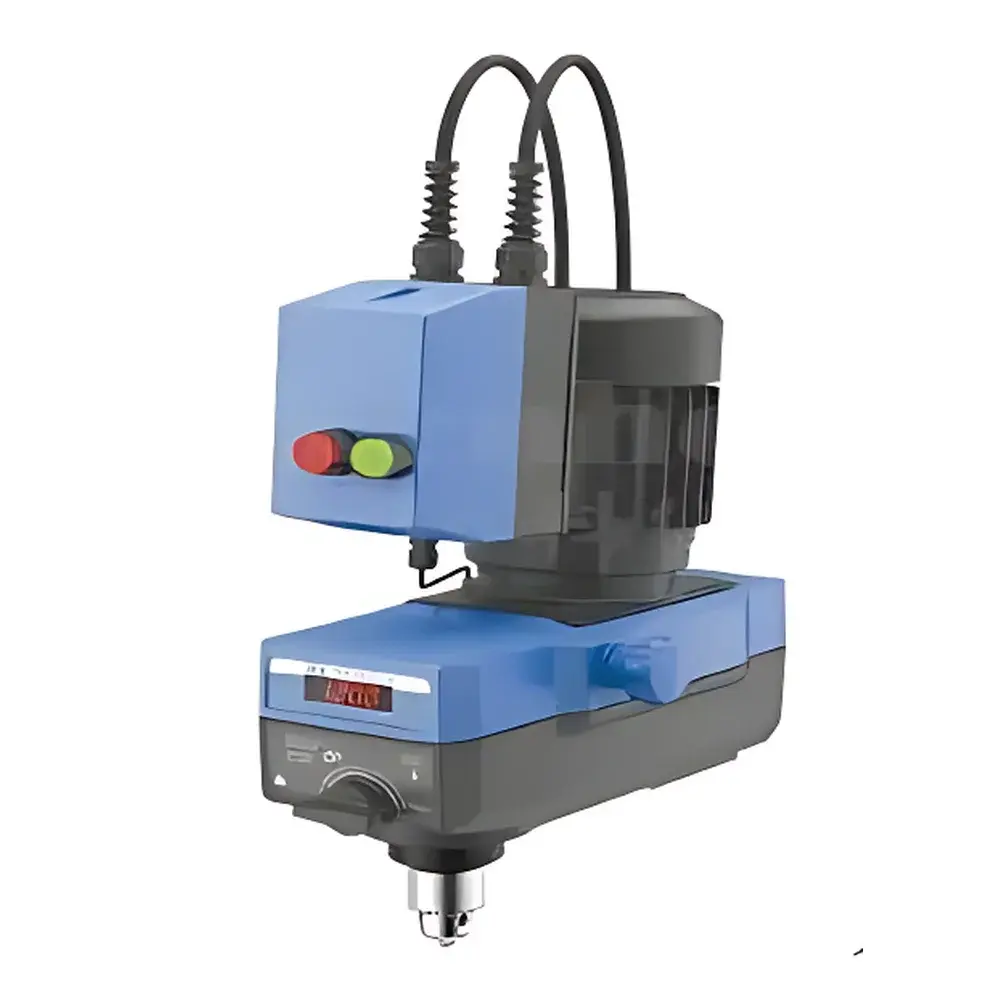
IKA RW 47 digital Heavy-Duty Mechanical Stirrer
| Brand | IKA |
|---|---|
| Origin | Germany |
| Model | RW 47 digital |
| Maximum Stirring Volume | 200 L (H₂O) |
| Speed Range | 57–1300 rpm |
| Speed Control | Continuously Variable, Dual-Speed Range (Range I: 57–275 rpm |
| Range II | 275–1300 rpm) |
| Speed Accuracy | ±1 rpm |
| Speed Measurement Deviation | ±10 rpm |
| Max. Torque (at 60 rpm) | 4642 N·cm |
| Rated Torque | 30 N·m |
| Max. Viscosity | 100,000 mPa·s |
| Motor Input Power | 513 W |
| Motor Output Power | 370 W |
| Stirring Shaft Output Power | 300 W |
| Duty Cycle | 100% continuous operation |
| Clamp Jaw Range | 3–16 mm |
| Hollow Shaft Inner Diameter | 13 mm |
| Housing Material | Cast Aluminum with Thermoplastic Coating |
| IP Rating | IP54 |
| Dimensions (W×H×D) | 145 × 465 × 358 mm |
| Weight | 16 kg |
| Ambient Temperature Range | 5–40 °C |
| Relative Humidity Limit | 80 % |
| Power Supply | 3 × 400 V / 3 × 230 V, 50 Hz |
Overview
The IKA RW 47 digital is a heavy-duty, three-phase mechanical stirrer engineered for high-torque, continuous-duty laboratory and pilot-scale mixing applications. Designed around Couette flow principles and optimized for viscous media handling, it delivers stable rotational motion under load through a robust planetary gearmotor architecture and precision-machined cast aluminum housing. Its dual-range speed control (57–275 rpm and 275–1300 rpm) enables precise adaptation to both low-shear homogenization and high-shear dispersion tasks—critical when processing non-Newtonian fluids such as polymer melts, ceramic slurries, or pharmaceutical suspensions. With a rated torque of 30 N·m and peak overload torque of 4642 N·cm at 60 rpm, the RW 47 digital maintains consistent angular momentum even during abrupt viscosity changes, minimizing speed droop and ensuring reproducible shear history across batches.
Key Features
- High-power three-phase motor delivering 370 W mechanical output and 300 W shaft power—optimized for sustained operation in demanding environments
- Dual-speed range architecture with continuously variable electronic speed control and ±1 rpm setting resolution
- Integrated thermal protection circuitry that automatically limits motor temperature rise, complying with IEC 60034-1 insulation class F requirements
- Ergonomic, low-noise design with vibration-damped mounting and IP54-rated enclosure for resistance to dust ingress and water splashing
- Hollow stainless steel stirring shaft (13 mm inner diameter) compatible with internal temperature probes or auxiliary sensors during operation
- Universal chuck with 3–16 mm clamping range and self-centering geometry for secure retention of impellers, anchors, and high-viscosity paddles
- Full 100% duty cycle rating validated per DIN EN 60034-1, enabling uninterrupted operation over extended process windows
Sample Compatibility & Compliance
The RW 47 digital accommodates a broad spectrum of sample types—from aqueous solutions and emulsions to highly viscous pastes (up to 100,000 mPa·s) and abrasive suspensions. Its mechanical drive system avoids electronic feedback loops susceptible to electromagnetic interference, making it suitable for use near analytical instrumentation or in shielded cleanroom-adjacent zones (though not certified for ISO Class 5+ environments). The unit meets CE marking requirements under the Machinery Directive 2006/42/EC and complies with EN 61000-6-2 (immunity) and EN 61000-6-4 (emission) standards. While not intrinsically safe, its IP54 rating supports deployment in controlled industrial labs where ambient humidity remains below 80 % RH and ambient temperature stays within 5–40 °C.
Software & Data Management
As a standalone electromechanical instrument, the RW 47 digital does not feature embedded firmware, USB, RS232, or analog output interfaces. All operational parameters—including real-time speed, overload status, and thermal error codes—are conveyed via high-contrast LED display. For integration into regulated environments (e.g., GLP or GMP-compliant facilities), users may document operating conditions manually or pair the stirrer with external data loggers connected to calibrated tachometers and torque transducers. Though lacking FDA 21 CFR Part 11-compliant audit trails natively, its deterministic mechanical behavior and repeatable setpoint response support validation protocols aligned with ASTM D2196 (viscosity measurement) and ISO 2557-2 (mixing equipment performance testing).
Applications
- Scale-down simulation of industrial mixing processes in chemical process development
- Preparation of high-solid-content battery electrode slurries requiring uniform particle dispersion without agglomeration
- Rheological conditioning of thermosetting resins prior to casting or injection molding trials
- Homogenization of food-grade hydrocolloid systems (e.g., xanthan gum, carrageenan) under controlled shear profiles
- Stirring of cell culture media containing microcarriers in bioreactor seed train workflows
- Dispersion of nanomaterials (e.g., graphene oxide, metal oxides) in solvent-based matrices for coating formulation
FAQ
Is the RW 47 digital compatible with overhead stirrer stands from other manufacturers?
Yes—its standardized M12 threaded base allows mechanical coupling to third-party support frames meeting DIN 28151 or ISO 8573-1 dimensional specifications.
Can the hollow shaft accommodate PT100 probes during active stirring?
Yes—the 13 mm internal diameter permits insertion of standard 6 mm sheathed RTD probes, provided the probe tip remains outside the impeller’s radial sweep zone to avoid mechanical interference.
Does the unit support programmable ramp-up or timer functions?
No—speed is manually set and maintained; timing and ramp profiles must be managed externally via process controllers or manual logging.
What maintenance intervals are recommended for continuous 24/7 operation?
IKA recommends inspecting gear oil levels every 2000 operating hours and replacing the lubricant every 6000 hours or annually—whichever occurs first—per maintenance manual section 4.3.
Is the RW 47 digital suitable for use in explosion-hazard areas?
No—it lacks ATEX or IECEx certification and must not be deployed in Zone 1 or Zone 2 classified locations without additional engineering controls.



