
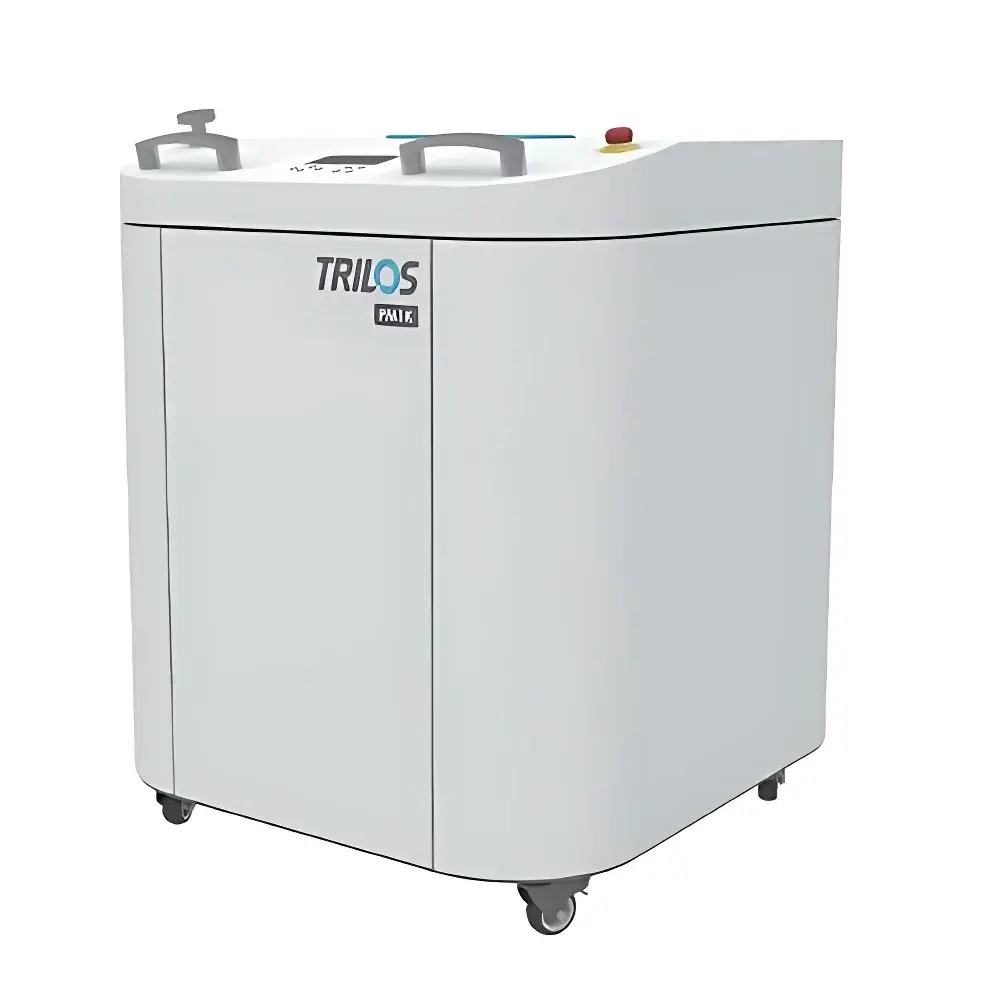
TRILOS PM1k Planetary Mixer-Deaerator
| Brand | TRILOS |
|---|---|
| Model | PM1k |
| Type | Planetary Dual-Cup Mixer & Vacuum Deaerator |
| Max. Capacity | 2 × 1100 mL (dual-cup) |
| Max. Orbital Speed | 750 rpm |
| Max. Rotational Speed | 750 rpm |
| Power Supply | 220 V, 3 kW |
| Dimensions (W×D×H) | 760 × 950 × 760 mm |
| Weight | 250 kg |
| Origin | USA |
| Compliance | CE, ISO 9001-certified manufacturing environment |
| Vacuum Option | Integrated vacuum deaeration module (optional configuration) |
Overview
The TRILOS PM1k is a high-performance planetary mixer-deaerator engineered for laboratory-scale process development and pilot-line production of viscous, heterogeneous, and air-sensitive formulations. It operates on the principle of synchronized planetary motion—where each mixing cup undergoes simultaneous orbital revolution around a central axis and independent rotational spin about its own axis. This dual-motion geometry generates controlled, high-shear, high-energy mechanical action without blade contact, enabling uniform dispersion, homogenization, and vacuum-assisted deaeration in a single integrated unit. Unlike conventional stirrers or rotor-stator systems, the PM1k avoids localized overheating, particle attrition, or shear degradation—making it especially suitable for shear-sensitive nanomaterials, conductive pastes, battery electrode slurries, and pharmaceutical ointments. Its robust cast-iron frame, precision-machined gear train, and sealed harmonic drive system ensure long-term repeatability under sustained operation at elevated torque loads.
Key Features
- Planetary dual-cup architecture supporting two independent 1100 mL vessels—enabling parallel processing, comparative formulation trials, or staggered batch staging.
- Independent digital control of orbital (0–750 rpm) and rotational (0–750 rpm) speeds via integrated touchscreen HMI, with programmable ramp profiles and multi-step sequences.
- High-torque, low-inertia servo-motor drive system with thermal overload protection and real-time torque monitoring—optimized for viscosities ranging from 1,000,000 mPa·s (high-fill conductive adhesives and sealants).
- Optional integrated vacuum deaeration module (up to 10 mbar absolute pressure) with pressure-regulated venting and condensate trap—designed to meet ASTM D1875 and ISO 16283 requirements for void-free sample preparation.
- Stainless steel (AISI 316L) mixing cups with removable, autoclavable lids and silicone-sealed ports for inert gas purging (N₂ or Ar)—supporting GMP-compliant handling of moisture- or oxygen-sensitive compounds.
- CE-marked electrical architecture compliant with IEC 61000-6-2/6-4 EMC standards; safety interlocks conform to EN ISO 13857 and EN 60204-1.
Sample Compatibility & Compliance
The PM1k accommodates a broad spectrum of material classes—including solvent-based and solvent-free polymer dispersions, ceramic and metal nanoparticle slurries, lithium-ion cathode/anode pastes (e.g., NMC, LFP, SiOx/C), UV-curable acrylates, silicone RTVs, epoxy encapsulants, and topical pharmaceutical gels. Its non-contact mixing mechanism eliminates contamination risk from wear particles and supports USP particulate matter testing workflows. When configured with vacuum deaeration and audit-trail-capable software (see below), the system meets functional requirements for GLP and GMP environments—including FDA 21 CFR Part 11 compliance when paired with validated electronic signatures and data integrity controls. All wetted surfaces are electropolished to Ra ≤ 0.4 µm and passivated per ASTM A967, ensuring compatibility with aggressive chemistries used in battery electrolyte R&D and semiconductor packaging.
Software & Data Management
The PM1k is equipped with TRILOS ControlSuite™ v3.2—a Windows-based application supporting full recipe management, real-time parameter logging (speed, torque, temperature, vacuum level), and CSV/PDF export with time-stamped metadata. The software includes built-in validation templates aligned with IQ/OQ protocols and supports optional 21 CFR Part 11 compliance packages featuring role-based access control, electronic signatures, and immutable audit trails. Data files are stored locally on an encrypted SSD with automatic backup to network drives via SMB protocol. Remote diagnostics and firmware updates are available through secure TLS 1.2–encrypted connections—enabling centralized fleet management across multi-site R&D facilities.
Applications
- Battery R&D: Homogeneous dispersion of conductive carbon additives and active materials in NMP or aqueous binders; deaeration of thick cathode slurries prior to slot-die coating.
- Electronics Manufacturing: Preparation of void-free solder pastes, underfill epoxies, and anisotropic conductive films (ACFs) for flip-chip and FOWLP processes.
- Pharmaceutical Development: Mixing and degassing of semi-solid dosage forms—including hydrophilic ointments, transdermal gels, and mucoadhesive buccal patches—under controlled humidity and inert atmosphere.
- Advanced Materials: Exfoliation-assisted dispersion of graphene, MXenes, or CNTs in polymer matrices; formulation of thermally conductive greases and phase-change materials.
- Automotive & Aerospace: Batch preparation of structural adhesives, sealants, and radar-absorbing composites requiring precise filler orientation and minimal entrapped air.
FAQ
What vacuum level can the optional deaeration module achieve?
The integrated vacuum system delivers stable operation down to 10 mbar absolute pressure, with optional upgrade to 1 mbar for ultra-low-void applications such as optical adhesive casting.
Can the PM1k handle abrasive fillers like alumina or silicon carbide?
Yes—the mixing cups and drive shaft seals are rated for continuous use with particulates up to 50 µm median size; wear-resistant ceramic-coated cups are available as a custom option.
Is the system compatible with hazardous area (ATEX) environments?
Standard units are not ATEX-certified; however, TRILOS offers Zone 2–rated variants with explosion-proof motors and intrinsically safe control circuitry upon request.
Does the PM1k support automated cleaning-in-place (CIP)?
While not fully CIP-enabled, the quick-release cup design and smooth internal geometry allow efficient manual cleaning using ultrasonic baths or solvent rinsing—validated per ISO 14644-1 Class 7 cleanroom protocols.
What documentation is provided for regulatory submissions?
TRILOS supplies full DQ/IQ/OQ documentation packages, material traceability certificates (EN 10204 3.1), and EU Declaration of Conformity—available in English and certified by TÜV Rheinland.



