
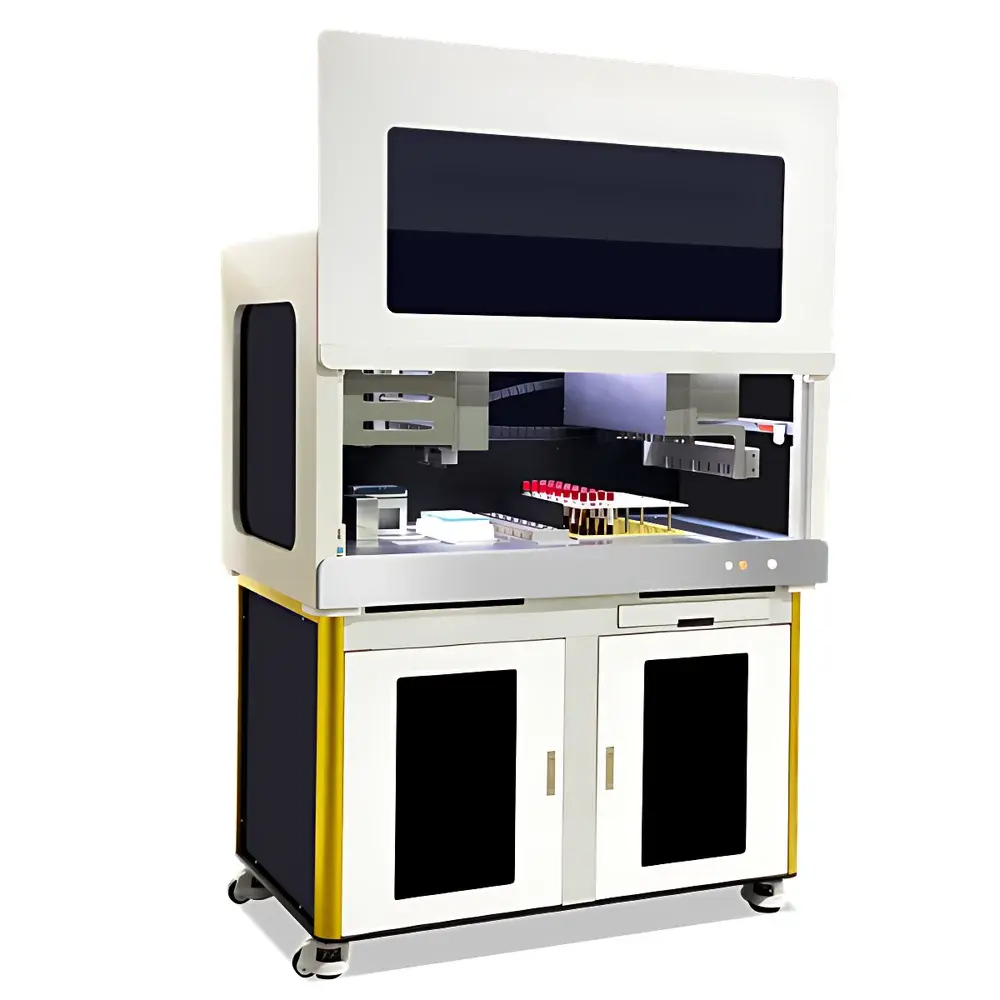
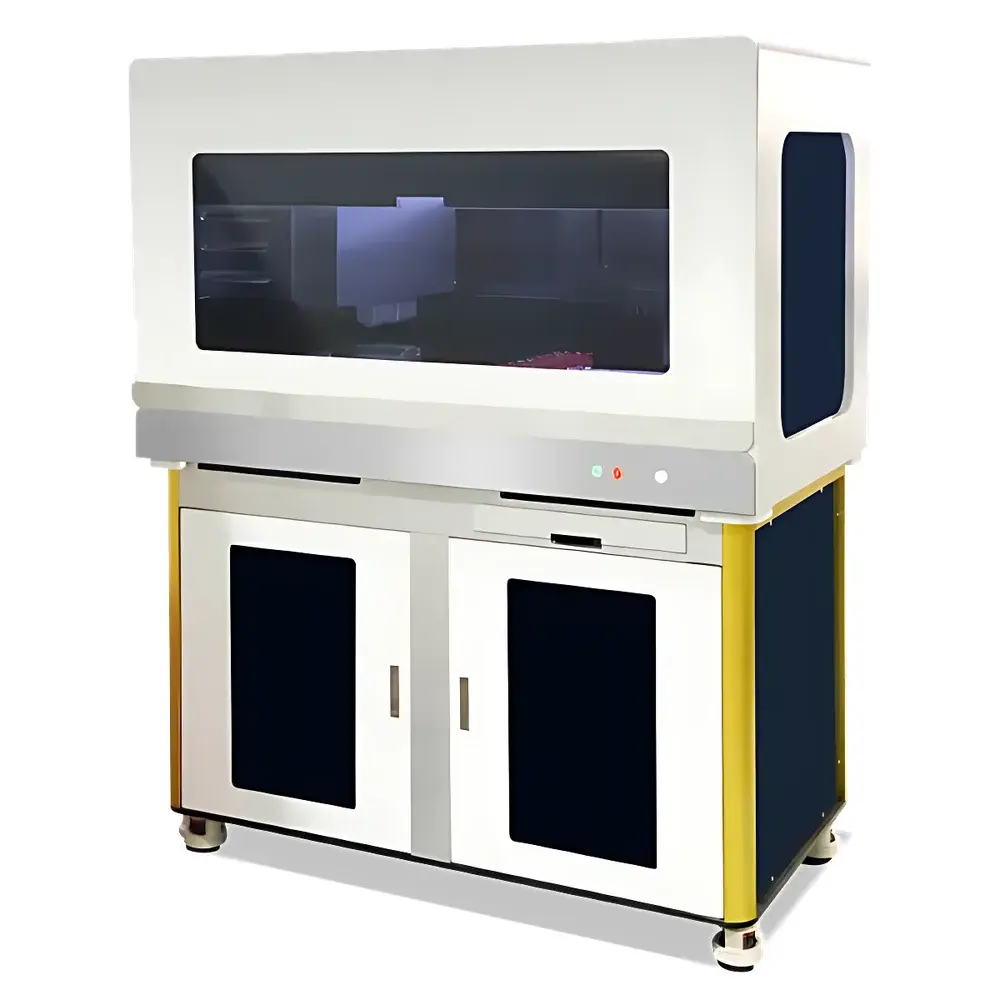
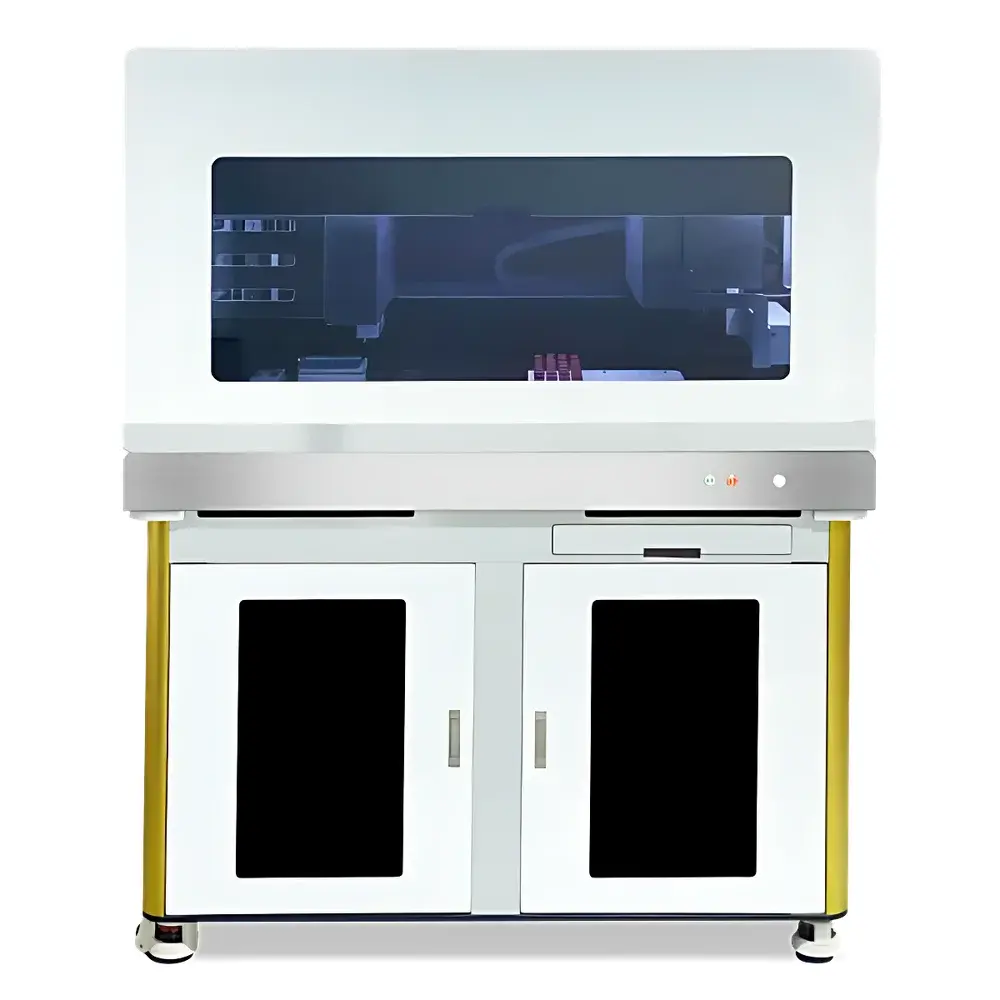
D.C. Labware ZY-B96 Fully Automated Blood Tube Aliquoting Workstation
| Brand | D.C. Labware |
|---|---|
| Origin | Guangdong, China |
| Manufacturer Type | Authorized Distributor |
| Country of Origin | China |
| Form Factor | Benchtop Cabinet System |
| Functional Modules | Automated Cap Piercing & Removal |
| Sample Throughput | 96 samples per batch |
| Sample Types | Whole Blood, Serum, Buffy Coat |
| Pipetting Range | 1–20 µL |
| Pipetting Speed | Complete serum transfer from 96 blood collection tubes in ≤15 minutes |
| Pipetting Accuracy | ±5% at 1 µL |
Overview
The D.C. Labware ZY-B96 Fully Automated Blood Tube Aliquoting Workstation is an integrated benchtop solution engineered for high-integrity, traceable sample partitioning in clinical diagnostics, biobanking, and translational research laboratories. It operates on a precision liquid handling architecture combining motorized cap-piercing mechanisms, dual-channel positive-displacement pipetting, and real-time CCD-based optical recognition of tube orientation, fill level, and phase boundary (serum/erythrocyte/buffy coat). Unlike gravity-based or manual centrifugation-assisted workflows, the ZY-B96 performs post-centrifugation aliquoting without requiring operator intervention to identify or manually select layers—enabling reproducible isolation of serum or buffy coat fractions directly from standard EDTA, heparin, or serum separator tubes (SSTs). The system is designed to comply with core preanalytical requirements outlined in ISO 15189:2022 and CLSI GP44-A6, ensuring specimen integrity, chain-of-custody continuity, and audit-ready process documentation.
Key Features
- Automated cap piercing and removal for sealed vacuum blood collection tubes (13 × 75 mm, 16 × 100 mm formats supported)
- CCD-guided multi-layer detection: real-time imaging identifies serum height, erythrocyte sedimentation interface, and buffy coat band thickness to dynamically adjust aspiration depth
- Dual independent pipetting channels with positive-displacement tips (1–20 µL range), calibrated per ISO 8655-6 and verified with gravimetric traceability
- Integrated barcode/QR code reader (ISO/IEC 15415 compliant) for bidirectional sample tracking—reads tube barcodes pre-aliquoting and prints/verifies destination plate/tube labels post-transfer
- Benchtop cabinet design with HEPA-filtered laminar airflow enclosure (Class II A2 equivalent) and UV-C decontamination cycle between runs
- Onboard touchscreen HMI with role-based access control (admin, technician, auditor) and configurable SOP-driven run protocols
Sample Compatibility & Compliance
The ZY-B96 accepts primary blood collection tubes from major manufacturers (BD Vacutainer®, Greiner Bio-One, Sarstedt) including gel separator, EDTA-K2/K3, sodium heparin, and citrate formulations. It supports direct transfer into 96-well PCR plates, deep-well storage plates, or individual QR-coded cryovials (0.5–2.0 mL). All fluidic pathways are constructed from medical-grade PTFE and chemically resistant elastomers, validated for compatibility with hemolyzed, lipemic, and icteric specimens. The system meets IEC 61000-6-2/6-3 for electromagnetic compatibility and carries CE marking under the EU In Vitro Diagnostic Regulation (IVDR) 2017/746 Annex XVI for low-risk instrumentation. Audit logs—including timestamped pipette calibration events, tip ejection records, and layer-detection confidence scores—are retained for ≥12 months and exportable in CSV/CSV-GZ format for GLP/GMP review.
Software & Data Management
Control software is built on a deterministic real-time OS with embedded SQLite database and optional integration via HL7 v2.5 or ASTM E1384 interfaces to LIS/HIS systems. Each aliquoting event generates a structured metadata record containing source tube ID, destination location, volume transferred, layer identification confidence (%), ambient temperature/humidity, and operator login context. Full electronic signatures adhere to FDA 21 CFR Part 11 requirements, including audit trail immutability, user authentication, and digital certificate support. Raw CCD image thumbnails (JPEG-2000 compressed) are archived alongside each run for retrospective phase boundary validation. Software updates are delivered via signed firmware packages with SHA-256 hash verification.
Applications
- Clinical trial biobanking: standardized serum/buffy coat partitioning across multi-site collections
- Reference laboratory high-throughput serology: preparation of replicate aliquots for ELISA, chemiluminescence, and neutralization assays
- Genomic DNA extraction workflows: targeted buffy coat recovery minimizing granulocyte contamination
- Quality assurance programs: inter-laboratory comparison studies requiring identical preanalytical handling conditions
- Regulatory submission support: generation of ALCOA+ compliant data packages for ICH M10 bioanalytical method validation
FAQ
Does the ZY-B96 require pre-centrifuged samples?
Yes. The workstation assumes samples have undergone standardized centrifugation (e.g., 1500 × g for 10 min at 22°C) prior to loading. It does not include an integrated centrifuge.
Can it handle clotted versus anticoagulated tubes differently?
Yes. Protocol templates allow separate configuration for serum separator tubes (SST) and EDTA tubes—adjusting aspiration offset and dwell time to accommodate clot retraction dynamics and plasma viscosity differences.
Is remote monitoring supported?
Yes. Optional Ethernet/Wi-Fi connectivity enables TLS 1.2-secured remote status viewing, alarm notification via SMTP/SNMPv3, and secure log export through HTTPS-based REST API endpoints.
What maintenance intervals are recommended?
Cap-piercing needles require replacement every 500 cycles; pipette calibration verification is recommended weekly using NIST-traceable gravimetric standards; CCD lens cleaning is advised monthly with isopropyl alcohol and lint-free wipes.
Does it support custom plate maps or LIMS-defined destination layouts?
Yes. CSV-based destination mapping files can be imported to define non-standard well patterns, skip positions, or staggered distribution schemes across multiple output plates.






