
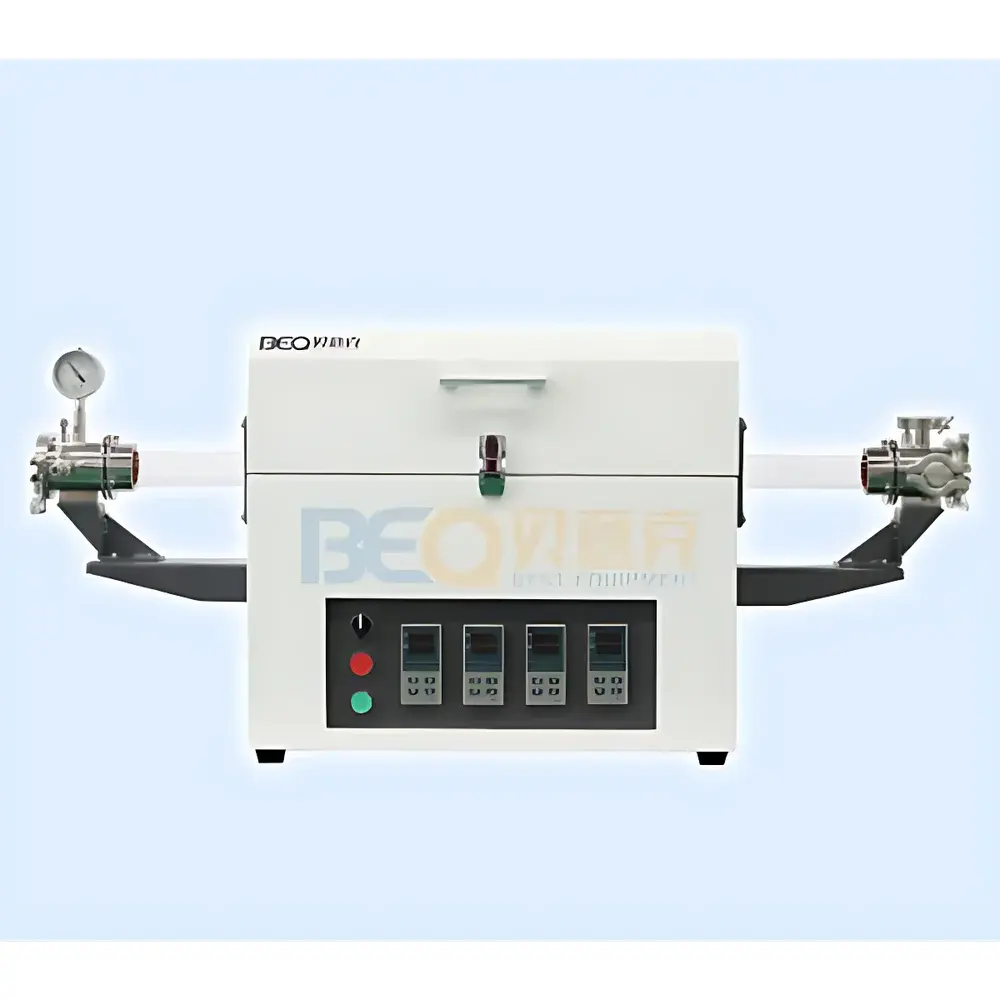
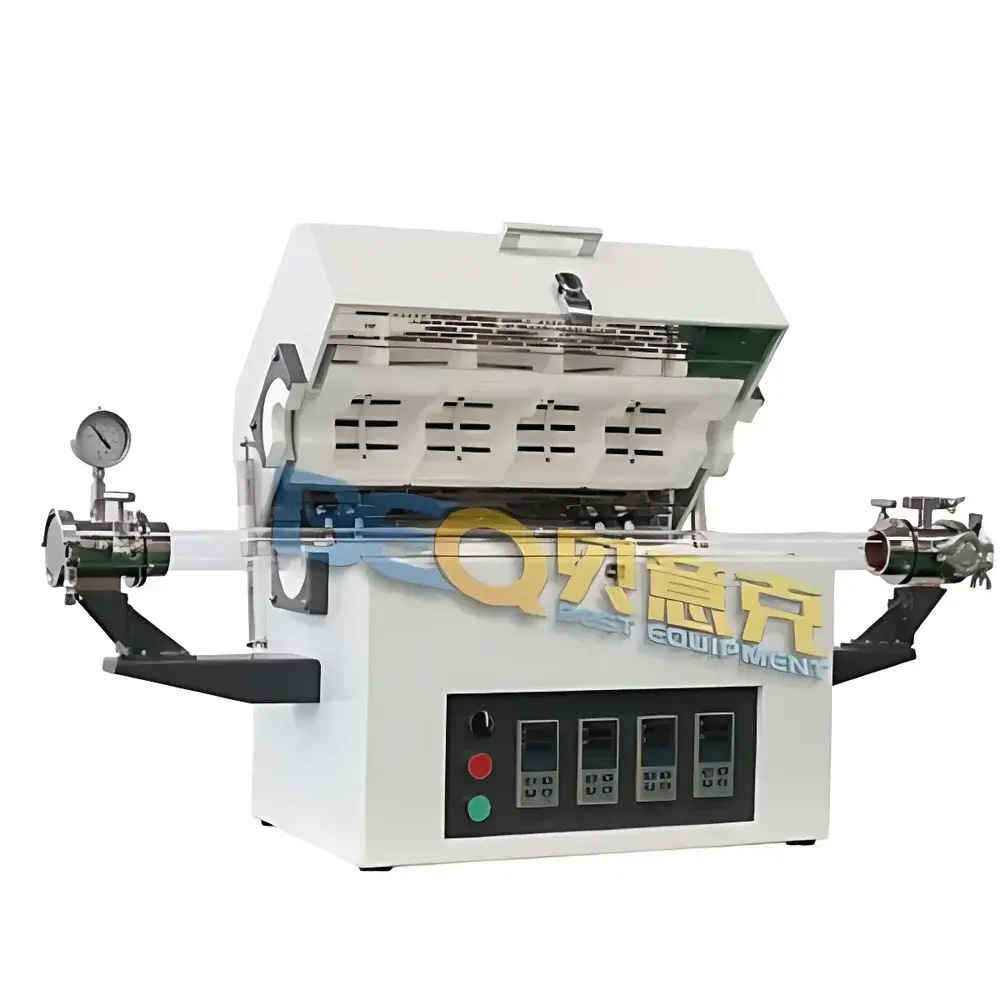
BEQ BTF-1200C-IV Four-Zone Openable Tube Furnace
| Brand | BEQ |
|---|---|
| Origin | Anhui, China |
| Model | BTF-1200C-IV |
| Maximum Temperature | 1200°C (1 hr) |
| Temperature Control Accuracy | ±1°C |
| Total Power Rating | 7 kW |
| Max Heating Rate to 1200°C | ≤30°C/min |
| Heating Method | Resistive Wire Heating |
| Control System | Fuzzy PID + Auto-Tuning |
| Programmable Profiles | 30-Stage Intelligent Ramp/Soak |
| Safety Features | Over-Temperature & Thermocouple Break Alarms |
| Tube Diameter Options | Φ50 / Φ60 / Φ80 / Φ100 / Φ130 × 1400 mm (L) |
| Configuration | Four Independent Axial Heating Zones |
| Structural Design | Pneumatic Spring-Assisted Hinged Lid with Dual End Supports |
Overview
The BEQ BTF-1200C-IV is a high-precision, four-zone openable tube furnace engineered for demanding thermal processing applications in materials science, catalysis research, and thin-film synthesis. Unlike conventional single- or dual-zone furnaces, this system employs four axially segregated heating zones—each independently controllable via dedicated thermocouples and solid-state relays—to establish precise longitudinal temperature gradients along the quartz or ceramic tube. The furnace operates on resistive wire heating elements embedded symmetrically in upper and lower furnace walls (six sets per side), ensuring exceptional radial and axial temperature uniformity across an extended isothermal zone (>300 mm at ±2°C under steady-state 1000°C conditions). Its openable design—enabled by a pneumatically assisted hinge mechanism—facilitates rapid sample loading/unloading, in-situ gas line integration, and real-time visual inspection without thermal cycling interruption. Rated for continuous operation up to 1200°C (1-hour maximum duty cycle), the unit complies with IEC 61000-6-3 (EMC) and IEC 61000-6-2 (immunity) standards and is constructed to meet general laboratory safety requirements per EN 61010-1.
Key Features
- Four independent axial heating zones with individual PID control loops, enabling complex thermal profiles such as gradient annealing, zone melting, or multi-step sintering.
- Symmetric 12-point resistive heating architecture (6 upper + 6 lower) minimizes radial thermal asymmetry and extends the effective uniform-temperature zone beyond 300 mm at operational temperatures ≥900°C.
- Pneumatic spring-assisted lid mechanism ensures smooth, counterbalanced opening/closing—reducing operator effort and eliminating mechanical stress on the tube during access.
- Dual end support brackets mounted on flange assemblies distribute mechanical load away from the tube body, preventing sagging or deformation during prolonged high-temperature operation.
- Integrated 30-stage programmable controller supports ramp-soak sequences with user-defined rate limits, dwell times, and conditional branching (e.g., trigger gas flow upon reaching setpoint).
- Dual safety interlocks: hardware-based over-temperature cutoff (independent of main controller) and thermocouple break detection with audible/visual alarm and automatic power cutoff.
Sample Compatibility & Compliance
The BTF-1200C-IV accommodates standard high-purity quartz tubes (Φ50–Φ130 mm × 1400 mm L) and compatible ceramic alternatives (e.g., alumina, silicon carbide) rated for continuous use at ≥1200°C. Tube mounting utilizes ISO-KF or CF flanges with high-temperature Viton or metal gaskets, supporting vacuum down to 10⁻³ mbar and inert/reducing atmospheres (N₂, Ar, H₂/N₂ mixtures) at pressures up to 0.5 bar gauge. The system conforms to GLP documentation requirements through timestamped profile logging and supports audit-ready operation when paired with optional external data acquisition modules. While not certified to UL or CSA standards out-of-box, its electrical architecture meets Class I, Division 2 hazardous location prerequisites when installed with appropriate purge systems and grounding protocols.
Software & Data Management
The embedded controller provides local interface via a 4.3-inch TFT touchscreen with intuitive icon-driven navigation. All thermal programs—including ramp rates, soak durations, and zone-specific setpoints—are stored internally with non-volatile memory retention (>10,000 cycles). Optional RS485 Modbus RTU or Ethernet TCP/IP connectivity enables integration into centralized lab management systems (LIMS) or SCADA platforms. Data export (CSV format) includes time-stamped temperature readings from all four zones, power consumption snapshots, and alarm event logs—fully traceable for FDA 21 CFR Part 11 compliance when used with validated third-party software and electronic signature workflows.
Applications
- Controlled-atmosphere annealing of transition metal oxides for battery cathode optimization (e.g., LiCoO₂, NMC).
- Chemical vapor deposition (CVD) precursor decomposition studies requiring precise axial thermal zoning.
- Thermal gravimetric analysis (TGA) coupling with mass spectrometry via direct tube outlet interfacing.
- High-temperature calibration of thermocouples and radiation pyrometers using fixed-point reference materials (e.g., Cu, Ag, Au).
- Multi-step calcination-reduction sequences for supported catalyst synthesis (e.g., Ni/Al₂O₃, Pt/CeO₂).
- Crystal growth via vertical Bridgman techniques under controlled thermal gradients.
FAQ
What tube diameters are supported, and are custom lengths available?
Standard tube length is 1400 mm; diameters include Φ50, Φ60, Φ80, Φ100, and Φ130 mm. Custom lengths up to 1800 mm can be accommodated upon request, subject to structural validation and thermal uniformity testing.
Does the furnace support vacuum operation, and what base pressure can it achieve?
Yes—the system is vacuum-compatible with standard KF40/KF50 flanges. With a two-stage rotary vane pump, typical base pressure is 1×10⁻³ mbar; integration with a turbomolecular pump enables ≤1×10⁻⁵ mbar.
Can individual zones be operated at different temperatures simultaneously?
Yes. Each of the four zones has independent setpoint control, allowing simultaneous operation at distinct temperatures—for example, 800°C (Zone 1), 1000°C (Zone 2), 1100°C (Zone 3), and 950°C (Zone 4)—to generate reproducible axial gradients.
Is the controller compliant with FDA 21 CFR Part 11 for regulated environments?
The embedded controller itself does not provide electronic signatures or audit trail encryption. However, when connected to validated external software (e.g., LabArchives, DeltaV) via Modbus or Ethernet, full Part 11 compliance—including role-based access, audit trails, and electronic signatures—is achievable.
What maintenance intervals are recommended for long-term reliability?
Inspect heating elements and insulation integrity every 200 operating hours above 1000°C. Replace thermocouples biannually or after 500 thermal cycles >1100°C. Clean flange surfaces and replace elastomer gaskets annually under continuous inert gas service.
Related Products



