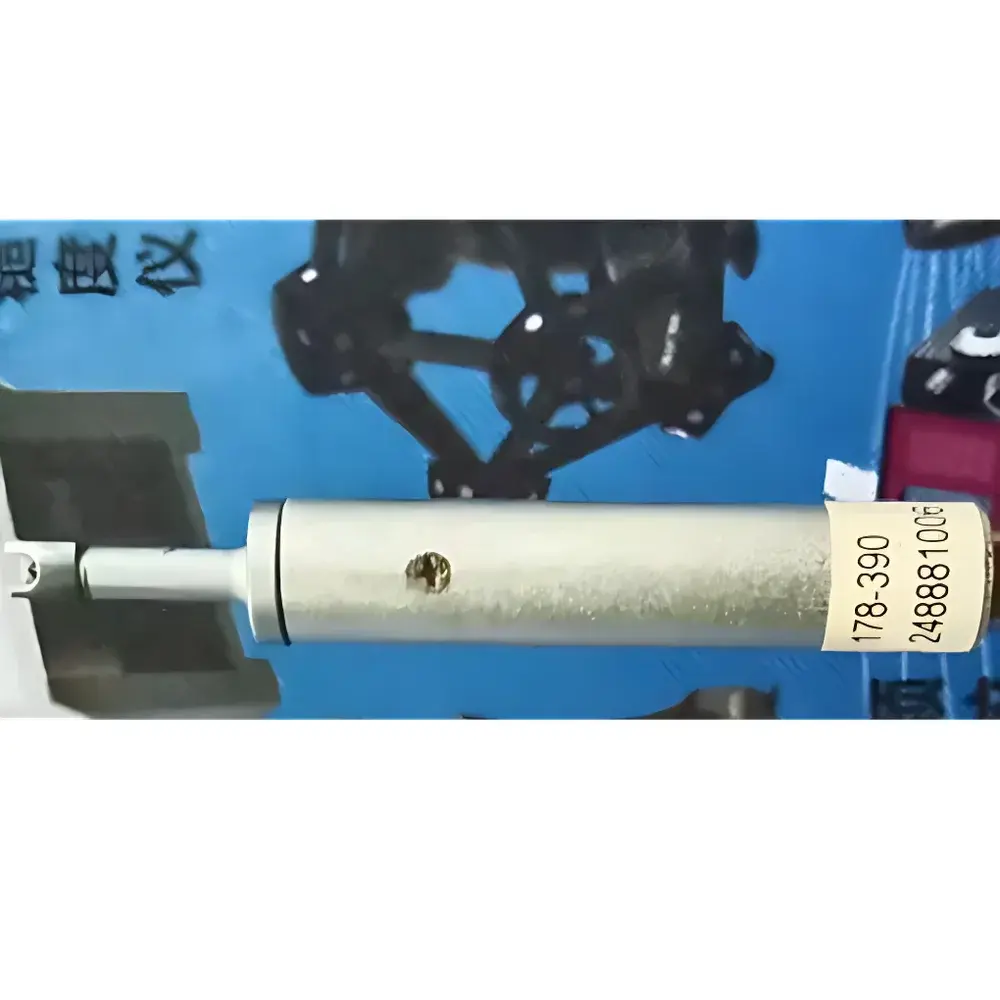
Accretech 248881006 Portable Surface Roughness Tester
| Brand | Accretech |
|---|---|
| Origin | Japan |
| Model | 248881006 |
| Type | Portable Contact-Type Profilometer |
| Measurement Principle | Stylus-Based Inductive Displacement Sensing |
| Standard Compliance | ISO 4287, ISO 4288, ISO 13565, ASME B46.1, JIS B 0601 |
| Surface Parameters Measured | Ra, Rz, Ry, Rq, Rp, Rv, Rt, Rsk, Rku, Rsm, Rmr, etc. |
| Stylus Tip Radius | 5 µm (standard diamond), 2 µm (optional) |
| Stylus Force | 0.75 mN (standard), 4 mN (high-force mode) |
| Scan Length | Up to 17.5 mm (standard), extendable via multi-trace stitching |
| Vertical Resolution | 0.001 µm |
| Vertical Range | ±20 µm (standard), ±200 µm (extended range option) |
| Traverse Speed | 0.1–1.0 mm/s (adjustable) |
| Data Storage | Internal flash memory (≥10,000 profiles), USB export support |
| Power | Rechargeable Li-ion battery (≥8 h continuous operation) |
Overview
The Accretech 248881006 is a high-precision, portable surface roughness tester engineered for traceable, repeatable assessment of micro-topographic features on machined, ground, polished, or coated surfaces. Based on the established contact profilometry principle, it employs a precision-ground diamond stylus with inductive displacement transduction to convert vertical surface deviations into calibrated analog voltage signals—digitized at high sampling density (up to 10,000 points per trace). Its mechanical architecture conforms to ISO 3274 and ISO 11562 standards for stylus tip geometry, skid design, and filtering methodology. Designed for both shop-floor deployment and laboratory-grade metrology, the instrument delivers metrological integrity under variable environmental conditions—including temperature fluctuations between 5 °C and 40 °C and relative humidity up to 80% non-condensing. The device is fully compatible with international surface texture standards, enabling direct compliance reporting for ISO/IEC 17025-accredited laboratories.
Key Features
- Modular probe assembly with interchangeable stylus tips (5 µm standard radius, 2 µm ultra-fine option) and selectable normal forces (0.75 mN for delicate surfaces, 4 mN for high-hardness or textured materials)
- Integrated digital filter suite compliant with Gaussian, PC (Phase-Corrected), and 2CR-75% analog filter types per ISO 16610-21; automatic cutoff wavelength selection (λc = 0.08, 0.25, 0.8, 2.5, 8 mm) and evaluation length configuration
- Real-time parameter calculation including amplitude (Ra, Rz, Rq), spacing (Rsm), hybrid (Rmr), and functional (Rk, Rpk, Rvk) parameters per ISO 13565-2 and ISO 13565-3
- Ruggedized magnesium alloy housing rated IP54 for dust and splash resistance; ergonomic handheld form factor with tactile feedback buttons and high-contrast OLED display (128 × 64 pixels)
- On-device statistical analysis: batch averaging, trend monitoring, tolerance band visualization, and pass/fail flagging against user-defined limits
- Support for calibration verification using certified step-height and roughness reference standards (e.g., NIST SRM 1963, PTB R100 series)
Sample Compatibility & Compliance
The 248881006 accommodates flat, curved (minimum radius ≥5 mm), and inclined surfaces across metallic alloys (steel, aluminum, titanium), ceramics, polymers, and thin-film coatings. It supports measurement on production parts without disassembly—ideal for in-process verification of grinding, turning, EDM, laser texturing, and additive manufacturing post-processing. All reported parameters adhere to ISO 4287:2021 (terms and definitions), ISO 4288:1996 (rules for filtering and evaluation), and ASME B46.1-2019. For regulated industries, raw profile data files (.prf) retain full traceability metadata (timestamp, operator ID, probe serial, calibration date), satisfying audit requirements under FDA 21 CFR Part 11 when paired with validated software workflows.
Software & Data Management
Accretech’s proprietary SURFPAK-V software (Windows 10/11 compatible) enables advanced post-processing: multi-trace alignment, 2D/3D profile overlay, spectral analysis (PSD), bearing ratio curve generation, and automated report generation in PDF or Excel formats. The software supports GLP/GMP-compliant operation with electronic signatures, audit trail logging, and role-based access control. Data exchange follows ASTM E1392 and ISO/IEC 11179 metadata standards. Raw profile exports are ASCII-compatible for integration with third-party statistical process control (SPC) platforms such as Minitab or JMP.
Applications
- Automotive: Cylinder bore honing verification, gear flank roughness, brake disc surface finish, and EV motor stator lamination texture control
- Aerospace: Turbine blade leading-edge roughness, thermal barrier coating uniformity, and fastener thread root inspection
- Medical Devices: Orthopedic implant surface topography (Ra < 0.2 µm), dental abutment finish, and catheter shaft polish validation
- Electronics: Wafer edge exclusion zone profiling, heat sink fin surface consistency, and PCB solder mask roughness impact on conformal coating adhesion
- Tooling & Dies: EDM electrode wear assessment, mold cavity replication fidelity, and injection molding insert surface degradation tracking
FAQ
What surface parameters does the 248881006 calculate natively?
It computes all primary ISO 4287 amplitude parameters (Ra, Rz, Rq, Rt, Rp, Rv), spacing parameters (Rsm), hybrid parameters (Rmr), and functional parameters (Rk, Rpk, Rvk) per ISO 13565.
Is calibration traceable to national metrology institutes?
Yes—Accretech provides factory calibration certificates traceable to NMIJ (Japan) and optional UKAS-accredited calibration services through authorized partners.
Can the device measure on curved surfaces?
Yes, with curvature compensation enabled; minimum measurable radius is 5 mm for standard probes and 2 mm with optional articulated probe mounts.
Does it support automated reporting for quality documentation?
Yes—SURFPAK-V generates configurable reports with embedded calibration status, measurement uncertainty estimates, and digital signature fields compliant with ISO 9001:2015 clause 8.5.2.
How is data integrity maintained during field use?
Each measurement includes embedded cryptographic checksums, time-stamped metadata, and write-once internal storage to prevent tampering—meeting baseline requirements for ISO/IEC 17025 Clause 7.5.2.