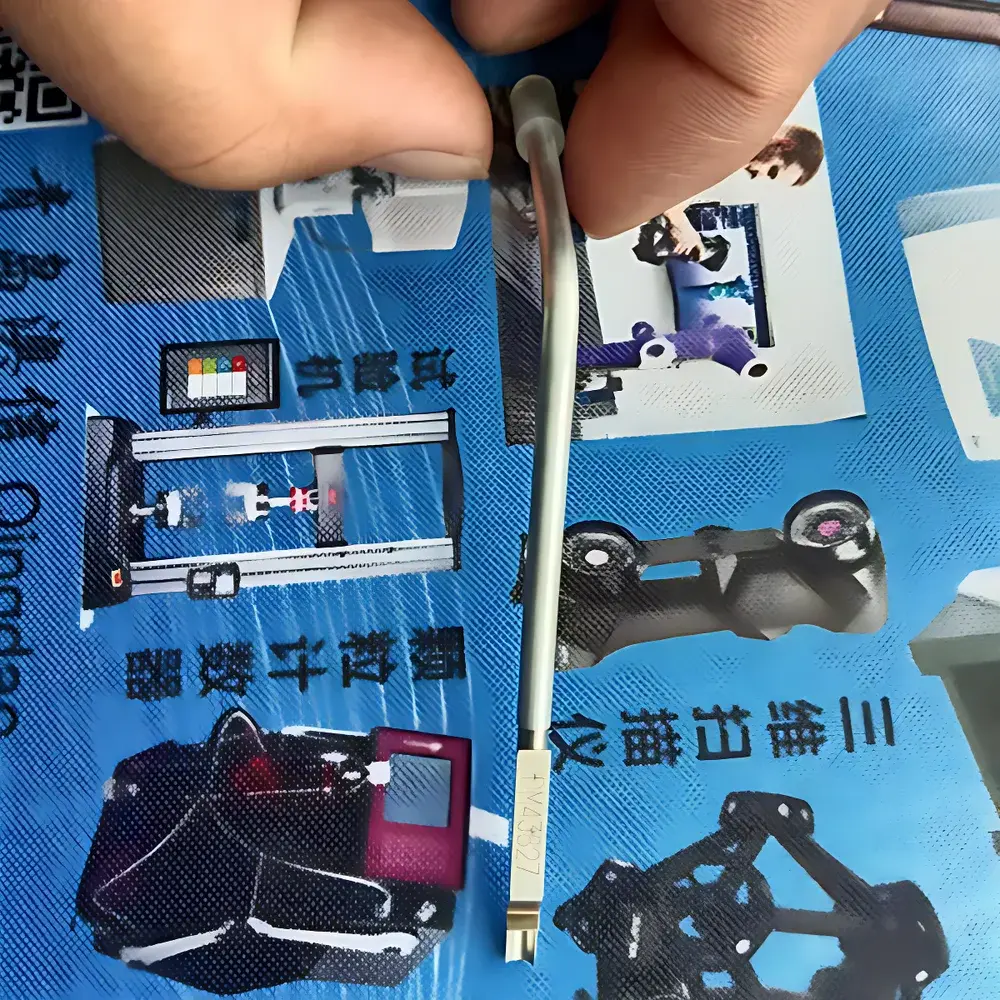
Accretech DM43827 Precision Stylus Probe
| Brand | Accretech |
|---|---|
| Origin | Japan |
| Model | DM43827 |
| Type | Contact Stylus for Geometric Metrology |
| Application | Roundness, Surface Roughness, and Profile Measurement Systems |
| Compliance | Designed for Integration with Accretech Roundness/Cylindricity Testers (e.g., RA-2200, RA-1200), PGI Profilometers, and Compatible CMM Platforms |
| Mounting Interface | Standard M2.5 × 0.45 mm Threaded Shank |
Overview
The Accretech DM43827 is a high-precision mechanical contact stylus probe engineered for traceable, repeatable surface topography and form measurement in metrology-grade applications. Designed and manufactured in Japan by Tokyo Seimitsu Co., Ltd. (operating globally under the Accretech brand), this stylus adheres to stringent JIS B 7521 and ISO 5436-1 standards for profile and roundness measurement instrumentation. It operates on the principle of mechanical displacement transduction—where physical deflection of the diamond-tipped cantilever is converted into analog voltage signals via integrated strain gauges or inductive sensing elements—enabling sub-micron resolution in vertical (Z-axis) displacement detection. The DM43827 is not a standalone instrument but a critical subsystem component, intended exclusively for integration with Accretech’s family of roundness testers (e.g., RA-2200 series), surface profilometers (e.g., PGI 1200, PGI 2500), and select coordinate measuring machines configured for tactile form analysis. Its design prioritizes thermal stability, minimal hysteresis, and low lateral force (< 5 mN nominal), ensuring minimal sample deformation during scanning of delicate or high-hardness materials—including hardened steels, ceramics, silicon wafers, and precision-ground bearing races.
Key Features
- Diamond spherical tip (2 µm radius, Class 1 per ISO 3274) with ultra-low wear rate and certified sphericity deviation ≤ 0.02 µm
- Stainless steel shank with M2.5 × 0.45 mm fine-pitch thread for secure, vibration-damped mounting on Accretech sensor arms
- Optimized cantilever stiffness (k ≈ 1.2 N/m) balancing sensitivity and resonance frequency (> 1.8 kHz) to suppress scanning artifacts at speeds up to 5 mm/s
- Hermetically sealed housing rated IP54, protecting internal transduction elements from dust and incidental moisture exposure in controlled lab environments
- Calibration traceability to NMIJ (National Metrology Institute of Japan) via included certificate of conformity (CoC) with as-received tip radius verification data
- Compatible with both analog (±10 V differential output) and digital (RS-422/SSI) interface variants of Accretech controller units
Sample Compatibility & Compliance
The DM43827 is validated for use across a broad spectrum of engineering surfaces requiring ISO/ASME B46.1-compliant roughness evaluation (Ra, Rz, Rq), as well as ISO 1101-conformant cylindricity, concentricity, and runout assessment. It supports measurement of materials with hardness up to 72 HRC without measurable tip degradation over 500+ hours of cumulative scanning time. The stylus meets electromagnetic compatibility requirements per IEC 61326-1 (industrial environment) and carries CE marking for conformity with EU Measuring Instruments Directive (MID) Annex MI-002 for dimensional measuring instruments. When deployed within an Accretech-certified system architecture—including calibrated rotary tables, linear stages, and temperature-controlled enclosures—it satisfies audit readiness for ISO/IEC 17025 accredited laboratories performing third-party geometric inspection per ASTM E1155, ISO 12179, and JIS B 0601.
Software & Data Management
The DM43827 interfaces natively with Accretech’s proprietary TalyProfile and RoundTest software suites (v6.5+), enabling automated tip calibration routines, real-time filtering (Gaussian, 2CR-75%), and standardized reporting per ISO 4287 and ISO 13565. All raw displacement data is acquired at ≥ 20 kHz sampling rate and stored in vendor-neutral ASCII or HDF5 formats, supporting post-processing in MATLAB, Python (via accretech-sdk), or metrology-specific platforms such as PolyWorks Inspector. Audit trails—including stylus ID, calibration date, operator login, environmental logs (temperature/humidity), and measurement parameter history—are maintained in accordance with FDA 21 CFR Part 11 requirements when configured with Accretech’s optional SecureLog module and Windows domain authentication.
Applications
- Precision bearing raceway roundness verification in aerospace and automotive supply chains
- Surface finish validation of medical implant components (e.g., femoral heads, dental abutments) per ISO 14644-1 cleanroom-compatible protocols
- Form error mapping of optical lens mounts and semiconductor wafer chucks
- GD&T evaluation of turbine blade root profiles and gear tooth flanks
- Process capability studies (Cpk/Ppk) for grinding, lapping, and superfinishing operations
- Reference standard calibration against NIST-traceable step-height artifacts and roughness specimens (e.g., PTB RM 100–300)
FAQ
Is the DM43827 compatible with non-Accretech metrology systems?
No. Mechanical and electrical interface specifications—including signal conditioning, mounting geometry, and firmware handshake protocols—are proprietary to Accretech platforms. Cross-platform integration is not supported.
What is the recommended recalibration interval?
Annual recalibration is advised under typical usage; however, intervals must be risk-assessed per ISO/IEC 17025 Clause 6.6 and documented in the laboratory’s metrological traceability procedure.
Can the stylus be used for scanning soft polymers or elastomers?
Yes—with caution. Tip force must be reduced to ≤ 2 mN using software-set gain adjustment; scanning speed should not exceed 1 mm/s to prevent viscoelastic recovery artifacts.
Does the DM43827 include a certificate of calibration?
Each unit ships with a manufacturer’s Certificate of Conformity (CoC); full NMIJ-traceable calibration reports are available as a separate service upon request.
What is the maximum permissible scanning length per pass?
Up to 100 mm at standard velocity (2 mm/s); extended-range measurements require multi-pass stitching with overlapping regions and software-based alignment compensation.