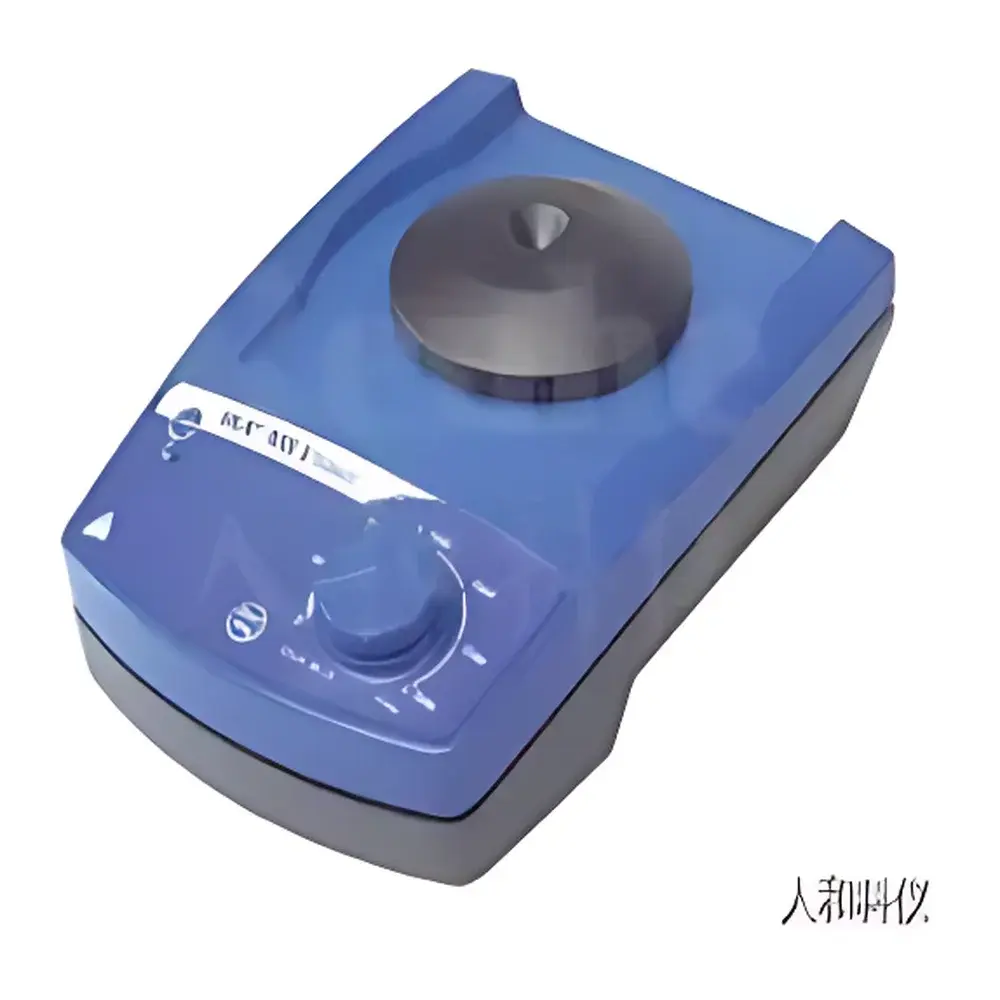
IKA MS3 basic Orbital Shaker
| Brand | IKA |
|---|---|
| Origin | Germany |
| Model | MS3 basic |
| Oscillation Frequency | 0–3000 rpm |
| Oscillation Diameter | 4.5 mm |
| Temperature Range | 5–40 °C |
| Max Load Capacity (incl. fixture) | 0.5 kg |
| Input Power | 20 W |
| Dimensions (W × H × D) | 148 × 205 × 63 mm |
| Weight | 2.9 kg |
| Protection Rating | IP21 |
| Operating Ambient | 5–40 °C, ≤80% RH |
| Voltage | 100–240 V AC, 50/60 Hz |
| DC Supply | 24 V, 800 mA |
| Minimum Adjustable Speed | 200 rpm |
| Timer Function | Yes (countdown) |
| Operation Modes | Continuous & Pulse (with standard mat) |
| Safety Mode (Mode A) | Pad detection enabled, max 3000 rpm with IKA-certified mat |
| Mode B | No pad detection, full 3000 rpm with any mat |
| Compatibility | Microtubes, PCR tubes, microplates (1× 96-well plate) |
| Housing | Zinc-coated cast iron |
| Motor Output Power | 8 W |
| Motor Input Power | 10 W |
| Duty Cycle | 100% |
| RS232 Interface | None |
| Analog Output | None |
Overview
The IKA MS3 basic Orbital Shaker is a compact, precision-engineered benchtop shaker designed for consistent, low-volume mixing applications in molecular biology, microbiology, and biochemistry laboratories. It operates on the principle of orbital shaking—generating smooth, circular motion with a fixed 4.5 mm diameter orbit—to ensure uniform suspension of cells, reagents, or enzymatic reactions without splashing or foaming. Its robust zinc-coated cast iron housing provides mechanical stability and long-term durability under continuous operation, while its universal AC input (100–240 V, 50/60 Hz) ensures compatibility across global laboratory power infrastructures. Engineered for reliability rather than complexity, the MS3 basic delivers stable rotational performance from 200 to 3000 rpm with high reproducibility across repeated runs—critical for protocols requiring tight kinetic control, such as ELISA incubation, bacterial culture resuspension, or antibody binding steps.
Key Features
- Two operational modes: Mode A (safety mode with intelligent pad detection) and Mode B (unrestricted speed mode); Mode A enforces speed limits based on mat certification to prevent imbalance-induced vibration or sample loss
- Integrated countdown timer with visual indication—enables precise endpoint control for time-sensitive assays
- Pulse (‘point’ or ‘touch’) function for rapid, transient agitation—ideal for brief mixing before centrifugation or plate reading
- Full 100% duty cycle rating—designed for uninterrupted 24/7 operation in automated workflows or overnight incubations
- IP21-rated enclosure—provides protection against vertically falling drips and solid objects >12.5 mm, meeting standard lab environmental requirements
- Low thermal footprint and silent brushless DC motor architecture—minimizes heat transfer to samples and ambient noise in shared lab spaces
Sample Compatibility & Compliance
The MS3 basic accommodates standard microtubes (0.2–2.0 mL), PCR strips, and single 96-well microplates—making it suitable for high-throughput screening prep, cell culture maintenance, and immunoassay plate washing steps. Its 0.5 kg maximum load capacity (including fixture weight) ensures safe handling of common labware configurations without risk of mechanical overload. While not a regulated medical device, the unit complies with DIN EN 60529 (IP21), IEC 61000-6-3 (EMC emission standards), and IEC 61000-6-2 (immunity). Its design supports GLP-aligned documentation practices: all operational parameters—including speed, duration, and mode selection—are manually set and visually confirmed, enabling traceable manual log entries per batch record requirements.
Software & Data Management
The MS3 basic is a stand-alone analog instrument with no digital interface, firmware, or data export capability. It features a mechanical speed dial calibrated to ±5% accuracy across its 0–3000 rpm range and a discrete LED timer display. This intentional simplicity eliminates software validation burdens typically associated with FDA 21 CFR Part 11 compliance—making it especially appropriate for QC labs operating under ISO/IEC 17025 or GMP Annex 11 frameworks where audit trails must be human-readable and paper-based. Users retain full control over protocol execution without dependency on proprietary drivers or cloud services.
Applications
- Resuspension of bacterial pellets and yeast cultures prior to lysis or plating
- Equilibration of enzyme-substrate mixtures in kinetic assays
- Coating and blocking steps in ELISA and Western blot workflows
- Hybridization buffer agitation during DNA/RNA probe incubations
- Pre-centrifugation homogenization of viscous lysates or serum samples
- Continuous agitation of low-volume reagent stocks to prevent precipitation
FAQ
What is the difference between Mode A and Mode B?
Mode A activates pad-detection logic: only certified IKA mats allow full 3000 rpm operation; non-certified mats limit speed to 1300 rpm for safety. Mode B disables detection, permitting 3000 rpm regardless of mat type—but requires user verification of mechanical balance.
Can the MS3 basic be used inside a refrigerated incubator?
Yes—the unit is rated for ambient operation between 5 °C and 40 °C and has no internal cooling system; however, condensation ingress must be prevented if placed in high-humidity cold chambers.
Is the shaker compatible with deep-well plates or 384-well formats?
No—it is validated exclusively for single 96-well microplates and small-diameter tubes; larger or heavier plates exceed its 0.5 kg load limit and may compromise orbit stability.
Does it support external triggering or programmable sequences?
No—the MS3 basic has no digital interface, relay outputs, or scripting capability; all operation is manual and real-time.
How often does the unit require preventive maintenance?
Under normal use, no scheduled maintenance is required beyond periodic cleaning of the platform surface and visual inspection of the mat fixation points; the brushless motor has no serviceable wear parts.