
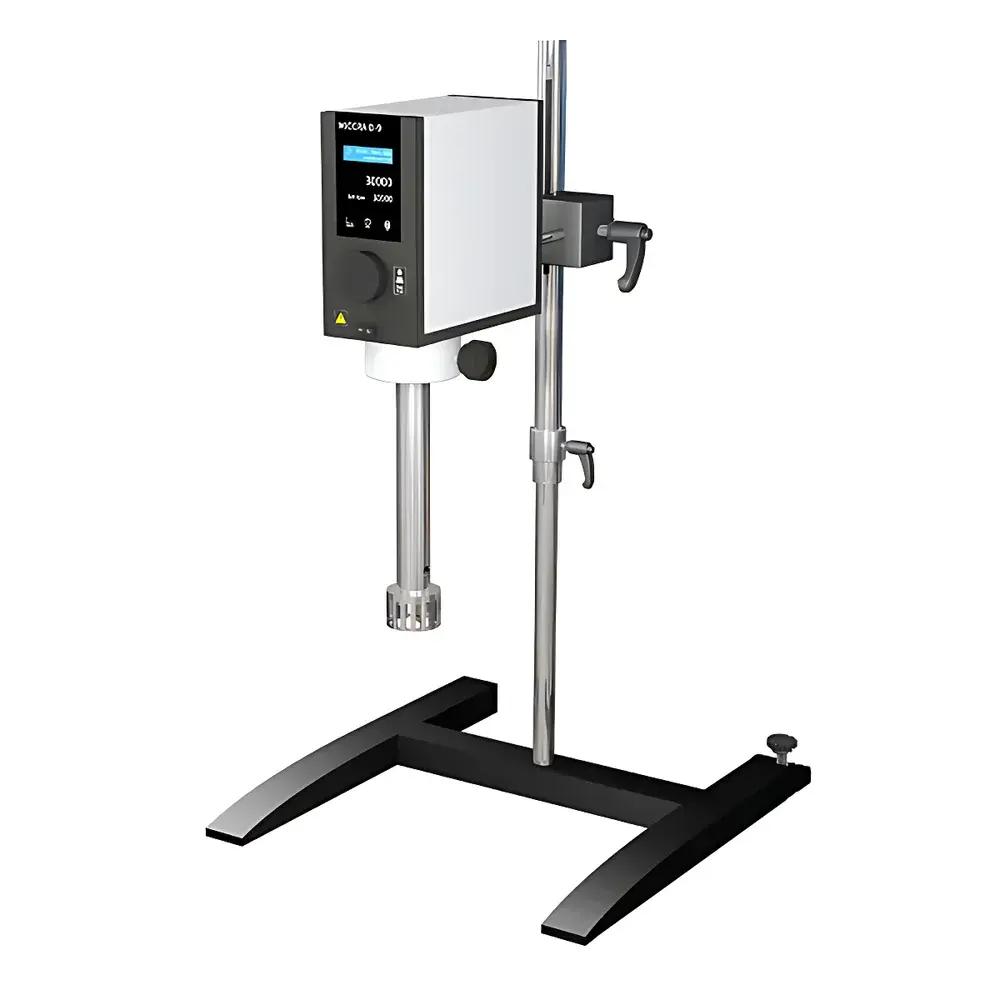
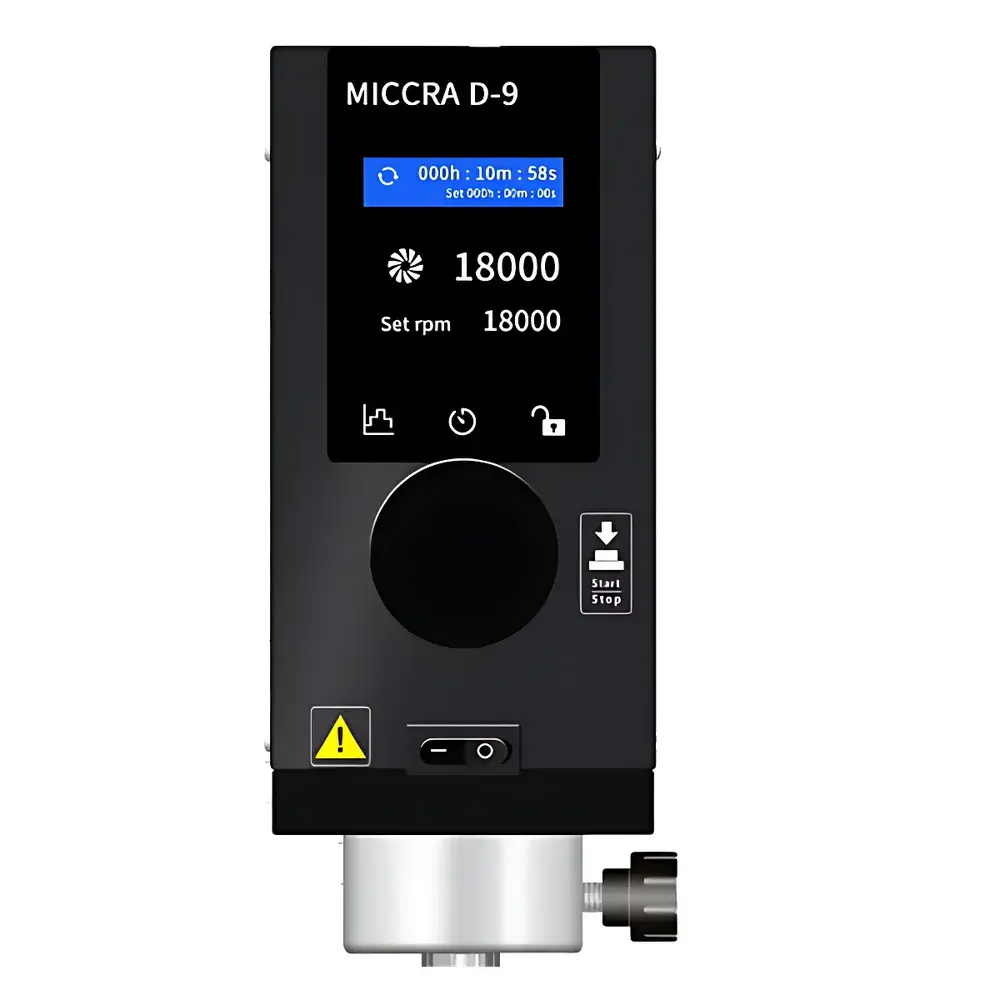
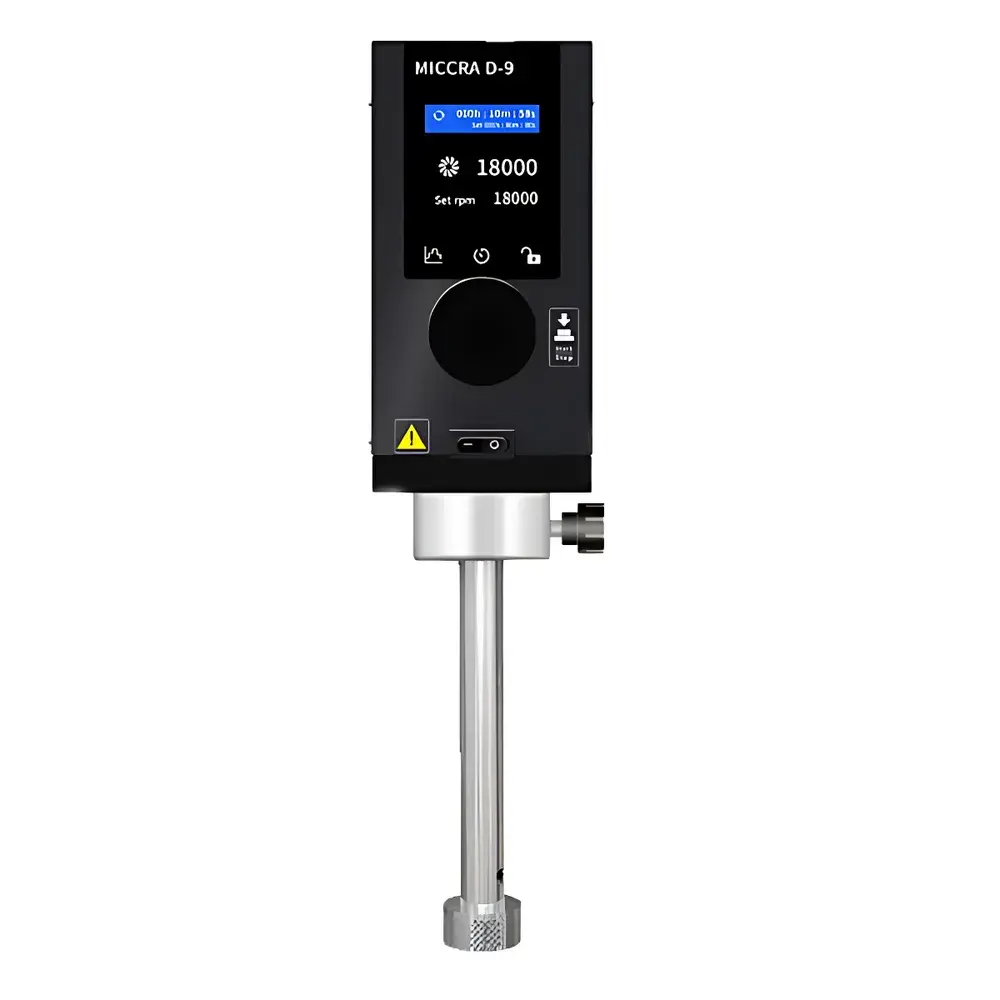
MICCRA D-9 Smart Series High-Speed Disperser
| Brand | MICCRA |
|---|---|
| Origin | Germany |
| Model | D-9 |
| Instrument Type | Probe-type Rotor-Stator Homogenizer |
| Dimensions (W×D×H) | 92 × 183 × 177 mm |
| Processing Volume | 0.1–20,000 mL (H₂O) |
| Speed Range | 3,000–25,000 rpm |
| Motor | Brushless DC (BLDC) |
| Input/Output Power | 950 W / 760 W |
| Speed Display | LED TFT |
| Speed Control | PID-regulated |
| Speed Accuracy | ±100 rpm |
| Housing Material | Anodized Hard-Aluminum Alloy |
| Noise Level | ≤55 dB(A) |
| Protection Rating | IP20 |
| Overload & Thermal Protection | Yes |
| Soft Start/Stop | Yes |
| Continuous Duty Cycle | 100% |
| Power Supply | 230 V, 50/60 Hz |
| Operating Ambient Temperature | 5–45 °C |
| Relative Humidity Limit | ≤85% RH |
Overview
The MICCRA D-9 Smart Series High-Speed Disperser is a precision-engineered laboratory homogenizer designed for reproducible, scalable dispersion, emulsification, and particle size reduction across diverse sample matrices. Based on the rotor-stator principle—where high-shear forces are generated by the relative motion between a rapidly rotating probe tip and a stationary stator sleeve—the D-9 delivers consistent mechanical energy input to break down agglomerates, disintegrate cells, or homogenize viscous suspensions. Its brushless DC (BLDC) motor eliminates carbon brush wear, electrical arcing, and associated particulate contamination—critical for GMP-compliant pharmaceutical formulation development, ISO 17025-accredited QC labs, and sensitive applications in nutraceutical and cosmetic R&D. The device operates within a validated speed range of 3,000–25,000 rpm, enabling fine-tuned control over shear rate without compromising thermal stability or mechanical integrity.
Key Features
- Brushless DC motor architecture ensures zero carbon dust generation, intrinsic safety in flammable environments, and maintenance-free operation over extended service life.
- High-resolution LED TFT display simultaneously shows set speed, real-time speed, and elapsed run time—enabling full operational traceability during method execution.
- PID-based closed-loop speed regulation maintains target rotational velocity within ±100 rpm tolerance, even under dynamic viscosity shifts (e.g., during polymer dissolution or nanoparticle suspension thickening).
- Programmable timer supports single-stage timed runs or multi-step sequential protocols, facilitating unattended batch processing and method standardization.
- Soft-start and soft-stop algorithms gradually ramp torque to prevent sample splashing, vortex collapse, or probe-induced foaming—particularly beneficial for low-volume, high-value biological samples.
- Integrated dual-protection circuitry provides automatic shutdown in response to thermal overload or current surge, ensuring compliance with IEC 61000-6-2 electromagnetic compatibility and EN 61010-1 safety standards.
Sample Compatibility & Compliance
The D-9 accommodates aqueous, organic, and semi-viscous media across volumes from 0.1 mL (micro-scale cell lysis in PCR tubes) to 20 L (large-batch emulsion pre-homogenization), when paired with optional large-diameter dispersing tools and vessel adapters. It is routinely deployed in workflows aligned with USP (liposomal dispersion), ASTM D2887 (petrochemical homogenization), and ISO 13320 (laser diffraction sample preparation). Its anodized aluminum housing meets IP20 ingress protection requirements for dry, non-condensing lab environments, and its continuous-duty rating supports uninterrupted operation under GLP audit conditions—including full electronic record retention when interfaced with compliant LIMS platforms.
Software & Data Management
While the D-9 operates as a standalone instrument, its digital interface supports RS-232 or optional USB-to-serial connectivity for integration into centralized instrument management systems. When linked to validated laboratory software (e.g., LabArchives ELN or Thermo Fisher SampleManager), all parameter settings, runtime logs, and operator IDs can be exported in CSV or XML format—fulfilling FDA 21 CFR Part 11 requirements for electronic signatures and audit trails. The embedded firmware retains up to 9 user-defined protocols with timestamped execution history, supporting method reproducibility and internal SOP enforcement.
Applications
- Pharmaceutical: Pre-formulation screening of nanoemulsions, lipid nanoparticles (LNPs), and amorphous solid dispersions.
- Food Science: Homogenization of dairy analogs, plant-based protein suspensions, and functional ingredient blends.
- Materials Research: Exfoliation of 2D materials (e.g., graphene oxide), dispersion of carbon nanotubes in polymer matrices, and ceramic slurry deagglomeration.
- Cosmetic Chemistry: Stable oil-in-water emulsion development, pigment dispersion in sunscreen formulations, and rheological conditioning of surfactant systems.
- Academic & Industrial QC: Routine particle size distribution (PSD) sample prep prior to laser diffraction or dynamic light scattering analysis.
FAQ
What is the minimum and maximum recommended sample volume for optimal shear efficiency?
For consistent rotor-stator interaction and minimal air entrainment, use 0.5–500 mL with standard 10 mm probes; larger volumes require extended probes and calibrated vessel geometry.
Can the D-9 be used for sterile processing?
Yes—when equipped with autoclavable stainless-steel dispersing tools (e.g., type S6G) and operated in Class II biosafety cabinets, it supports aseptic homogenization of microbial cultures and vaccine adjuvants.
Is speed calibration traceable to national standards?
Each unit ships with a factory-issued calibration certificate referencing DIN EN ISO/IEC 17025-accredited tachometer verification; annual recalibration is recommended per ISO/IEC 17025 clause 6.5.
Does the instrument support external trigger signals for synchronized data acquisition?
Yes—via TTL-compatible digital I/O port (optional module), enabling precise synchronization with particle analyzers, temperature controllers, or spectroscopic detectors.
What maintenance intervals are required for long-term reliability?
No routine motor servicing is needed; however, quarterly inspection of probe threads, stator alignment, and cooling fan functionality is advised per MICCRA Technical Bulletin TB-D9-REV3.



