
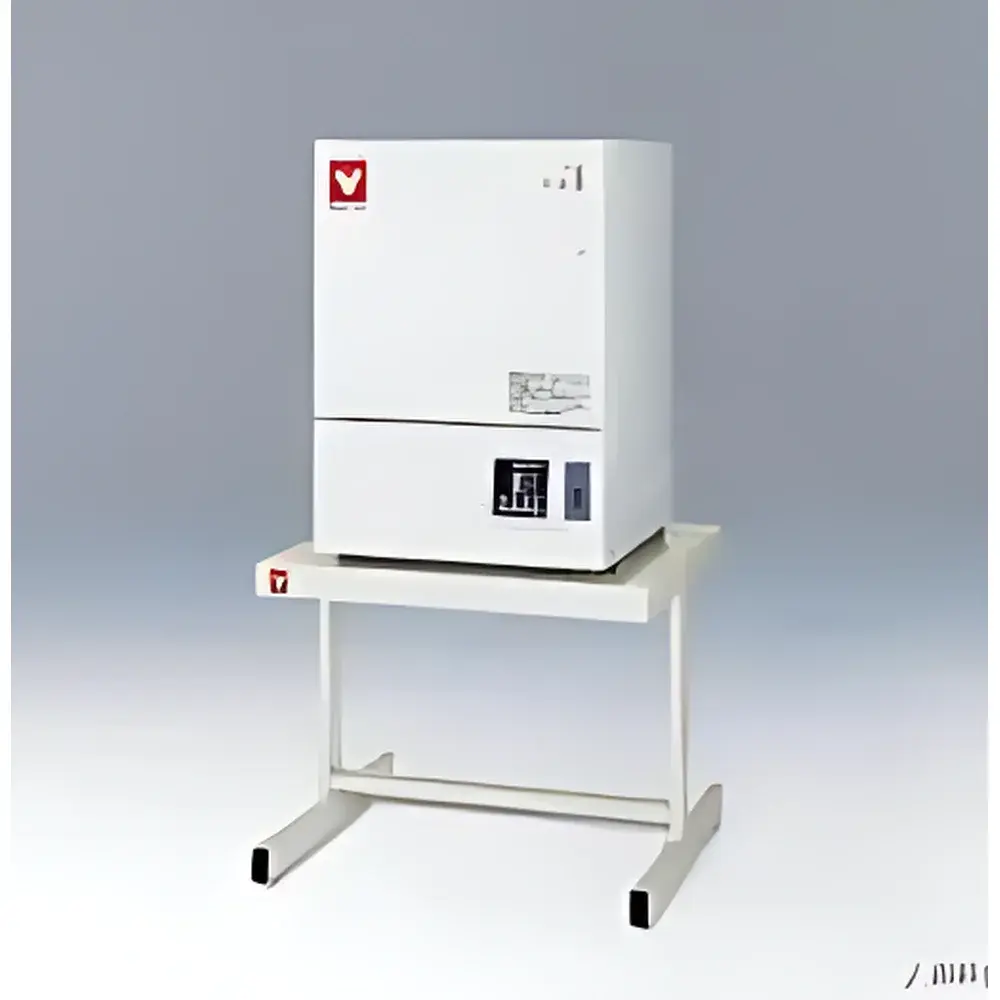
YAMATO SI411C Natural Convection Dry Heat Sterilizer
| Brand | YAMATO |
|---|---|
| Origin | Japan |
| Model | SI411C |
| Heating Method | Natural Convection |
| Temperature Range | Ambient +5°C to 260°C |
| Temperature Control Accuracy | ±2°C (at 260°C) |
| Temperature Uniformity | ±20°C (at 260°C) |
| Heating Power | 1.2 kW |
| Internal Dimensions (W×D×H) | 450 × 430 × 400 mm |
| Chamber Volume | 77 L |
| Shelf Load Capacity | 15 kg per shelf |
| Number of Adjustable Shelves | 10 |
| Shelf Spacing | 30 mm |
| Power Supply | AC 220 V, 6 A, 50/60 Hz |
| Net Weight | ~42 kg |
Overview
The YAMATO SI411C is a compact, entry-level natural convection dry heat sterilizer engineered for routine laboratory sterilization of glassware, metal instruments, powders, and other heat-stable, moisture-sensitive materials. Unlike forced-air or mechanical convection systems, the SI411C relies on passive thermal buoyancy—hot air rising and cooler air descending—to achieve uniform heat distribution within its insulated chamber. This design eliminates fan-induced turbulence and particulate circulation, making it especially suitable for applications where contamination control and minimal airflow disturbance are critical. The unit operates across a wide temperature range (ambient +5°C to 260°C), supporting standard dry heat sterilization protocols such as those defined in ISO 17665-1 and USP , including depyrogenation at ≥250°C for 45 minutes or equivalent lethality cycles. Its robust architecture—featuring an inner stainless-steel chamber, outer cold-rolled steel housing with chemical-resistant coating, and high-density glass fiber insulation—ensures long-term thermal stability and operator safety.
Key Features
- Natural convection heating system with no internal fan—eliminates airborne particle dispersion and preserves sterility integrity during and after cycles
- Triple-stage PID temperature controller with independent over-temperature protection circuitry, ensuring precise thermal regulation and fail-safe operation
- Programmable 3-segment, 30-step controller enabling complex multi-phase sterilization and cooling profiles (e.g., ramp-hold-cool sequences)
- Dual LED display: green 4-digit readout for actual chamber temperature; red 4-digit readout for setpoint—enhancing operational clarity and real-time monitoring
- Comprehensive self-diagnostic system detecting thermocouple failure, heater open-circuit, SSR short-circuit, and automatic over-temperature activation
- Integrated safety mechanisms: independent overheat prevention device, residual-current circuit breaker (RCCB), key lock function, and power-loss recovery mode
- Adjustable shelving system with 10 positions (30 mm spacing), each supporting up to 15 kg; includes two stainless-steel wire mesh shelves and four shelf supports
Sample Compatibility & Compliance
The SI411C is validated for sterilizing non-porous, thermally stable items including borosilicate glass vials, stainless-steel forceps and scalpels, ceramic filters, talc, and anhydrous powders. It is not intended for use with plastics, rubber, or biological liquids. The unit complies with general electrical safety requirements per IEC 61010-1 and supports GLP/GMP-aligned documentation practices through its programmable cycle logging capability. While the SI411C itself does not include built-in data recording or audit trail functionality, its timer and program memory support manual validation protocols—including IQ/OQ documentation—and facilitate repeatable execution of standardized sterilization cycles referenced in ISO 13485 and FDA 21 CFR Part 820.
Software & Data Management
The SI411C operates via an embedded microprocessor-based controller with no external software dependency. All parameters—including time, temperature, and step progression—are configured directly via dedicated function keys and up/down buttons. Cycle data (start time, duration, setpoints) are retained in non-volatile memory and persist through power interruption. Though the unit lacks USB/Ethernet connectivity or PC interface, its programmable structure enables consistent replication of validated sterilization processes without reliance on proprietary software. Users may integrate the SI411C into broader lab quality systems by manually recording cycle logs in electronic lab notebooks (ELNs) or LIMS platforms compliant with 21 CFR Part 11 when paired with appropriate procedural controls.
Applications
- Sterilization of glassware (pipettes, Petri dishes, flasks) prior to aseptic cell culture or microbiological assays
- Depyrogenation of containers used in parenteral drug manufacturing, in accordance with USP thermal validation criteria
- Moisture-free sterilization of surgical instruments in low-resource or field-deployable settings
- Thermal treatment of calibration standards, reference materials, and analytical consumables requiring traceable dry-heat exposure
- Pre-sterilization conditioning of desiccants, silica gel, and other hygroscopic lab reagents
FAQ
What is the maximum recommended load volume for optimal temperature uniformity?
For compliance with ±20°C uniformity specification at 260°C, the chamber should be loaded to no more than 60% of total volume (≤46 L), with adequate spacing between items to permit unobstructed natural air circulation.
Does the SI411C meet regulatory requirements for pharmaceutical depyrogenation?
The unit provides the thermal capability required for depyrogenation (≥250°C); however, final validation—including mapping studies, load configuration testing, and cycle qualification—must be performed by the end user per ISO 17665-1 and local regulatory guidance.
Can the SI411C be used for sterilizing plastic or polymer-based labware?
No. The SI411C is designed exclusively for heat-stable, non-melting materials. Plastics, elastomers, and coated instruments may deform, emit volatile compounds, or degrade at temperatures above 120°C.
Is calibration certificate included with shipment?
A factory calibration report is provided upon request; however, users must perform initial and periodic verification using NIST-traceable thermocouples and documented procedures aligned with ISO/IEC 17025.
How does the “power loss compensation” function operate?
Upon restoration of mains power, the controller resumes the previously active program from the exact step and remaining time—provided the interruption did not exceed 10 minutes and chamber temperature remained above 100°C.
Related Products



